
Basic deduction for non-resident single-home owners restored to 1.2 billion won
Benefits concentrated in high-end properties, limiting impact on mid- to low-priced rental market
Seoul jeonse and monthly rent listings each down more than 10% over the past year
Tightened long-term capital gains residency rules keep pressure on landlords to move back in
![Monthly rental listings posted at a real estate agency in Gangnam-gu, Seoul, on Aug. 17. [Yonhap]](https://wimg.heraldcorp.com/news/cms/2026/09/02/rcv.YNA.20260817.PYH2026081704700001300_P1.jpg)
The government reversed course within a month, scrapping a plan to lower the comprehensive real estate tax deduction threshold for non-resident single-home owners and restoring it to the current 1.2 billion won ($876,000) — but analysts say the move falls well short of calming the severe jeonse and monthly rent instability gripping the rental market. Because the change mainly affects owners of high-priced properties, its impact on the mid- to low-priced segment, where the rental crunch is most acute, is limited.
The government announced its revised 2026 tax reform package on Tuesday, walking back the original proposal to cut the basic deduction for non-resident single-home owners from 1.2 billion won to 900 million won and restoring it to 1.2 billion won. The revision reflects a policy stance that non-resident single-home owners should not be treated as speculators — yet the broader tilt toward favoring owner-occupants remains unchanged. The original plan had proposed cutting the per-person deduction for non-resident couples holding a home under joint ownership from 900 million won to 400 million won; the revised package sets it at 600 million won. The gap with owner-occupant couples holding jointly — each eligible for 900 million won — is deliberately preserved.
Non-resident single-home owners also face pressure to move back in for capital gains tax purposes. Under the current long-term holding special deduction, a home sold above 1.2 billion won that has been held and occupied for at least 10 years each qualifies for a deduction rate of up to 40 percent per criterion, capped at 80 percent. After the reform, the scheme will be restructured into a residency-based deduction with a cap of 1 billion won from 2029 onward. With the average Seoul apartment price having surpassed 1.6 billion won and continuing to climb, analysts say a significant number of homeowners will find it hard to escape the pressure to move back into their properties. The concern over a shrinking rental supply has eased somewhat, but a meaningful expansion looks equally unlikely.
Park Hap-su, an adjunct professor at Konkuk University's Graduate School of Real Estate, said the most damaging aspect of the revised package is that its punitive structure — which in effect excludes non-residents from the long-term holding special deduction — has not changed. "Aside from some retirees and elderly owners who plan to sell, most will still feel they need to move back into their homes at some point," he said, adding that demand among landlords to convert to owner-occupancy has not been fully eliminated.
The reform's limited reach is compounded by the fact that mid- to low-priced apartments — where demand from non-homeowners is highest and the rental crunch is most visible — were never significantly affected by adjustments to the comprehensive real estate tax deduction in the first place. A property must be valued at roughly 4.4 billion won or more to fall within the current taxable base of 1.2 billion won for single-household homeowners. That is the fundamental reason why, even with the revised tax package, a meaningful increase in mid- to low-priced rental supply sufficient to ease the crunch remains out of reach.
![A real estate agency in Songpa-gu, Seoul. [Yonhap]](https://wimg.heraldcorp.com/news/cms/2026/09/02/rcv.YNA.20260831.PYH2026083109490001300_P1.jpg)
One real estate expert said the key point is that while non-resident owners of high-priced apartments may face less pressure to put their units on the market, the change merely eases one factor behind the decline in rental supply — it does not actually increase the volume of rental listings available.
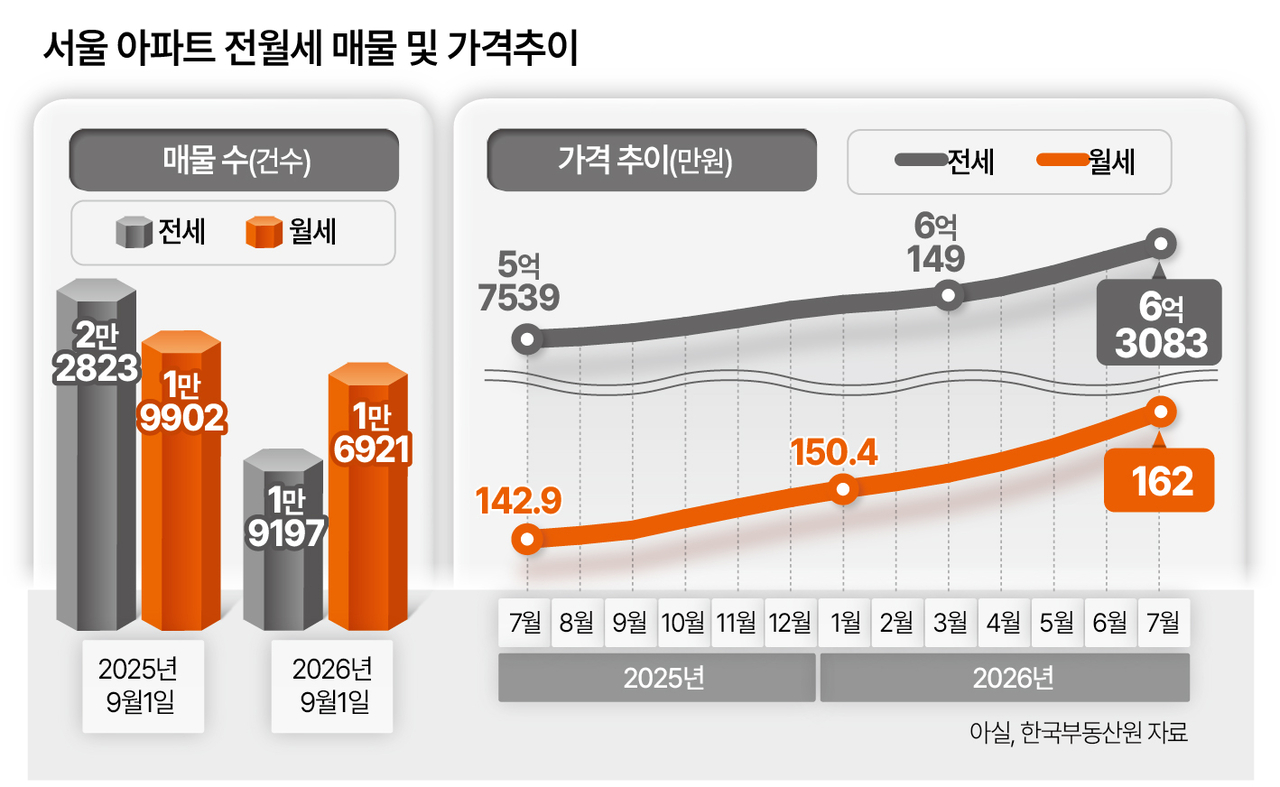
Rental listings have been on a downward trend as tighter owner-occupancy requirements tied to lending regulations and land transaction permit zones, the tax overhaul, and owners vacating units ahead of a sale all converge at once. According to real estate data platform Asil, as of Tuesday, jeonse and monthly rent listings for Seoul apartments stood at 19,902 and 16,921 respectively — down 12.8 percent and 11.9 percent from a year earlier, when they numbered 22,823 and 19,197.
The five districts recording the steepest drops in jeonse listings were Jungnang-gu (down 74.4 percent), Dongdaemun-gu (down 69.5 percent), Geumcheon-gu (down 65.4 percent), Guro-gu (down 64.1 percent) and Nowon-gu (down 58.4 percent) — all outer Seoul areas dense with mid- to low-priced apartments, where the rental supply decline has been particularly sharp. A "triple rise" — simultaneous increases in sale prices, jeonse deposits and monthly rents — has taken hold, pushing the average Seoul apartment jeonse deposit above 600 million won in March and monthly rents past 1.6 million won in July, both on steep upward trajectories.
Growing expectations in the market hold that sale prices in mid- to low-priced apartment clusters in Seoul and Gyeonggi Province — areas relatively insulated from the tax changes — will continue to rise as an easing of aggregate lending caps improves access to the purchase market. Nam Hyeok-woo, a real estate researcher at Woori Bank, said that if the volume of homes listed for sale increases, the supply of jeonse and monthly rent units could shrink further from current levels. "The ongoing conversion from jeonse to monthly rent is also still in progress, so volatility in jeonse prices is likely to grow," he added.
hope@heraldcorp.com





