
Rental demand pushed out of Seoul accelerates jeonse market collapse in Gyeonggi Province
August apartment jeonse transactions fall to 8,316 — down sharply from 20,000 five years ago
Record-high jeonse deposits reported across sought-after areas including Gwangmyeong, Yongin and Suwon
![Apartment buildings in Mabook-dong, Giheung-gu, Yongin, Gyeonggi Province. [Herald DB]](https://wimg.heraldcorp.com/news/cms/2026/09/03/news-p.v1.20260716.329eedf2f4d84b6ba2c8bfec241fc8c1_P1.jpg)
The jeonse market in Gyeonggi Province is accelerating toward collapse as rental demand spills out of Seoul into the surrounding metropolitan area. Apartment jeonse transactions in the province have fallen below 10,000 for the first time in nearly nine years, while a shortage of available units has sent deposit prices soaring to levels rivaling outright purchase prices. The pace of decline has now surpassed even the worst of the jeonse crisis under the Moon Jae-in administration — when the so-called "two lease laws," including the contract renewal right, were introduced — and the shift from jeonse to monthly rent is proceeding faster than the market had anticipated.
According to the Gyeonggi Real Estate Portal, apartment jeonse transactions in Gyeonggi Province totaled 8,316 in August — down 45 percent from the same month last year (15,173) and 34 percent from July (12,557). Since December 2017, when transactions stood at 9,959, monthly figures had consistently ranged between 10,000 and 20,000, but this year the trend has turned sharply downward.
After starting the year at 16,725 transactions in January, the monthly count fluctuated — dipping to 14,037 in February before rebounding to 16,960 in March — then fell steadily: 14,360 in April, 13,355 in May, 12,951 in June and 12,557 in July.
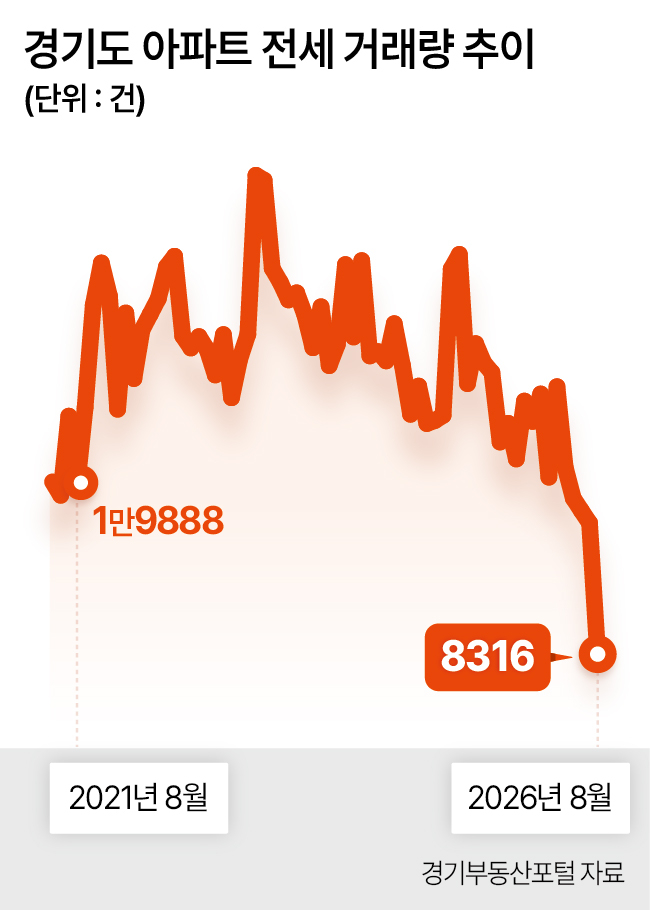
The August figure represents just 41.8 percent of the 19,888 transactions recorded in August 2021, when the jeonse shortage was at its most severe following the introduction of the two lease laws, a new two-year residency requirement for capital gains tax exemptions, mandatory owner-occupancy rules for apartments subject to the price ceiling on new apartments, and tightened land transaction permit zones and mortgage residency requirements.
The decline has been especially pronounced in high-demand areas with strong access to Seoul. Gwangmyeong saw apartment jeonse transactions plunge 62 percent from January to August — from 582 to 220. Seongnam fell 56 percent over the same period, from 1,379 to 600, while Suwon dropped 50 percent, from 1,518 to 756. Yongin contracted 59 percent, from 1,713 to 709, and Hanam declined 46 percent, from 465 to 250.
Analysts attribute the accelerating disappearance of jeonse in Gyeonggi Province to a combination of factors: the extension of owner-occupancy requirements under land transaction permit zones across all of Seoul and select Gyeonggi areas, tighter regulations on jeonse mortgage loans, and a severe shortage of new apartment move-ins. As mandatory owner-occupancy rules reduce the supply of jeonse listings across Seoul, rental demand has migrated to well-connected Gyeonggi areas — only to find supply drying up there as well. The situation worsened further after July 5, when areas that had been experiencing a spillover effect — including Dongtan, Guri and Giheung — were also designated as land transaction permit zones, intensifying the lock-up of jeonse listings and accelerating the conversion to monthly rent.
With supply shrinking and rental demand continuing to grow, record-high jeonse deposits are being reported across major Gyeonggi areas. An 84-square-meter unit at Cheolsan Central Prugio in Cheolsan-dong, Gwangmyeong set a new high on Aug. 7, when a new tenant moved in with a deposit of 930 million won ($679,000) — surpassing the average apartment sale price in Seoul's outer districts such as Nowon, Dobong and Gangbuk-gu, and the Geumcheon, Gwanak and Guro-gu cluster. The deposit was 200 million won higher than the 730 million won paid for a new jeonse contract on the same unit type in the same neighborhood last December.
An 84-square-meter unit at Dasan Lotte Castle in Dasan-dong, Namyangju also set a record on Aug. 14, with a new contract signed at a deposit of 700 million won — more than 100 million won above the 556.5 million won deposit on a renewal contract for the same unit type signed the same day. A 74-square-meter unit at e-Pyeonhansesang Guseong Station Platform City in Mabook-dong, Giheung-gu, Yongin crossed the 700 million won threshold for the first time on Aug. 8, with a new tenant moving in at a deposit of 720 million won. In Suwon, a 59-square-meter unit at Maetan Weave Haneulchae in Maetan-dong, Yeongtong-gu hit the 500 million won mark with a new contract signed Saturday at that same deposit level.
Ko Joon-seok, a professor at Yonsei University's Sangnam School of Management, said the market has reached a point where anyone who buys a home is required to live in it, leaving jeonse prices with nowhere to go but up amid the supply shortage. "The jeonse crunch in the 15 areas within Gyeonggi Province that are designated as regulated zones or land transaction permit zones will persist for now, as there are no short-term supply measures in place," he said.
hwshin@heraldcorp.com





