
Guidelines clarify bargaining scope amid Samsung Electronics bonus and Honam investment disputes
Employers may refuse profit-linked bonus demands without committing unfair labor practices
New factory construction and AI adoption itself excluded from mandatory bargaining
Layoffs and transfers become bargainable once concrete plans take shape
![Members of the Samsung Electronics Workers' Union Donghaeng chapter chant slogans outside Samsung Electronics' Suwon campus in Yeongtong-gu, Suwon, Gyeonggi Province, on Aug. 16, protesting disparities in performance bonuses. [Yonhap]](https://wimg.heraldcorp.com/news/cms/2026/09/03/rcv.YNA.20260716.PYH2026071620330006100_P1.jpg)
The government has issued guidelines stating that union demands to pay a fixed percentage of operating profit as performance bonuses are unlikely to qualify as subjects of mandatory collective bargaining or industrial action. Opposition to the construction or relocation of factories, or to the introduction of AI, is also excluded from mandatory bargaining.
The move clarifies the boundaries of labor disputes amid ongoing controversy over Samsung Electronics' union demands for a share of corporate profits and efforts to put the Honam semiconductor project on the bargaining agenda.
The Ministry of Employment and Labor announced Thursday the "Implementation Guidelines on the Scope of Labor Disputes Concerning Performance Bonuses and Management Decisions." The guidelines supplement an interpretive directive on the revised Trade Union Act issued in February, setting out criteria for judging performance bonuses and business management decisions, and will be applied to the government's handling of labor dispute mediation and unfair labor practice cases.
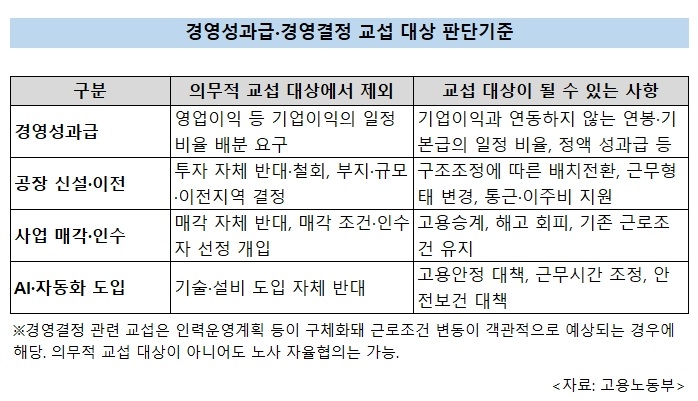
Earlier this year, Samsung Electronics' union demanded during wage negotiations that the company enshrine in writing a formula allocating 15 percent of operating profit as the funding source for performance bonuses. A general strike was threatened amid the dispute over profit sharing, but labor and management reached a tentative agreement on May 20 and signed a wage accord on May 27.
The question of whether corporate investment decisions are also subject to bargaining then sparked further controversy.
The Samsung Electronics chapter of the Samsung Group inter-company union said in a statement on July 13 that 84 percent of members surveyed opposed the Honam semiconductor megaproject, and announced it would place the issue on the 2027 bargaining agenda. The union argued that because the revised Trade Union Act extends the scope of labor disputes to business management decisions affecting working conditions, union input should be reflected in the pursuit of projects that could affect members' workplaces and treatment.
The new guidelines draw a distinction between performance bonuses in general and demands that bonuses be tied to a fixed percentage of corporate profits. While reaffirming that performance bonuses — as part of wages, welfare and other working conditions — are subject to mandatory bargaining, the ministry drew a line at demands linking bonuses to metrics such as sales, operating profit or net profit for the period.
The ministry argued that corporate profits serve as the funding source for a range of management decisions, including research and development, capital investment and dividends. Requiring that a fixed share be allocated to bonuses first could fundamentally restrict a company's freedom to conduct business, it said. Operating profit, the ministry noted, is calculated before interest, corporate taxes and dividends are deducted, and is therefore tied to the interests of shareholders, bondholders and the state.
![A rally organized by the Korea Shareholders' Action Center is held near Samsung's Seocho office in Seoul on Aug. 21, calling for the invalidation of the performance bonus agreement and greater shareholder returns. [Yonhap]](https://wimg.heraldcorp.com/news/cms/2026/09/03/rcv.YNA.20260821.PYH2026082113330001300_P1.jpg)
Voluntary labor-management consultations on profit-linked bonuses remain permissible. The ministry said negotiations should take into account a company's business performance, investment plans, liquidity and sustainability. It suggested alternatives such as tying bonuses to a fixed percentage of annual salary or base pay — rather than to a specific profit ratio — or having labor and management jointly determine payment criteria, timing and eligibility.
On business management decisions, the guidelines distinguish between the decision itself and any resulting changes to working conditions. They explicitly state that demands to reverse or oppose factory construction, overseas investment or production-base relocation — or to determine the site, scale, destination or timing of such moves — do not fall under mandatory bargaining.
The key test is whether changes to working conditions are a mere possibility or an objectively foreseeable outcome. Investment announcements, medium- to long-term business plans, or abstract remarks by management alone are insufficient to trigger bargaining obligations. However, if internal notices, labor-management council materials or employer confirmations during negotiations establish that a concrete policy or plan — such as mass layoffs — is being formulated or has been decided, unions may demand bargaining on the matter.
Once plans for layoffs following factory construction or relocation, or for reassignments following restructuring, become concrete, matters such as transfers to new facilities, changes in work arrangements, and commuting or relocation support may become subjects of bargaining. Similarly, while opposition to a business sale itself or demands to change the acquirer are not subject to mandatory bargaining, once workforce management plans take shape, unions may bargain over employment succession, measures to avoid dismissals and the preservation of existing working conditions.
The same standard applies to the introduction of AI and automated equipment. Opposition to adoption itself is excluded from mandatory bargaining, but once concrete plans emerge for changes to job duties or work arrangements, or for mass layoffs, matters such as job security measures, working-hour adjustments and occupational health and safety steps may become bargainable. Even where mandatory bargaining does not apply, labor and management may still engage in voluntary consultations over working conditions that may change in the future.
At the labor dispute mediation stage, if a union seeks to press demands for a fixed share of corporate profits or for a say in management decisions themselves, the Labor Relations Commission will actively recommend that the union modify its demands. If the union refuses, the commission will issue an administrative guidance ruling on the grounds that the relevant demands do not constitute a labor dispute under the Trade Union Act.
The guidelines also state that an employer's refusal to bargain over profit-linked bonuses or management decisions themselves is unlikely to constitute an unfair labor practice. Where a strike or other industrial action is pursued primarily over matters that are not subject to industrial action, its legitimacy will be assessed in accordance with Supreme Court precedent. When multiple demands are involved, the guidelines call for an examination of what the primary or genuine purpose of the action is.
Employment and Labor Minister Kim Young-hoon said the government would "respect and guarantee autonomous negotiations between labor and management to the greatest extent possible, while consistently interpreting and applying the law in accordance with the guidelines' content and standards, so that the guidelines can function as a practical norm in the field."
fact0514@heraldcorp.com





