![Real-time Kospi and Kosdaq readings are displayed on the trading-room board at Hana Bank's headquarters in Jung-gu, Seoul, on Thursday. [Yonhap]](https://wimg.heraldcorp.com/news/cms/2026/09/03/rcv.YNA.20260903.PYH2026090302880001300_P1.jpg)
Massive share buybacks by Samsung Electronics and SK hynix are acting as a buffer against further declines in the Kospi, but that support may disappear sooner than expected. The two chipmakers have purchased more than 15 trillion won ($11 billion) of their own shares over 10 trading sessions since launching their buyback programs on Aug. 20, and analysts warn that at the current pace the funds could run out around mid-October — leaving a significant supply-demand void.
According to Korea Exchange, the Kospi has been trading sideways in the 6,000s since closing above the 7,000 mark on July 23. Foreign and institutional investors have been heavy net sellers throughout the period, while the "other corporations" category has posted net purchases of roughly 1.5 trillion won over approximately 10 consecutive trading sessions.
That buying is almost entirely attributable to the large-scale buybacks by Samsung Electronics and SK hynix.
From Aug. 20, when the two companies began repurchasing shares as part of their shareholder-return policies, through Wednesday, the other-corporations category recorded net purchases of 15.09 trillion won. Given that the two companies' combined cumulative buyback execution stood at around 15.02 trillion won as of Wednesday, in effect nearly all of that net buying came from the two semiconductor giants.
Over the same period, retail investors were net sellers of 1.19 trillion won, foreign investors net sellers of 9.83 trillion won, and institutions net sellers of 4.06 trillion won. With every major market participant in net-selling mode, the Kospi's floor has been held up almost entirely by the buybacks of the two leading semiconductor stocks.
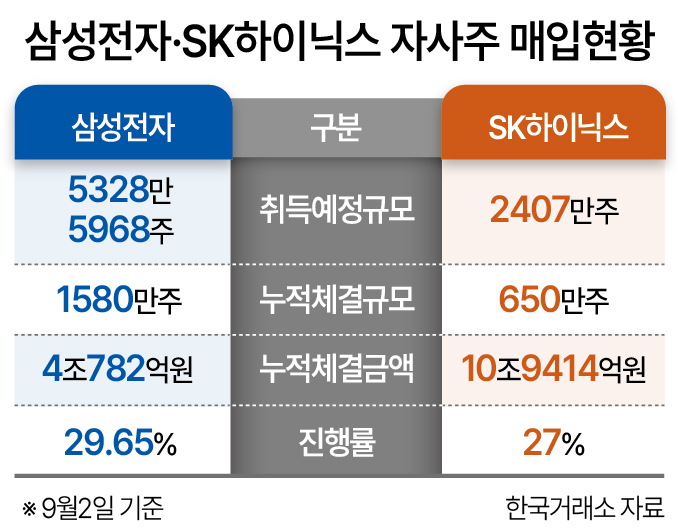
The buybacks are proceeding faster than originally planned. As of Wednesday, Samsung Electronics had repurchased 15.8 million shares — 29.65 percent of its total planned acquisition of 53.285968 million shares — while SK hynix had bought back 6.5 million shares, or 27 percent of its planned 24.07 million shares.
If the current pace is maintained, the buybacks could effectively be completed as early as mid-October — more than a month ahead of the originally disclosed completion dates of Nov. 21 for Samsung Electronics and Nov. 19 for SK hynix.
Han Ji-young, a researcher at Kiwoom Securities, said the buybacks have limited power to drive share prices meaningfully higher, noting that retail investors are selling to cut losses or recoup principal, institutions are adjusting positions, and foreign investors are taking profits and hedging macro risks. "Even so, assuming the current buyback pace holds, the positive takeaway is that the market has roughly a month of supply-demand cushion heading into the third-quarter earnings season around mid-October," Han said.
Securities analysts are closely watching for supply-demand volatility after October, with the global macro environment and a return of foreign capital seen as the key to any index rebound. Geopolitical tensions in the Middle East — including a recent tanker attack near the Strait of Hormuz and a US counterstrike — have pushed West Texas Intermediate crude back above $90 a barrel. The yield on 10-year US Treasuries has climbed above 4.8 percent, while Japan's 10-year yield has broken through 3 percent for the first time in roughly 30 years, heightening market caution.
Lee Kyung-min, a researcher at Daishin Securities, said cumulative net purchases by the other-corporations category had expanded to around 15 trillion won following SK hynix's shareholder-return policy announcement, providing a floor for the market even amid recent external uncertainty. "However, the sharp rise in international oil prices and major-country government bond yields has intensified selling by foreign investors and institutions, making it difficult to fully defend against index declines," Lee said.
Lee added that the recent stabilization and decline in the dollar-won exchange rate was favorable for foreign investor flows, but that rising government bond yields were dampening appetite for risk assets and appeared to be accelerating foreign capital outflows.
Kang Jin-hyeok, a researcher at Shinhan Investment, also said the buybacks were preventing further downside rather than lifting the index. "What is needed going forward is either confirmation of improving fundamentals through export data, or a calming of macro uncertainty that prompts foreign investors to switch to net buying," Kang said.

jiyun@heraldcorp.com