Skipping the filing when inheritance deductions cover the full estate can lower your acquisition cost basis, sharply raising capital gains tax when you sell.
Single-family homes and villas require particular caution — get an appraisal within six months of the last day of the month in which the deceased died.
![[Created using ChatGPT]](https://wimg.heraldcorp.com/news/cms/2026/09/03/news-p.v1.20260903.e72e37cbc9ac475abd6197c15b096a38_P1.png)
Housing costs, food, transportation — money seems to drain away just by breathing. But one more expense runs quietly through everyday life without drawing much attention: taxes. Drawing on consultations with tax-saving specialists, this column — "Your Everyday Tax Clinic" — breaks down the tax dilemmas ordinary people face.
Lee Se-sang, a man in his 60s, lost his father last September. The estate included a 106-square-meter villa in Seoul valued at around 800 million won ($584,000), bank deposits of 150 million won and insurance proceeds of 50 million won — roughly 1 billion won in total. Because the estate fell within the inheritance deduction ceiling of 1 billion won, Lee reasoned there was no inheritance tax to pay and skipped filing a return.
The unexpected tax bill arrived later, when he went to sell the inherited villa. Depending on whether an inheritance tax return had been filed, the capital gains tax liability differed by more than 60 million won. Tax accountant Kim Hye-ri — known online as "National Tax Unni" — explains why neglecting to file an inheritance tax return can lead to a far larger tax bill down the road.
Q. If the inheritance deduction ceiling is 1 billion won, don't I simply owe no inheritance tax?
A. When both a spouse and children survive the deceased and the estate is worth 1 billion won or less, a lump-sum deduction of 500 million won and a spousal deduction of at least 500 million won apply, leaving no inheritance tax liability.
However, a zero tax bill does not mean filing is unnecessary. If the estate includes real estate, whether or not you file can determine how heavy your capital gains tax burden will be years later.
If you skip the filing, the National Tax Service may value the inherited real estate using a "supplementary valuation method" — such as the officially assessed standard price — which can come in well below the actual market value at the time of inheritance.
Q. What is the "supplementary valuation method"?
A. It is the method by which tax law values real estate using officially published prices when the actual transaction price — the market value — cannot be confirmed. For land, the individual publicly notified land price applies; for housing, the individual publicly notified housing price is used. These figures are generally lower than actual market transaction prices.
When an inherited property is sold, the acquisition cost for tax purposes is set at the appraised value at the time the inheritance commenced. If no market value was reported at inheritance and the supplementary assessed value — such as the published price — is applied instead, the acquisition cost will be lower when you eventually sell, inflating the capital gain and the resulting capital gains tax.
In such cases, obtaining a professional appraisal within six months before or after the date the inheritance commences and filing that appraised figure as the market value is the more tax-efficient approach.
Q. You're saying that not filing when inheritance tax is zero can lead to a capital gains tax difference of more than 60 million won?
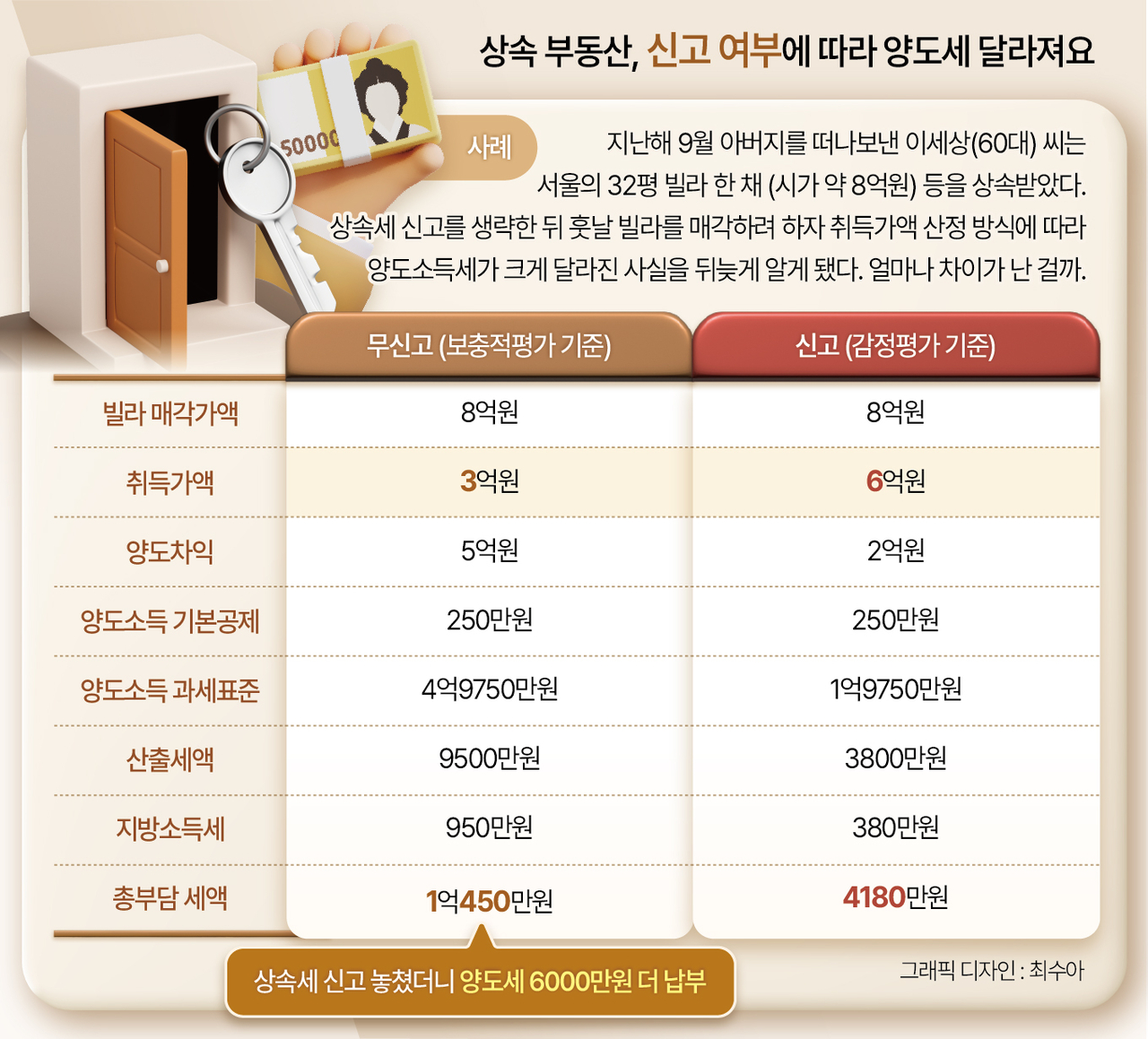
A. Consider a hypothetical in which Lee sells the villa for 800 million won.
If no inheritance tax return was filed and the officially assessed price of 300 million won is recognized as the acquisition cost, the capital gain comes to 500 million won. After subtracting the basic capital gains deduction of 2.5 million won, the taxable base is 497.5 million won, and the combined capital gains tax and local income tax liability reaches roughly 104.5 million won.
By contrast, if an appraisal had been obtained at the time of inheritance and the property was reported at 600 million won, the acquisition cost would be recognized at 600 million won, reducing the capital gain to 200 million won. The taxable base would be 197.5 million won, and the combined tax burden including local income tax would be approximately 41.8 million won. Selling the same villa at the same price, the tax difference attributable solely to the acquisition cost recognized at inheritance amounts to roughly 62.7 million won.
For this reason, it is worth obtaining a professional appraisal and filing at that value for real estate — such as detached houses, villas and land — where market value is difficult to confirm. Even when inheritance tax works out to zero within the deduction ceiling, doing so can bring the acquisition cost basis in line with reality, reducing capital gains tax when the property is eventually sold.
Q. Can I simply file the inheritance tax return now, even belatedly?
A. The inheritance tax filing deadline is within six months from the last day of the month in which the deceased passed away.
If the death occurred last September, the return should have been filed by the end of March this year. If at least one heir is a non-resident living abroad, the deadline is extended to nine months to allow time for overseas communication and document preparation.
When preparing the filing, past gift transfers and withdrawal records should also be reviewed.
Funds withdrawn from accounts held in the deceased's name — 200 million won or more within one year before death, or 500 million won or more within two years — must be accounted for. If the purpose cannot be clearly established, the funds may be treated as "presumed inherited assets" and included in the taxable estate. In that case, the burden of proving how the money was actually used falls on the bereaved family.
Q. How can I check for pre-death gift transfers?
A. The government operates a one-stop inheritance inquiry service to prevent heirs from suffering disadvantages due to incomplete knowledge of the deceased's assets and liabilities. Applications can be submitted online through the Government24 portal or in person at a city or district office or a community service center.
However, the service is designed only to confirm the balances of assets held in the deceased's name and the financial institutions involved. It does not provide a detailed history of past deposits, withdrawals or cash outflows from those accounts.
Heirs must therefore visit each identified financial institution directly to obtain transaction records. It is standard practice to review withdrawal histories for one to two years before the date of death; to check for pre-death gift transfers as well, records going back up to 10 years may be needed.
Q. I see a record of 24 million won given as a wedding congratulatory gift to a grandchild in the spring of 2021. At the time, the gift fell within the 50 million won gift tax deduction ceiling applicable to adult grandchildren over a 10-year period, so I assumed no tax was owed and did not file.
A. If the 24 million won wedding gift was not reported as a pre-death transfer, it could be flagged as an omitted asset in a future National Tax Service audit, added back into the taxable estate and subject to additional penalties.
When calculating inheritance tax, gifts made before the inheritance commences are also added to the estate.
Gifts to heirs — a spouse or children — made within 10 years before the inheritance date are included; gifts to non-heirs such as grandchildren, daughters-in-law or sons-in-law made within five years are also included. In Lee's case, the 2021 gift was made to a non-heir, and since the inheritance commenced last September, it falls within the five-year lookback window and may be added to the taxable estate.
It is true that the gift may have generated zero gift tax liability at the time because it fell within the deduction ceiling. But owing no gift tax and being excluded from the inheritance tax calculation are two separate matters. Moreover, 24 million won generally exceeds the range of a customary social congratulatory gift and could be characterized as a pre-death transfer.
This is also why it is worth examining tax-planning strategies that manage the lookback period for inheritance consolidation.
If it appears unlikely that more than 10 years will remain before the inheritance commences, one strategy is to distribute gifts among non-heirs — such as grandchildren, daughters-in-law or sons-in-law — rather than giving a lump sum to children, thereby shortening the lookback period to five years.
However, direct gifts to grandchildren should be approached carefully, as they may trigger a generation-skipping surcharge — an additional 30 percent levied on top of the calculated gift tax for transfers that skip a generation.
If the recipient is a minor and the gift exceeds 2 billion won, the surcharge rate rises to 40 percent. Gifts to grandchildren therefore warrant a careful comparison between the tax savings from the shorter five-year lookback period and the added burden of the generation-skipping surcharge.
Q. Looking at the withdrawal records, I see 80 million won taken out under the name of medical expenses.
A. When a large sum is withdrawn from the deceased's account and its use cannot be verified, tax law may treat it as "presumed inherited assets." The rule is intended to prevent people from avoiding inheritance tax by withdrawing or disposing of assets shortly before death.
If a lump sum was withdrawn for treatment costs, the family should gather hospital receipts, pharmacy receipts and caregiver contracts to document that the money was genuinely spent on living expenses or medical treatment.
Q. If the deceased's debts far exceeded the assets and all heirs renounced the inheritance through the court, does that eliminate any inheritance tax issue entirely?
A. Not necessarily.
Renouncing an inheritance because of heavy debt does not automatically make inheritance tax concerns disappear.
Even after renouncing, heirs may still face inheritance tax liability if they received life insurance proceeds from the deceased or if they received pre-death gifts from the deceased within 10 years before death.
Wedding congratulatory gifts, childbirth support payments, startup funds and similar transfers to children are also subject to consolidation if they qualify as gifts under tax law. Gifts made to non-heirs — such as grandchildren, daughters-in-law or sons-in-law — are included if they were made within five years before death.
It is therefore not enough to confirm only whether the inheritance was renounced; insurance proceeds received and pre-death gift records must be reviewed as well.
[By Yoo Hye-rim / Tax accountant Kim Hye-ri, deputy head of Tax Corporation HKL]

forest@heraldcorp.com