'Please speak to the commissioner' — Kim replied 'OK'
Prosecutors gave deferred indictment, citing no direct exchange of money
'Simple public grievance relay — approval process proceeded normally'
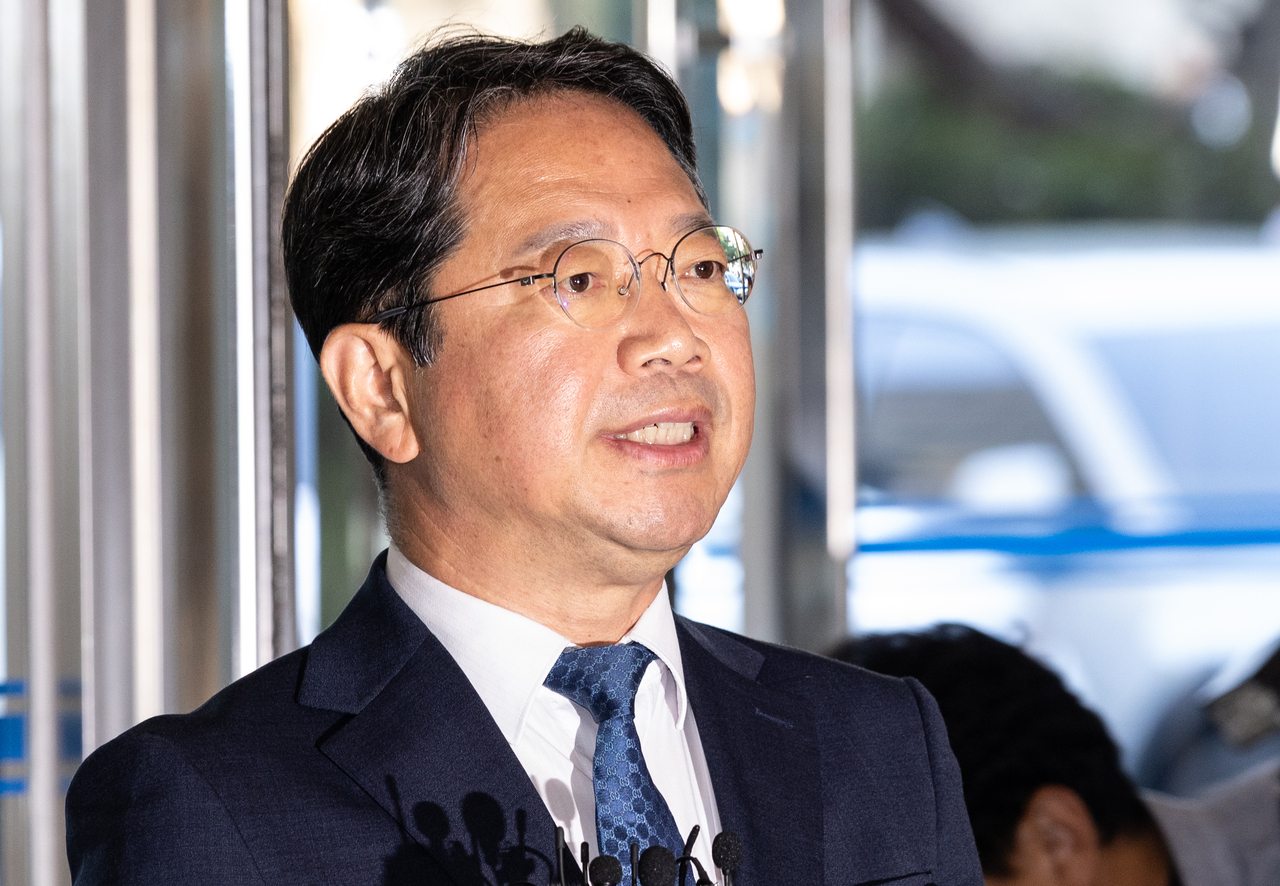
Controversy is growing over allegations that Kim Seung-won, nominee for minister of justice, lobbied for approval of a COVID-19 drug clinical trial. Kim has denied wrongdoing, saying he merely passed along a public-interest grievance, but the dispute has intensified after records emerged showing he relayed a request to the head of the Ministry of Food and Drug Safety to expedite the approval — and that a donation was subsequently mentioned in follow-up messages.
According to court rulings and indictment documents, a university professor surnamed Kang who had founded pharmaceutical manufacturer Genencell and was developing a COVID-19 treatment asked a businessman surnamed Yang between September and Oct. 6, 2021, to use political connections to speed up approval of a clinical trial plan. Kang had agreed to receive investment contingent on obtaining that approval.
On Oct. 7 of that year, Yang contacted Kim — then a first-term Democratic Party of Korea lawmaker — and told him that Genencell's clinical trial approval was being delayed. "It would be great in many ways if oppa could look into this a little, because 30 billion won in investment has already been secured here," Yang said.
Yang added that it would be helpful if the Ministry of Food and Drug Safety could look into Genencell's situation, and sent Kim an email with materials on the treatment's development progress.
The following day, Yang told Kim that Genencell was on track for a stock listing the following year and had drawn up plans around that timeline, and asked him to "please speak to the commissioner." Kim replied, "OK."
Four days later, on Oct. 12, Kim contacted then-Commissioner Kim Kang-rip of the Ministry of Food and Drug Safety, told him that Genencell had applied for approval of a COVID-19 treatment clinical trial, and asked him to "take good care of it," according to the investigation. Kim then told Yang: "He said he would check on it and report back to me, so wait a bit."
When Yang sent a text message the same day saying, "Three divisions are handling this — the herbal medicine division, the clinical trial system division, and the statistical analysis team. Please ask the staff in charge to process it quickly," Kim forwarded the message to the former commissioner.
About 20 minutes later, the former commissioner replied: "We are working with the company on supplementary materials and other matters regarding your concern. I have passed word to the staff to handle it well." Kim forwarded that reply to Yang, who then shared it with Kang.
Contact between Yang and Kim continued afterward. On the 17th of that month, Yang met Kim in person at a bar in Yeouido, Seoul. Yang asked how he could repay Kim for his help, saying he and Kang wanted to show their gratitude. Kim said in response that if Yang truly felt grateful, the maximum individual political donation to a lawmaker's support association was 5 million won ($3,650), and that doing so if things worked out would be enough, according to the investigation.
On the 24th, Yang sent Kim another message: "It looks like approval will come on Tuesday the 26th, but we still need to make sure your contribution is properly recognized." Kim replied: "Yeah, yeah, of course. Gotta stop the outflow of national wealth."
The Ministry of Food and Drug Safety approved the phase 2 and 3 clinical trial plan for the treatment on Oct. 26 — two weeks after Kim first contacted the former commissioner.
Once approval came through, Yang emailed Kang: "Please send a 5 million won donation to Assembly member Kim Seung-won, who worked hard on the approval." In December of that year, Yang also sent a message saying: "The Lee Jae Myung line is Seung-won oppa, and it feels awkward to ask again since we haven't been able to repay him."
Yang later told Kim, at Kang's request, that "the professor says he wants to send a donation as a thank-you," and asked for Kim's account number. Kim replied with his support association's account number and added, "Thank you."
When passing the account number to Kang, Yang also suggested sending the donation under a different business name or Kang's personal name rather than Genencell's. The transfer never went through, however, because Kim's donation limit had already been reached. Yang testified at trial that Kim declined, saying he would "just accept the sentiment," according to court records.
The Seoul Western District Prosecutors Office, which investigated the case, gave Kim a deferred indictment in December 2024, citing the absence of a direct exchange of money between Kim and Kang and the difficulty of establishing that the lobbying was clearly unlawful. Kang and Yang have been indicted on charges including promising to offer bribes and are currently standing trial at the first-instance level.
A deferred indictment is a decision not to prosecute even when charges are deemed credible, based on a range of circumstances including the nature and degree of the alleged conduct. Kim filed a constitutional complaint in May last year, arguing that the factual and legal premises underlying the prosecutors' decision were flawed.
How Kim and Yang first came to know each other has not been confirmed. Kim — a former judge — did represent Yang in a Labor Standards Act violation case involving a bar Yang operated in 2013, and the two remained in contact afterward.
Kim's camp flatly denied the lobbying allegations. His confirmation hearing preparation team said Thursday that the matter was "not lobbying, but simply the relay of a public-interest grievance, which is explicitly permitted even under the anti-graft law governing lawmakers."
The team said Kim had asked that a domestic small and medium-sized enterprise's clinical trial process not be unfairly delayed during the COVID-19 pandemic, and stressed that he "did not request approval of the treatment, priority review, relaxation of standards, or the skipping of any procedures."
Kim's camp also said prosecutors had determined that a request for expedited processing alone was insufficient to constitute illegal lobbying. It cited as further grounds the fact that no unusual violations of regulations or manuals occurred during the Ministry of Food and Drug Safety's review process, and that seven staff members involved stated there had been no separate instructions or special reports from the then-commissioner.
The team also said Kim had not received any political donations, money or entertainment. It noted that the investigation was conducted under the Yoon Suk Yeol administration, with Han Dong-hoon as justice minister and Lee Won-seok as prosecutor general, and said claims of a "lenient disposition" had "no objective basis."
Kim, speaking to reporters Thursday on his way into the confirmation hearing preparation office for the first time, said prosecutors had deployed more than 10 investigators over three years starting in 2021 and conducted an intensive investigation, yet still declined to indict. "I believe a finding of no suspicion would have been warranted, and the deferred indictment based on certain conduct is unjust," he said.
Kim's camp also drew a line against suggestions that the approval was expedited because of his intervention. In a supplementary statement, the preparation team said COVID-19 treatments at the time were subject to an expedited review program under which applications were to be processed within 15 days of receiving supplementary materials, and that the approval in question was completed within that window. "The approval was granted through the Ministry of Food and Drug Safety's official procedures, which had been under way for several months," the team said.
mp1256@heraldcorp.com