
$5.8B invested; 2.7 million tons annually from 2029
First US electric-arc mill for auto steel; carbon emissions cut 70%
Integrated hydrogen ecosystem planned; Posco to provide technology, sales support
![Key dignitaries break ground at the HPLS groundbreaking ceremony held Friday (local time) in Donaldsonville, Louisiana. From left: Posco Group Chairman Chang In-hwa, Louisiana Governor Jeff Landry, Hyundai Motor Group Executive Chair Euisun Chung, US Rep. Troy Carter, Minister of Trade, Industry and Energy Kim Jung-kwan, US Deputy Secretary of Commerce for International Trade William Kimmitt, and Hyundai Steel President Lee Bo-ryong. [Hyundai Steel]](https://wimg.heraldcorp.com/news/cms/2026/09/05/news-p.v1.20260905.3adde1c7b30b40c18c8eb3a413648ed9_P1.jpg)
About 100 kilometers from New Orleans, Louisiana's largest city, a vast open field in Donaldsonville is where Hyundai Steel and Posco's Louisiana electric-arc steelmaking facility — known as HPLS — will rise. The site, once a sugarcane field, can only be reached after more than an hour's drive down a single-lane road flanked by dense rows of sugarcane and corn.
Donaldsonville offers both maritime and overland logistics infrastructure. The Mississippi River allows vessels of roughly 70,000 tons to dock nearby, and major US railroad lines also run through the area.
It was here that Hyundai Steel broke ground on what will be the first electric-arc-based steelmaking facility in the United States dedicated to automotive steel sheet. HPLS is set to serve as a key production base supporting Hyundai Motor Group's global competitiveness while leading the shift to a low-carbon production system.
Strong US steel demand and prices make local production a winning bet
![The HPLS electric-arc steel mill site in Donaldsonville, Louisiana. [Hyundai Steel]](https://wimg.heraldcorp.com/news/cms/2026/09/05/news-p.v1.20260905.fe2bf41d92534114991ddd74f37a1919_P1.jpg)
Hyundai Steel held the HPLS groundbreaking ceremony in Donaldsonville, Louisiana, on Friday (local time). The project, which will receive a total investment of $5.8 billion (8 trillion won), will be the first electric-arc-based steel mill in the United States dedicated to automotive steel sheet. Spanning 7.36 million square meters, construction is set to begin in the fourth quarter of this year, with annual production of 2.7 million tons of hot-rolled, cold-rolled and coated steel sheet starting in the first quarter of 2029.
The facility's most notable feature is an integrated production system capable of processing raw materials through to finished products in a single continuous flow, while cutting carbon emissions compared with blast-furnace steelmaking and producing high-value strategic products.
Hyundai Motor Group Executive Chair Euisun Chung said in a welcoming address that "the steel produced here will play a major role not only for Hyundai Motor Group but also for American automakers building next-generation mobility." He added that the facility "will also help lay the foundation for key industries — from AI data centers to the power sector — and contribute to creating safer workplaces."
Chung announced the HPLS project alongside broader US investment plans at the White House in March last year. Hyundai Steel then established a dedicated North America Steel Business Division in May last year, incorporated a Louisiana subsidiary in June, and has since proceeded with equipment contracts and equity contributions in sequence.
Hyundai Steel chose the United States as its overseas production base largely because of the market's robust profitability and strong demand. The US was the world's third-largest steel producer last year, yet supply has consistently fallen short of demand, requiring imports of more than 20 million tons of steel annually.
The United States is also the world's second-largest auto producer after China, with about 10.24 million vehicles produced domestically last year. Hyundai Motor Group has secured production capacity of more than 1 million vehicles there, and that figure is expected to grow further as the US government pursues a domestic-production-first policy.
![Hyundai Motor Group Executive Chair Euisun Chung delivers a welcoming address at the HPLS groundbreaking ceremony in Donaldsonville, Louisiana, on Friday (local time). [Hyundai Steel]](https://wimg.heraldcorp.com/news/cms/2026/09/05/news-p.v1.20260905.a0219d6c78ae484d8dbbb766f39d2aa9_P1.jpg)
A beachhead for hydrogen-based steelmaking — with robots and rockets in mind
HPLS will supply high-quality steel to Hyundai Motor Group as a forward base for the transition to low-carbon production. A direct reduction plant will use iron ore and natural gas to produce direct reduced iron, cutting carbon emissions by about 70 percent compared with blast-furnace hot metal.
Looking further ahead, the facility will also serve as a stepping stone toward hydrogen-based direct reduction steelmaking, replacing natural gas with hydrogen. Once HPLS's production system is stably established, Hyundai Steel plans to apply the same model to its domestic operations.
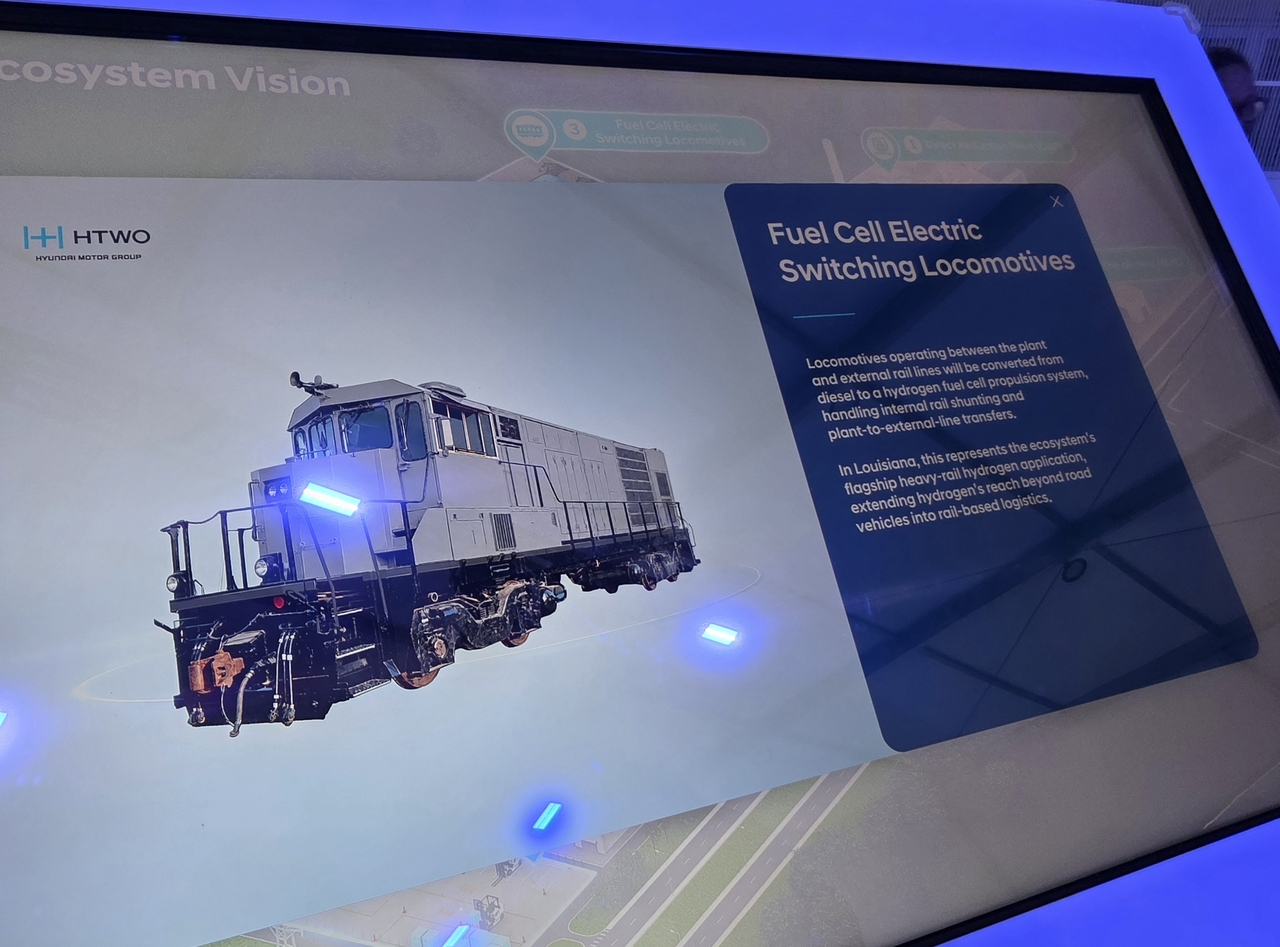
An integrated hydrogen ecosystem concept was also on display at the groundbreaking. The plan envisions converting the switching locomotives that move between the plant and external rail lines from diesel to hydrogen fuel cells, and running forklifts that carry coils and slabs, emergency generators, and industrial burners used in boilers and kilns on hydrogen as well. "We are still in the planning stage for building the hydrogen ecosystem and have not set a timeline," a Hyundai Steel official said.
Steel produced at HPLS will go into Hyundai Motor Group's vehicle manufacturing and is also expected to be used in Atlas, the humanoid robot currently under development. Chung went a step further, expressing his ambition that "by working even harder, I hope we can one day supply this steel to rockets like those made by SpaceX."
Hyundai Motor President Jose Munoz said he intends to "apply the steel produced at HPLS to as many vehicle models as possible at Hyundai Motor's US factories," adding that "we have tested steel from Hyundai Steel and Posco over many years, and the product from HPLS is even more satisfying because it reduces carbon emissions."
Posco targets 10 million tons of overseas steel output; two companies to deepen technology ties
![Posco Group Chairman Chang In-hwa answers reporters' questions at the HPLS groundbreaking ceremony in Donaldsonville, Louisiana, on Friday (local time). [Joint press pool]](https://wimg.heraldcorp.com/news/cms/2026/09/05/news-p.v1.20260905.83131a29b14a4aabbcb5dcf13c38fdf3_P1.jpg)
Hyundai Steel partnered with Posco Group in building its US production facility. Hyundai Steel and Posco hold 50 percent and 20 percent stakes in HPLS, respectively, and the two companies are expected to generate synergies by combining their accumulated experience operating electric-arc furnaces and their automotive steel sheet technology in Korea.
Posco Group Chairman Chang In-hwa said that "producing the highest-grade steel for automotive use from direct reduced iron absolutely requires Posco's hydrogen reduction steelmaking technology and steel sheet expertise," adding that "through the cooperation between Hyundai Steel and Posco, I expect HPLS to become the most competitive company in the world."
The two companies are also reviewing a plan for Posco to directly sell the steel produced at HPLS, with Posco considering supplying it to local automakers in the United States and to its Mexican production subsidiary. If the sales arrangement is finalized, Posco expects to secure a stable supply of materials for its Mexican operations.
Posco also plans to accelerate investment in high-growth global markets — starting with the United States and extending to India and Indonesia — with the goal of expanding its overseas crude steel production capacity to 10 million tons by 2031.
eyre@heraldcorp.com





