
Registry data on multi-ownership of collective buildings
Two-home owners at lowest since January 2023
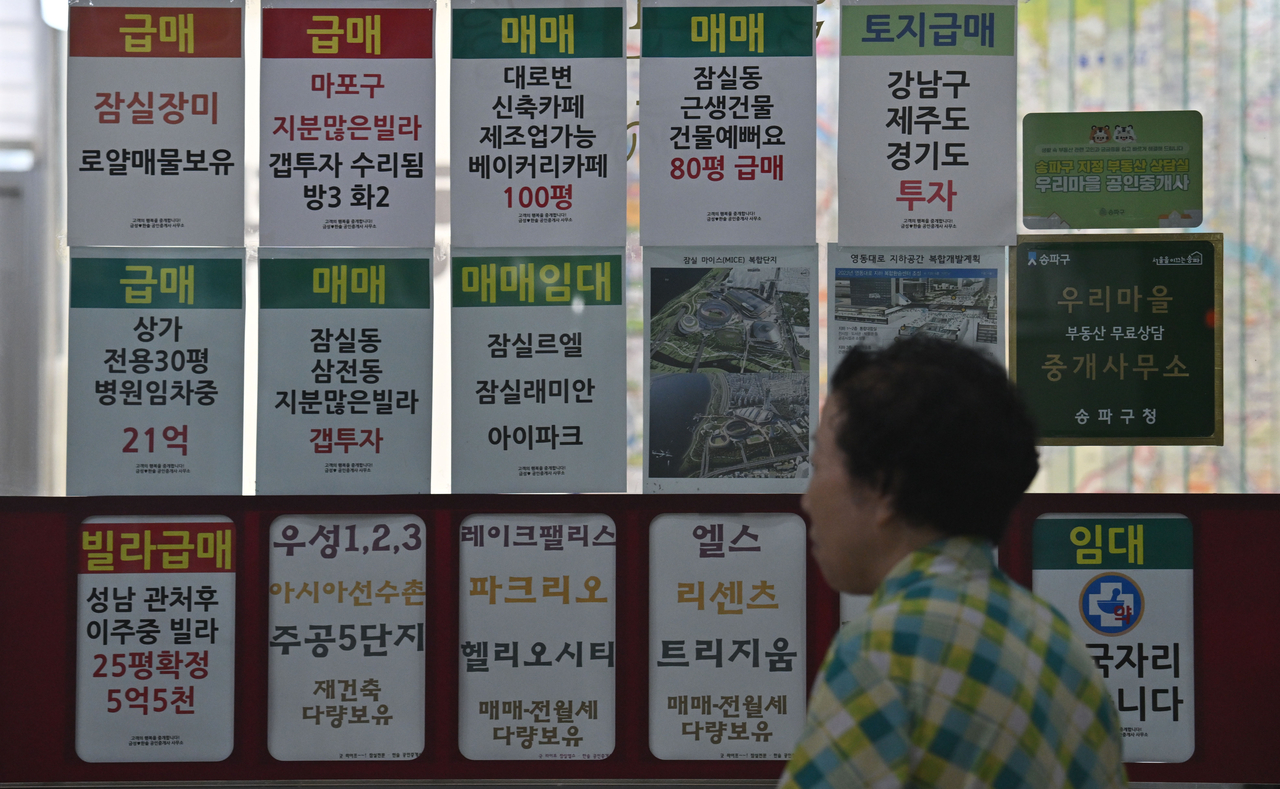
Multi-home owners are being driven to ruin. We demand that the basic deduction for the comprehensive real estate tax on multi-home owners be restored to its original level or adjusted to reflect reality.
The share of people owning two homes in South Korea has fallen to its lowest level in 44 months. The figure dropped sharply after President Lee Jae Myung raised the prospect of ending the capital gains tax surcharge exemption for multi-home owners earlier this year, and after the government unveiled its tax reform package, the two-home ownership rate retreated to levels last seen roughly three years ago — the result of a rapid wave of property sales by owners seeking to avoid a heavier tax burden.
Decline modest but marks 44-month low
According to data from the Supreme Court's Registry Information Plaza, the multi-ownership index for collective buildings — apartments, villas and similar properties — held by two-home owners nationwide stood at 11.108 as of Sunday, based on August figures. That is the lowest reading since January 2023, a span of three years and eight months.
The multi-ownership index measures the share of multi-home owners among all collective-building holders. An index reading of 10, for example, means 10 out of every 100 collective-building owners hold more than one property.
The two-home index had risen consistently since 2023, peaking at 11.357 in July last year. The pace of decline accelerated after President Lee said in January that the capital gains tax surcharge exemption for multi-home owners would be allowed to expire. The index stood at 11.307 in January, slipped to 11.155 in June and fell further to 11.108 in August.
While the decline is not steep, analysts say the 44-month low reflects the combined pressure of tighter lending rules on multi-home owners and selling pressure that intensified after the tax reform package was announced.
Since April, the government has in principle banned multi-home owners in the Greater Seoul area and other regulated zones from extending the maturities on their apartment mortgage loans. The policy — aimed at severing the link between real estate and credit — has effectively forced multi-home owners with maturing loans to repay them.
High-end multi-home owners appear to be responding to loan and tax pressure
Under the 2026 tax reform package, the government plans to raise the comprehensive real estate tax on high-priced homes worth more than 3.2 billion won ($2.35 million) and on multi-home owners in stages starting next year. For multi-home owners in particular, the basic deduction will be differentiated by property value, effectively reducing it. The long-term holding special deduction for capital gains tax will also be restructured — the ownership-period deduction will be eliminated and the total deductible amount capped at 1 billion won.
The government has, however, left an exit open for multi-home owners. The capital gains tax surcharge on properties in designated adjustment zones held by multi-home owners will be temporarily eased through 2028.
Analysts say some multi-home owners holding two or more high-priced properties have begun selling in response to the tax pressure. As of Thursday, the number of listings in the three Gangnam districts — Gangnam-gu, Seocho-gu and Songpa-gu — reached 26,268, up 18 percent from 22,182 a month earlier. Over that period, listings rose across all three districts: Gangnam-gu from 9,453 to 11,194, Seocho-gu from 7,630 to 9,048, and Songpa-gu from 5,099 to 6,026.

On the ground, the reform package targeting multi-home owners has stirred growing resistance. A person identified only by the surname Jo filed a petition through the National Assembly's electronic petition system, arguing that the basic deduction structure announced for multi-home owners — a base deduction of 400 million won plus up to an additional 500 million won depending on the ratio of the owner-occupied home's value — "is clearly at odds with tax equity."
Jo added that because the additional 500 million won deduction is proportional to the share of the owner-occupied home's value relative to the total assessed value of all properties held, "it is structurally impossible to receive the full additional deduction," and called on the government to restore the original basic deduction for the comprehensive real estate tax on multi-home owners or adjust it to reflect current conditions.
Experts say the finalization of the tax reform package could trigger a more substantial wave of listings. At the same time, analysts note that buyers looking to trade up may create a period of mutual hesitation between buyers and sellers for now.
Nam Hyeok-woo, a real estate researcher at Woori Bank, said that while the restoration of the basic comprehensive real estate tax deduction for non-resident single-home owners offered some relief, the key factors determining the actual tax burden remained intact: a newly introduced cap on tax credits, differentiated deduction rates based on residency and holding period, a higher comprehensive real estate tax rate, and a new ceiling on the long-term residency income deduction. "We expect the 'sell' sentiment among sellers to remain largely unchanged," Nam said, "and some sellers may move up their timeline for putting properties on the market."
hss@heraldcorp.com





