![Employees monitor stock and exchange rate movements at the dealing room of Hana Bank's headquarters in Jung-gu, Seoul, on Monday. The Kospi opened up 3.34 percent, or 223.57 points, at 6,910.78. [Yonhap]](https://wimg.heraldcorp.com/news/cms/2026/09/07/rcv.YNA.20260907.PYH2026090703410001300_P1.jpg)
Samsung Electronics and SK hynix surged in early trading Monday in the wake of OpenAI's next-generation AI model GPT-6 Astra, with foreign investors — who had dumped more than 1.6 trillion won ($1.18 billion) worth of the two stocks last week — returning as net buyers. Analysts say selling pressure on semiconductor shares has been easing after a recent round of corrections.
A semiconductor rally that began on Wall Street carried over into the domestic market Monday. Samsung Electronics and SK hynix both jumped sharply at the open, with foreign investors net-buying the two stocks and helping drive a Kospi rebound — a marked shift from last week, when the pair accounted for roughly 81 percent of all foreign net selling on the Kospi.
According to Korea Exchange data as of 9:17 a.m. Monday, Samsung Electronics was trading at 266,500 won, up 11,000 won, or 4.31 percent, from the previous session. SK hynix rose 96,000 won, or 5.83 percent, to 1.74 million won. The Kospi was up 227.12 points, or 3.40 percent, at 6,914.33 at the same time.
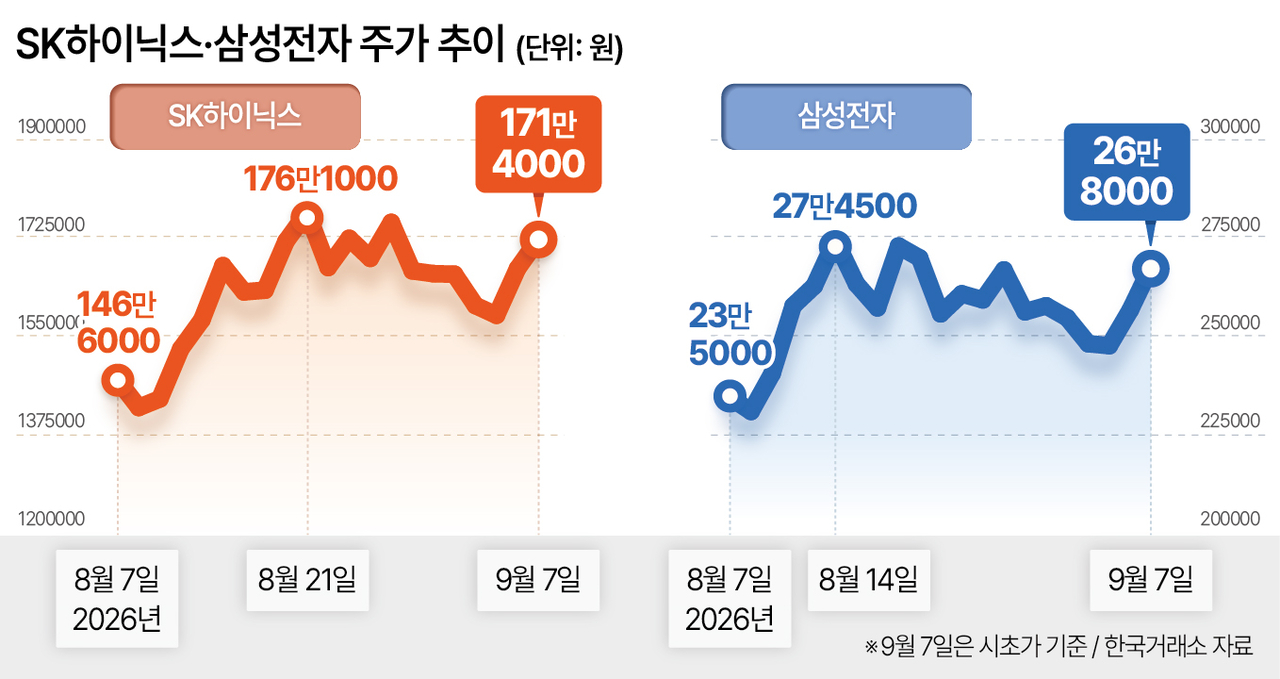
Foreign investors were net buyers of more than 500 billion won on the Kospi Monday. Samsung Electronics and SK hynix ranked among the top net-purchase targets, drawing 65.2 billion won and 87.1 billion won in foreign net buying, respectively.
The shift stands in sharp contrast to last week's flows. Korea Exchange data show that from Aug. 31 through Friday, foreign investors net-sold 1.99 trillion won worth of Kospi shares. Of that total, they net-sold 518.1 billion won in Samsung Electronics and 1.09 trillion won in SK hynix — a combined 1.61 trillion won, equal to roughly 81 percent of total foreign net selling over the period.
Last week, retail and institutional investors also sold heavily. Other corporations, however, were large net buyers, recording 6.5 trillion won in net purchases, driven by buybacks at the two major semiconductor companies.
"Over the past week, we saw the unusual situation of all three investor groups — retail, foreign and institutional — simultaneously net-selling," said Cho Jun-ki, a researcher at SK Securities. "While net buying by other corporations has been substantial due to semiconductor blue-chip buybacks, it is also true that, excluding that factor, there is a clear absence of a dominant buying force."
The domestic semiconductor surge was underpinned by a strong performance on Wall Street on Friday (local time). The Philadelphia Semiconductor Index rose 3.37 percent, while SanDisk jumped 11.90 percent, SK hynix's American depositary receipts gained 8.14 percent, and Micron climbed 6.10 percent. That came even as the Dow Jones Industrial Average fell 0.51 percent, the S&P 500 dropped 0.38 percent and NASDAQ declined 0.29 percent on the same day.
US nonfarm payrolls for August came in at 162,000, nearly triple the market consensus of 55,000 to 56,000. The strong jobs data heightened concerns about Federal Reserve interest rate hikes, yet semiconductor stocks rose anyway. Analysts attributed the divergence to renewed expectations for expanded AI infrastructure investment and higher demand for high-capacity memory chips following OpenAI's unveiling of GPT-6 Astra.
Analysts also pointed to rebound buying after a steep price correction. "Positive news on the memory chip cycle and the GPT-6 Astra announcement likely played a role, but I believe the dominant dynamic was an oversold perception and short-covering in a segment that had seen a significant price pullback," Cho said.
Analysts say selling pressure on semiconductor stocks has been easing through the recent correction. "As Friday's US semiconductor rally suggests, the persistent selling pressure on domestic and overseas chip stocks is increasingly likely to be running out of steam," said Han Ji-young, a researcher at Kiwoom Securities. "It is appropriate to set as the base scenario a path in which market recovery momentum strengthens compared with last week, as investors digest Oracle's earnings and the August US consumer price index."

hajun825@heraldcorp.com