Korea Enterprise Federation survey of 1,078 teachers finds 46% lack basic grasp of entrepreneurship; training seen as key to closing knowledge gap
![[123RF]](https://wimg.heraldcorp.com/news/cms/2026/09/08/news-p.v1.20260907.6817cac98a324969992d0b3d031ab8a4_P1.jpg)
Nearly half of elementary, middle and high school teachers in South Korea are unfamiliar with the concept of entrepreneurship, a new survey shows. The most commonly cited reason was a lack of opportunities to receive relevant training. Teachers who have completed economics and entrepreneurship training show markedly higher awareness and a greater willingness to encourage students to start businesses, pointing to a need for expanded teacher education.
According to a survey of 1,078 teachers nationwide conducted by the Korea Federation of Teachers' Associations on behalf of the Korea Enterprise Federation's Entrepreneurship Institute, 46.2% of respondents said they were "largely unfamiliar with" or "completely unaware of" entrepreneurship.
Entrepreneurship, a concept developed by management scholar Peter Drucker, refers to the spirit of taking calculated risks to turn identified opportunities into viable businesses.
Breaking down the responses, 38.4% said they had "heard of it but don't really know what it means," while 7.8% said they were "completely unaware." Only 13.2% said they were well-informed on the subject.
Among teachers who said they were unfamiliar with entrepreneurship, 51.4% attributed this to a lack of training opportunities at school. Another 18.7% cited insufficient information and understanding about startups, while 12.2% pointed to a shortage of entrepreneurship education content outside school.
Teachers also rated their students' grasp of economics and entrepreneurship poorly. Some 77.3% said their students' level of economic knowledge was low, while 81.3% said the same about their students' entrepreneurial mindset.
The economic competency most lacking among students was identified as "the ability to make rational economic decisions in everyday life," cited by 55.8% of respondents, followed by "financial literacy" at 54.1%.
In terms of entrepreneurial competencies, "the ability to identify and solve problems" was rated the most deficient, cited by 46.6% of teachers.
Teachers' understanding of entrepreneurship also influenced how they guide students on career paths. While 54.9% of respondents said they would be willing to recommend entrepreneurship to students, 14.1% said they would not.
Among those unwilling to recommend it, 55.9% said it was because they did not know enough about startups to offer guidance. Another 11.8% said they believed students would lack the necessary technical skills and knowledge, while 9.2% expressed concern about the psychological burden of potential failure.
Teachers who had completed training in economics and entrepreneurship, however, showed higher awareness of entrepreneurship and a greater willingness to recommend startups to students than those who had not.
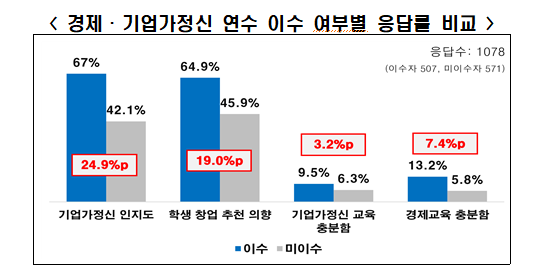
Among teachers who had completed such training, 64.9% said they would recommend entrepreneurship to students — a significantly higher share than the 45.9% among those without training.
Teachers said they wanted future training programs to cover AI and shifts in future industries, as well as practical economics for everyday life. The most sought-after topic for entrepreneurship training was "changes in future industries and careers driven by AI" at 53.7%, followed by "how to apply entrepreneurship education in school settings" at 48.4% and "teaching core competencies such as problem identification, problem-solving and creativity" at 35.3%.
For economics training, "practical financial and consumer education for everyday life" topped the list at 69.6%, followed by "understanding industrial and economic changes driven by AI and digital technology" at 58.2% and "student-centered teaching and learning methods for economics classes" at 29.4%.
Jung Chul, head of research at the Korea Enterprise Federation and director of its Entrepreneurship Institute, said that for students to properly learn about economics and entrepreneurship at school, "teachers must be equipped with the ability to understand the changing industrial environment and connect it to their lessons through systematic training."
go@heraldcorp.com