
1,161 subcontractor unions demanded bargaining with 439 primary contractors
91.2% of decided cases recognized primary employer status
Labor minister says Samsung Electronics strike would be illegal under new guidelines
Boundaries on workforce deployment and restructuring remain unclear
![Members of the Korean Metal Workers' Union under the Korean Confederation of Trade Unions attend a review hearing at the National Labor Relations Commission at Government Complex Sejong. [Newsis]](https://wimg.heraldcorp.com/news/cms/2026/09/08/news-p.v1.20260814.e41710ddba224dcd8483d8309688eff8_P1.jpg)
Since the Yellow Envelope Act — the revised Trade Union Act — took effect, 103 workplaces have had their primary contractors recognized as employers under the law. Yet the grounds for those rulings and the scope of bargaining obligations they impose on primary contractors remain undisclosed, leaving companies and unions struggling to gauge what the law actually requires of them. Even a newly issued implementation guideline spelling out the boundaries of labor disputes has done little to dispel the uncertainty on the ground.
According to the Ministry of Employment and Labor, 1,161 subcontractor unions demanded bargaining with 439 primary contractor workplaces between March 10 and June 19. A total of 164,000 union members took part, with an average of 2.6 unions per primary contractor. Of the 141 primary contractor workplaces where labor commission proceedings were initiated, 103 of the 113 cases that reached a decision — 91.2 percent — resulted in the primary contractor being recognized as an employer.
Ninety-six workplaces — including 42 that voluntarily initiated proceedings and 54 that moved to follow-up steps after employer status was recognized — proceeded with measures such as consolidating bargaining channels. Of those, 51 entered preliminary consultations and 10 moved to full bargaining.
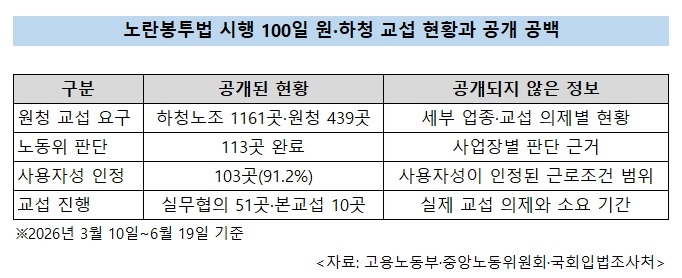
The numbers alone, however, tell little about how broadly the Yellow Envelope Act is actually being applied. The specific powers and influence that led each primary contractor to be recognized as an employer have not been made public, nor has it been disclosed which of the agenda items proposed by subcontractor unions were deemed subject to a primary contractor's bargaining obligation.
Under the Yellow Envelope Act, a primary contractor is recognized as an employer only to the extent that it "substantially and specifically controls or determines" the working conditions of subcontracted workers. The same primary contractor may be recognized as an employer with respect to industrial safety or the work environment, but not necessarily with respect to wages, working hours or welfare benefits.
What companies and unions ultimately want to know, then, is not how many primary contractors have been recognized as employers, but under what conditions and on which agenda items a primary contractor's bargaining obligation arises.
The "Implementation Guideline on Labor Dispute Subjects Including Management Performance Bonuses," which the Ministry of Employment and Labor announced Thursday, has not fully resolved that uncertainty. The guideline stipulates that demanding a fixed percentage of corporate profits as a performance bonus, or opposing management decisions such as building or relocating a factory or introducing new technology, does not constitute a subject of mandatory bargaining or industrial action. It does allow, however, that bargaining may be required when working-condition changes — such as reassignments stemming from layoffs or restructuring — are objectively foreseeable.
Companies say even that standard leaves them uncertain about how far it will reach in practice. When AI or automated equipment is introduced and existing workers are reassigned to different tasks or processes, for instance, unions may seek to make that a bargaining subject. The concern is that business decisions on technology investment and workforce management could increasingly become flashpoints in labor-management disputes.
Above all, the guideline addresses only what may qualify as a subject of labor dispute — a separate question from when a primary contractor is recognized as the employer of subcontracted workers. Even where employer status is recognized, that does not automatically trigger a bargaining obligation on every agenda item.
The guideline also carries no binding force on courts. If either party refuses to accept a labor commission ruling, the legitimacy of bargaining obligations or industrial action will ultimately have to be settled in court.
Labor Minister Kim Young-hoon said Tuesday on SBS Radio that, under the new guideline, the strike by Samsung Electronics workers in May — in which the union demanded a performance bonus equal to a fixed percentage of operating profit — would constitute illegal industrial action. He added, however, that the guideline would not be applied retroactively, given that Samsung Electronics and its union had already established a bonus payment method through a collective agreement. "The law is not something that can be cut cleanly in two — precedents need to accumulate," Kim said.
The problem, however, is that those very precedents are not being disclosed in enough detail for companies and unions to use as practical reference.
An interpretive guideline the ministry drew up in February to help determine primary contractor employer status similarly stopped at laying out general criteria such as "structural control." How factors like contractual authority, budget and staffing control, and the independence of subcontractors are weighed together in actual cases can only be understood by examining the specific rulings of the labor commissions.
The ministry also said that of 18 primary-subcontractor cases that went through appellate review, 2 reached conclusions different from the initial ruling — but the factual findings and reasoning behind those reversals have not been made public.
"The new guideline is out, but we're still completely in the dark about under what conditions a primary contractor becomes a bargaining counterpart," said a labor affairs manager at one primary contractor company. "The specific criteria for these decisions should be made public so that both labor and management can use them as a reference."
fact0514@heraldcorp.com





