PISA 2025 results released
Science 526, reading 501, math 522 — all above OECD average
Top-tier readers fall from 13.3% to 10.3%, bottom tier rises from 14.7% to 17.8%
Ministry cites possible combined effects of short-form video, social media

South Korean students are showing warning signs in literacy. In the Program for International Student Assessment, which measures reading proficiency among 15-year-olds, South Korea's average score fell 14 points over three years. The share of top performers shrank, while the share of low performers grew. The Ministry of Education said changes in the digital environment — including short-form video and social media — may have affected students' attitudes and motivation toward reading.
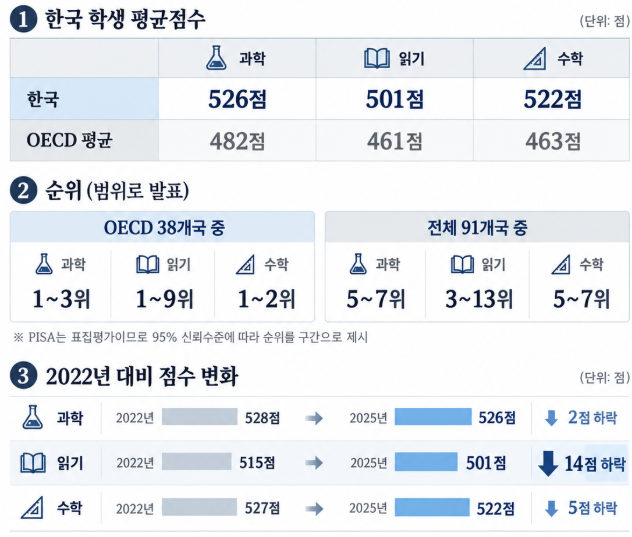
The Ministry of Education and OECD released PISA 2025 results Tuesday, showing South Korean students scored an average of 526 in science, 501 in reading and 522 in math. All three scores were above the OECD averages of 482, 461 and 463, respectively. Among the OECD's 38 member countries, South Korea ranked first to third in science, first to ninth in reading and first to second in math. Among all 91 participating countries, it ranked fifth to seventh in both science and math, and third to 13th in reading.
PISA is an international comparative study assessing science, reading and math literacy among 15-year-olds. This round involved about 760,000 students from 91 countries worldwide, including 6,859 students from 196 middle and high schools in South Korea. However, average scores fell across the board from 2022. Science dropped 2 points, from 528 to 526, while math fell 5 points, from 527 to 522. Reading saw the largest decline, falling 14 points from 515 to 501. OECD member countries as a whole also saw declines in science, reading and math scores over the same period.
The Ministry of Education said the decline in South Korea's scores is not statistically significant and that the country still ranks near the top overall. Because PISA estimates nationwide student achievement by sampling a subset of students, it presents country rankings as a range at a 95 percent confidence level rather than a single rank. In 2022, South Korea ranked second to fifth in science, first to seventh in reading and first to second in math among OECD countries. This year, those ranges were first to third, first to ninth and first to second, respectively.
A notable feature of this year's PISA results is the pronounced decline in reading. The share of students at the top proficiency level, Level 5 or above, fell from 13.3 percent in 2022 to 10.3 percent this year, a drop of 3.0 percentage points. The share at the bottom proficiency level, Level 1 or below, rose from 14.7 percent to 17.8 percent, an increase of 3.1 percentage points. In science, the share of top performers also fell, from 15.7 percent to 14.6 percent, while the share of low performers rose from 13.7 percent to 14.2 percent. In math, both the top and bottom shares increased. Top performers rose from 22.9 percent to 23.2 percent, up 0.3 percentage points, while low performers rose from 16.2 percent to 18.6 percent, up 2.4 percentage points.
The Ministry of Education cited changes in students' digital media environment as one possible factor behind the decline in reading achievement. "Reading scores have declined across the world," a ministry official said. "While it is difficult to pinpoint a single cause, the digital media environment, along with short-form video and social media, appears to have had a combined effect on students' motivation and attitudes toward reading."
The Ministry of Education plans to expand reading education linked to school curricula and discussion- and question-based instruction to boost reading competency. It will increase the number of schools participating in its "Building a Reading Culture in Schools" project from 1,000 this year to 3,000 next year. Starting next year, the ministry will designate third- and fourth-grade elementary school students, first-year middle school students and first-year high school students as intensive reading education grades.
"We need to further examine the digital environment and the attitudes toward reading held by this generation of students," a ministry official said. "We will incorporate reading education and discussion-based instruction into policy to help build literacy and reading skills."
brunch@heraldcorp.com