
EVO Plant to produce 200,000 PBVs a year
Sequential assembly maximizes manufacturing efficiency
Conversion center creates tailored production ecosystem
Kia accelerates push into personalized mobility market
PV7 debuts this month as West Plant automation advances

On Tuesday, at Kia's Hwaseong EVO Plant assembly facility in Ujeong-eup, Hwaseong, Gyeonggi Province, PV5 Passenger, Cargo and Chassis Cab models moved down a single line one after another to receive Kia's signature emblem. Despite the mix of models and specifications, robots recognized each vehicle's information in real time, selected the matching emblem and automatically attached it to the hood or tailgate in the precise location.
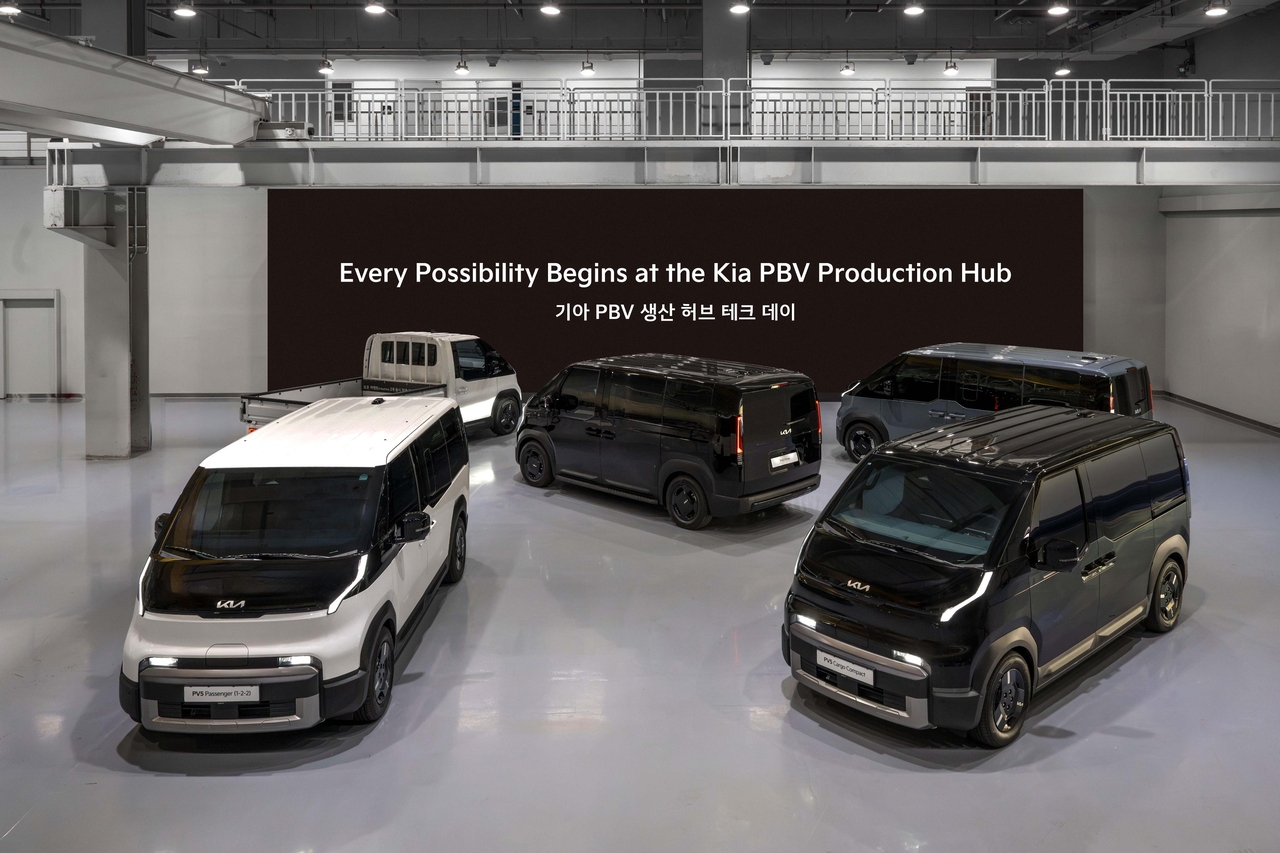
The PV5 is Kia's purpose-built vehicle (PBV), offered in 10 variants tailored to different customer uses. The Hwaseong EVO Plant built a system that uses robot-driven automation and data-based quality control to produce multiple vehicle types flexibly and accurately on a single line. As Kia rolls out the larger-bodied PV7 this month to accelerate its push into the personalized mobility market, the plant is set to support that expansion with high quality and productivity.
Different models, one line: 'automation lifts efficiency 10%'

Kia is redesigning its factories to expand PBVs beyond simple vehicle models into personalized mobility solutions that can be reshaped around individual customer needs. Because PBVs come in a far wider range of models and specifications than standard passenger cars, the plant builds multiple vehicle types simultaneously on a single production line while using automation technology to reduce quality variation.
The Hwaseong EVO Plant is Kia's first factory dedicated to PBVs. It comprises the East Plant, which currently produces the PV5, and the West Plant, which will produce the larger electrified PV7 and PV9 models. Each plant has an annual production capacity of 100,000 units. Once the West Plant is completed in June next year, the two together will produce 200,000 PBVs a year.
The key feature is "multi-model flexible production," in which the manufacturing equipment itself distinguishes between different vehicle models and specifications as they arrive in sequence. At the body shop, the PV5 alone comes in more than 180 specifications. Rather than relying on workers to visually identify each part, the plant uses data matrices embedded in components so equipment can automatically determine the specification.
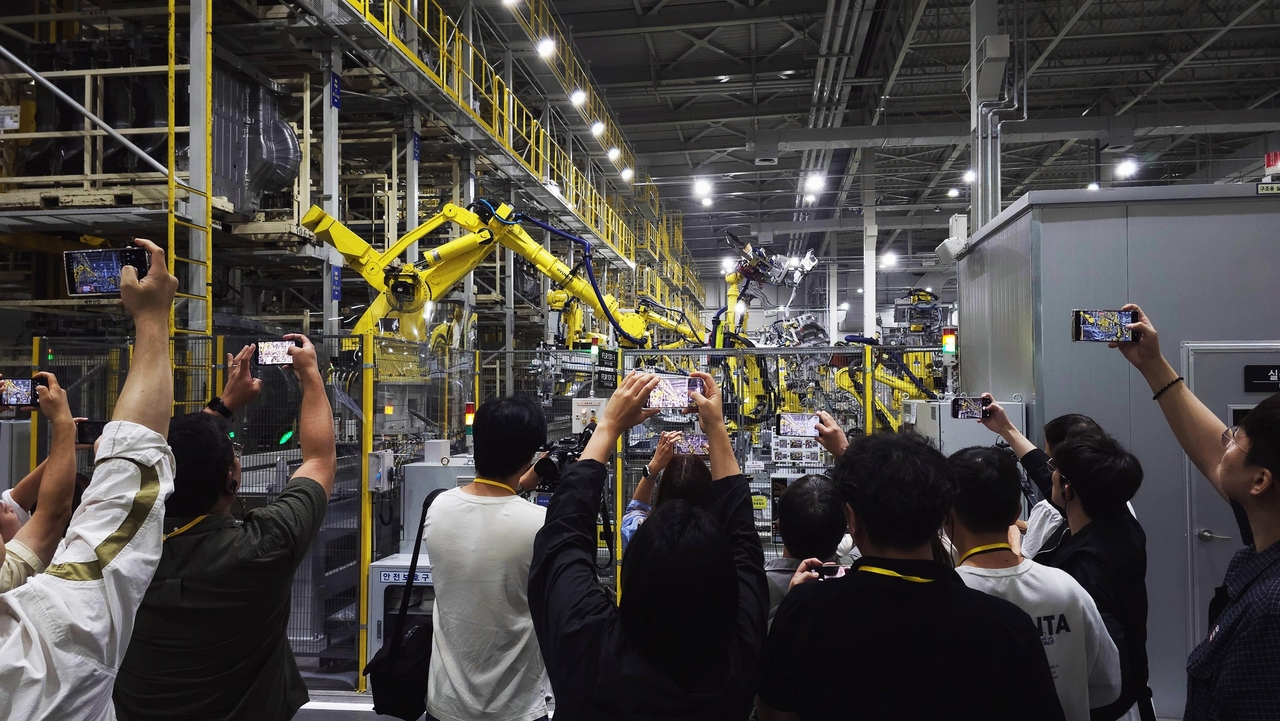
Automation is most pronounced in the welding process, which has reached a 100 percent automation rate. Where major body components were once assembled in a single process, the EVO Plant East now divides the work into four sequential stages — inner buck, rail buck, outer buck and roof buck — allowing the line to adapt to different vehicle sizes and specifications. On the factory floor, yellow robotic arms moved up, down, left and right without any worker intervention to complete the vehicle's body frame.
Robots also moved heavy body parts and components throughout the plant. Two robots positioned front and back synchronized their movements to carry body frames of varying lengths and centers of gravity, while automated guided vehicles ferried bodies and parts to the processes that needed them. Including part transport, the body shop's overall automation rate reaches 83 percent.
"Compared to the existing Hwaseong plant, we are seeing an automation rate that is about 9 percent higher," said Seong Si-young, a senior manager on Kia's manufacturing planning team. "With increased automation, we are seeing about a 10 percent improvement in efficiency in terms of quality and operations."
Robots catch gaps as small as 0.2mm
West Plant to raise automation further next year
Automation also supports quality control. At the body shop, vision robots using a Body Measurement System measure and record the positions of body holes where doors and tailgates will be installed. After installation, a Car Measurement System rechecks the vehicle's gaps and level differences and sends the results back to the robots to correct assembly positions.
In the exterior quality inspection at the assembly plant, a 3D vision camera first scans the entire vehicle under light-purple lighting. Robots then measure gaps and level differences at 21 points on each side of the vehicle to within plus or minus 0.2 millimeters. Eighteen cameras also inspect 24 parts — including outside mirrors, door garnish, fenders and door handles — to automatically check whether any wrong-specification parts were installed or any parts are missing.
Smart tags attached to each vehicle are also central to the system. They track the vehicle's location and production information in real time, allowing work to proceed only when the correct tools and equipment are connected to that specific vehicle. The system is designed to prevent errors such as workers installing the wrong parts.
At the EVO Plant West, under construction with completion targeted for June next year, automation will go a step further. To handle the greater height and heavier components of large PBVs, the plant will feature automated installation of roof antennas and quarter glass, as well as automatic insertion of floor consoles.
"Through automated driving tests, we will quantitatively measure noise, and through tunnel-type exterior vision inspection, we will automatically detect exterior defects even in taller vehicle models," Seong said. "We also plan to apply automated inspection and correction for paint contamination."

Beyond the factory: conversion built in from the frame up, 40,000 units a year
Kia's PBV production system does not end at the vehicle plant. The company has integrated "conversion" — modifying vehicles to suit customer needs — into the base vehicle's development stage, rather than treating it as simple after-the-fact modification once vehicles roll off the line.
Kia operates a PBV conversion center near Autoland Hwaseong, where base vehicles such as the Passenger, Cargo and Chassis Cab are produced and then expanded into a range of vehicles including open-bed trucks, crew vans, and dry or refrigerated box trucks. The conversion center has 98 work cells and 14 inspection cells and can produce up to 40,000 units a year, covering not only the PV5 but future conversion models based on the PV7 and PV9.
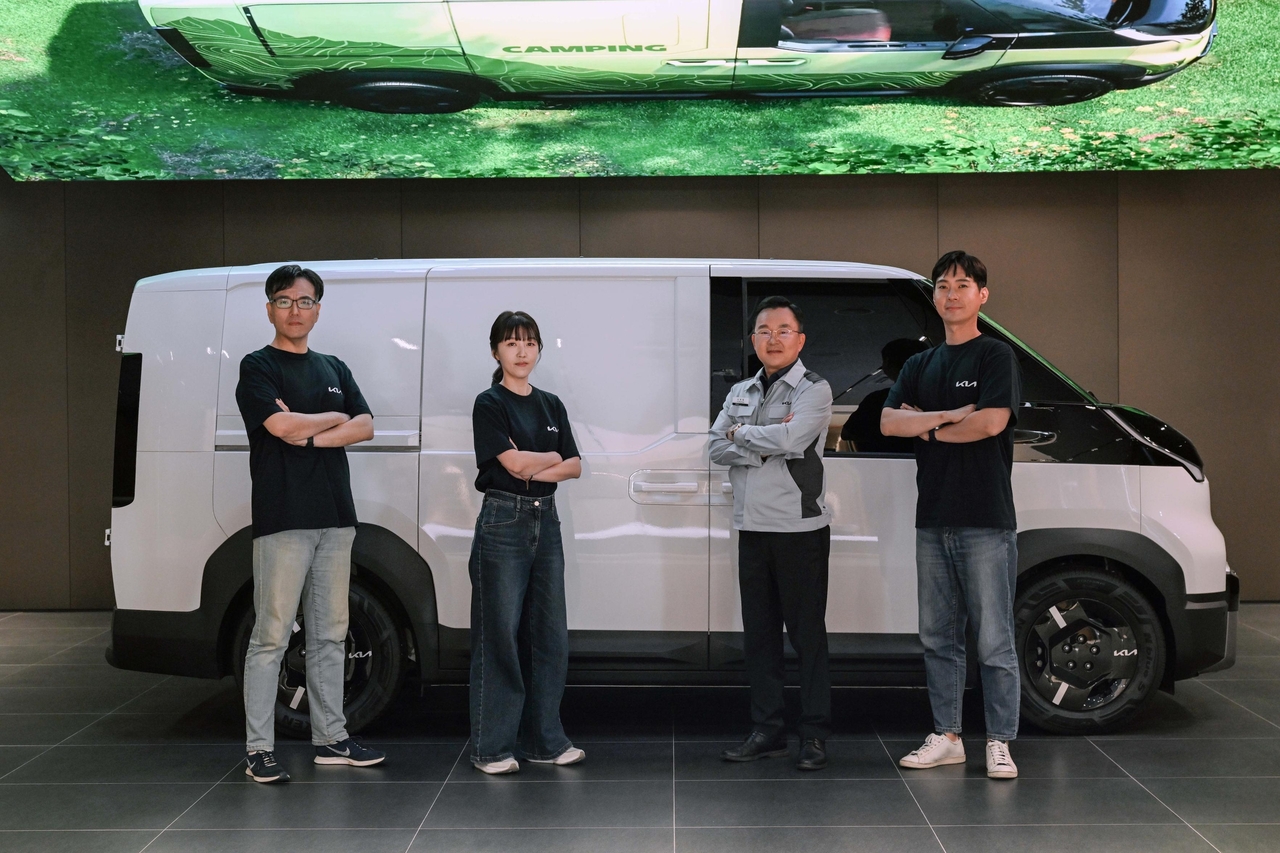
This differs from the conventional customization approach, which modifies a vehicle after it has been fully built. Kia incorporates holes, brackets, wiring and connectors needed for conversion parts starting from the base vehicle's development stage. It also supplies external customization companies with "donor models" — base vehicles shipped without seats, floor mats or other components unnecessary for conversion — to reduce the work of stripping unneeded parts and to boost quality and production efficiency.
Kia also runs a PBV conversion portal that provides outside companies with 3D CAD data for base vehicles, body-builder manuals and certification materials, along with a one-on-one technical hotline. Vehicles developed in partnership with external customization companies — including smart patrol cars, children's school buses, rear-entry wheelchair-accessible vehicles, motorcycle transport vehicles and refrigerated vans — are set to reach the market in sequence.
"Autoland Hwaseong is more than a factory that builds vehicles — it is a PBV production hub that turns the diverse ideas and needs of customers and partners into mobility solutions," said So Deuk-young, executive director and plant manager of Autoland Hwaseong. "We will continue to advance our smart manufacturing technology and conversion ecosystem to offer customers a wider range of choices and, together with our partners, create diverse possibilities in mobility."
eyre@heraldcorp.com





