Index falls 0.25% on Middle East tensions; Samsung Electronics, SK hynix both slip
Oil tops $100 a barrel; 10-year US Treasury yield hits 4.85%
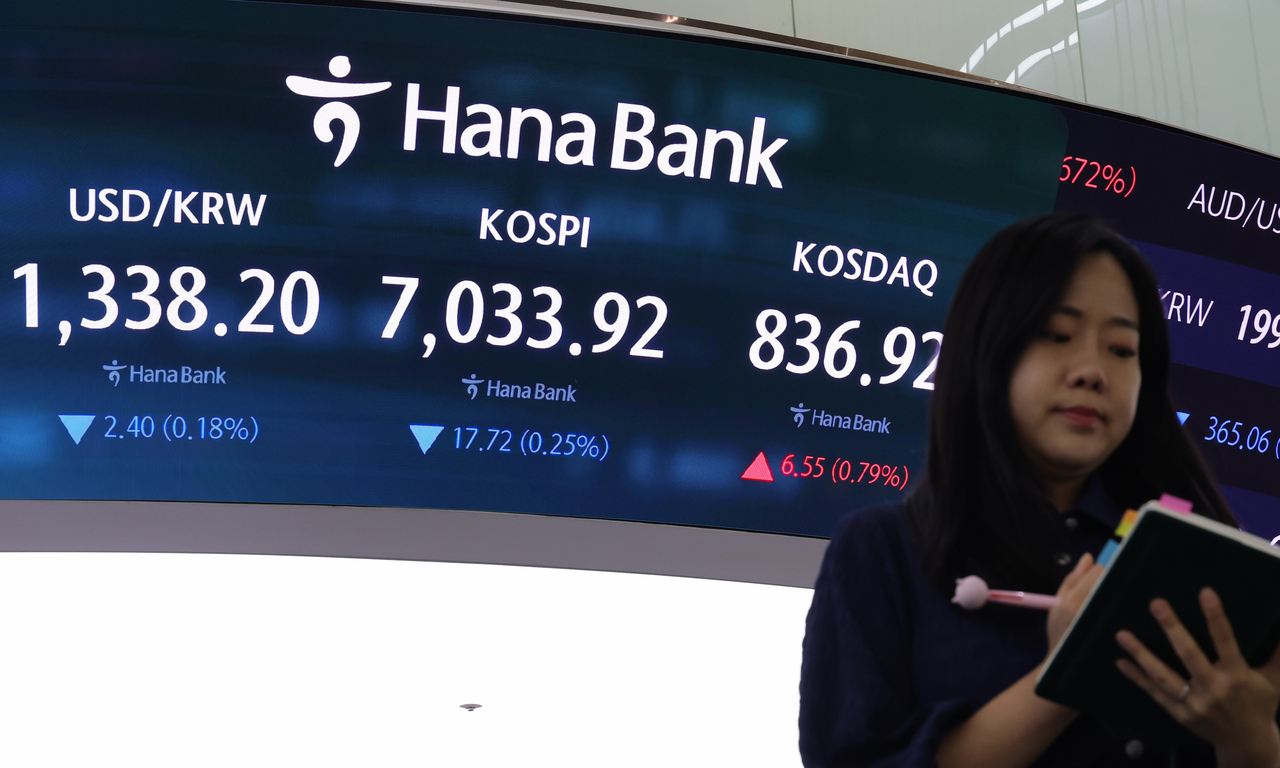
The Kospi edged down Thursday amid a surge in global oil prices triggered by Middle East tensions and interest rate jitters. However, the index held above the 7,000 mark at the close.
According to the Korea Exchange, the Kospi closed at 7,033.92, down 0.25% from the previous session. The index opened at 7,038.85, down 0.18% from the previous close, and fell as low as 6,898.45 during trading before narrowing its losses in the afternoon.
Samsung Electronics and SK hynix, the Kospi's two largest companies by market capitalization, both closed slightly lower. Samsung Electronics shares fell 0.19% to close at 269,000 won ($201). The stock opened weak, down 0.19%, and briefly recovered to 270,000 won during trading before ultimately falling back.
SK hynix shares also fell 0.16% to close at 1.85 million won. The stock opened up 1.24% and rose as high as 1.89 million won, a 1.83% gain, in early trading, but gave up all those gains by the close.
Among other large-cap stocks, SK Square fell 0.26%, Samsung Electro-Mechanics 0.28%, LG Energy Solution 1.62% and Samsung Biologics 2.00%.
A spike in oil prices stemming from a military clash between the US and Iran, compounded by concerns over a possible US interest rate hike, weakened investor sentiment.
Brent crude for November delivery rose $3.29, or 3.36%, from the previous session to settle at $101.21 per barrel, closing above the $100 mark for the first time since July 23.
The oil price surge fueled expectations that the US Federal Reserve would raise its benchmark interest rate to curb inflationary pressure. US government bond yields also rose.
The yield on the 10-year US Treasury note topped 4.85% during trading, marking its highest level since November 2023.
By investor type, retail and institutional investors made net purchases of 380.2 billion won and 433.4 billion won, respectively, in Kospi-listed shares, while foreign investors offloaded a net 2.48 trillion won.
Retail investors, who had been net sellers for five consecutive trading sessions, turned to net buying. Institutional investors extended their net buying streak to six consecutive sessions, helping cushion the index's decline.
The Kosdaq rose 0.79% to close at 836.92. Alteogen shares fell 0.89% to close at 277,000 won, while Ecopro (0.12%), Ecopro BM (3.31%), Jusung Engineering (7.02%) and Rainbow Robotics (0.79%) all ended higher.
Retail and foreign investors were net sellers of 269.8 billion won and 1.07 trillion won, respectively, while institutional investors made net purchases of 1.35 trillion won.
The Kosdaq, which recovered above the 800 mark at the close on Friday, has stayed above that level for five consecutive trading sessions, showing an upward trend.
Investor deposits at brokerages topped 100 trillion won again. According to the Korea Financial Investment Association, investor deposits — cash parked in brokerage accounts awaiting investment — stood at 102.85 trillion won as of Wednesday.
The figure grew by 5.86 trillion won in just one day, returning above the 100 trillion won mark for the first time in five trading sessions. It last topped that level on Sept. 2, when it stood at 102.27 trillion won. Deposits tend to rise during market upswings and fall during downturns, and the latest increase appears to reflect the Kospi's return above the 7,000 mark.
Lee Kyung-min, a researcher at Daishin Securities, said, "The domestic market opened lower due to external risks but found a bottom near the 6,900 level before rebounding to reclaim the 7,000 mark." He added, "Short-term volatility in supply and demand widened as the regular rebalancing of KRX sector indexes coincided with the simultaneous expiration of futures and options, while TSMC's solid sales results served as a positive factor for investor sentiment toward semiconductors."
jiyun@heraldcorp.com