Assets under management climb to W2,777tr, up 17.9%
Fee income expands on higher share prices, ETF growth
Loss ratio at private equity fund managers rises to 47.9%

Asset management companies' net profit rose 83.4 percent quarter-on-quarter in the second quarter of this year. Growth in assets under management, driven by rising domestic share prices and an expanding exchange-traded fund market, boosted fee income and securities investment gains. However, the ratio of loss-making firms also rose, driven mainly by private equity fund managers.
The Financial Supervisory Service released preliminary second-quarter business results Friday. Asset management companies posted a combined net profit for the period of 2.69 trillion won ($2.01 billion) in the second quarter, up 214.3 percent from a year earlier.
Operating profit came to 2.42 trillion won, up 78.9 percent quarter-on-quarter.
Fund-related fees, including management and performance fees, drove the earnings growth. Fee income totaled 2.61 trillion won in the second quarter, up 37.7 percent from the previous quarter. Of that, fund-related fees accounted for 2.03 trillion won and discretionary investment advisory fees came to 574.6 billion won.
Securities investment gains from proprietary asset management and other activities came to 829.7 billion won, up 159.6 percent from the previous quarter.
Assets under management also grew sharply. As of the end of June, asset management companies' assets under management stood at 2,777.5 trillion won, up 17.9 percent from the end of March. Fund net assets came to 1,730.9 trillion won, and discretionary investment assets totaled 1,046.6 trillion won.
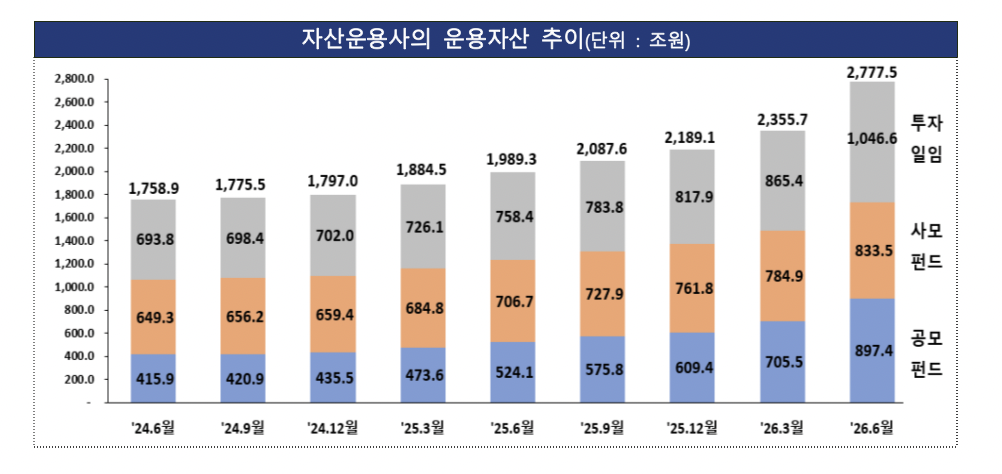
Public offering fund net assets, in particular, swelled to 897.4 trillion won on the back of the Kospi's rise and the expanding ETF market, up 27.2 percent from the previous quarter. ETF net assets grew 42.1 percent, from 360.7 trillion won at the end of March to 512.4 trillion won at the end of June.
Private equity fund net assets rose 6.2 percent quarter-on-quarter to 833.5 trillion won.
Under the Financial Investment Services and Capital Markets Act, public offering funds pool money from 50 or more unspecified investors, while private equity funds invest money raised from 49 or fewer investors in shares, bonds and other assets.
While the industry's overall net profit increased, the proportion of loss-making firms also rose, driven mainly by private equity fund managers. Of the 513 companies in the industry, 293, or 57.1 percent, posted a profit. The ratio of loss-making firms rose to 42.9 percent from 37.6 percent in the previous quarter.
Among the 77 public fund managers, the loss ratio fell 1.3 percentage points from the previous quarter to 14.3 percent. In contrast, the loss ratio among the 436 private equity fund managers climbed 6.4 percentage points to 47.9 percent.
The Financial Supervisory Service said asset management companies posted strong quarterly earnings in the second quarter on the back of rising domestic share prices.
However, it noted risk factors also emerged, including a concentration of investment funds in specific sectors and stocks, and excessive short-term trading and leveraged investment linked to ETFs. It added that uncertainty in financial markets remains due to rising interest rates at home and abroad and increased volatility in share prices and exchange rates.
"We will closely monitor asset management companies with weak soundness and continue efforts to ease market volatility, including curbing leveraged and debt-funded investment, while continuing supervision and regulatory improvements so that the asset management industry can achieve sound growth by restoring investor trust and encouraging long-term investment," the Financial Supervisory Service said.
Financial authorities implemented supplementary measures in July, including raising the minimum deposit for single-stock leveraged products to 30 million won. Additional measures, such as expanding minimum trading units, are planned going forward.
moon@heraldcorp.com