![[123rf]](https://wimg.heraldcorp.com/news/cms/2026/09/30/news-p.v1.20260327.c8e3ef5646e749cbaef48e3e662a9a4a_P1.png)
South Korean retail investors are shifting money out of US stocks and into bonds. This month, their net purchases of US Treasuries more than doubled their net purchases of US equities. Analysts are cautioning that bond investors should remain alert, as US long-term interest rates could rise further.
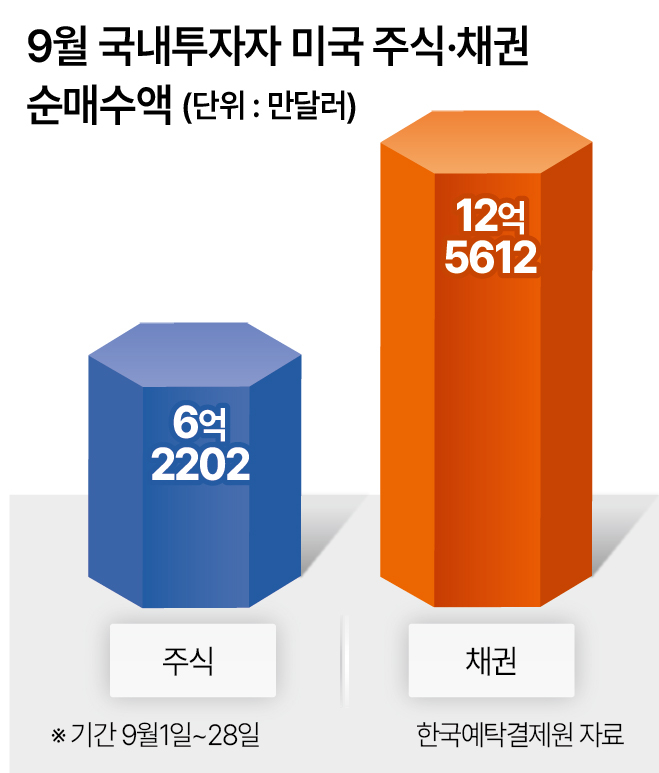
According to the Korea Securities Depository, domestic investors net purchased $1.26 billion in US bonds from Sept. 1 to Sept. 28. Over the same period, net purchases of US stocks came to only $622.02 million — meaning bond net purchases were more than double those of stocks.
Buying of US bonds by Korean retail investors has surged in the second half of the year. After net selling $167 million in US bonds in June, domestic investors swung to net purchases of $889 million in July. Last month, net purchases hit $1.82 billion, the highest level of the year.
The shift from stocks to bonds reflects growing volatility in financial markets driven by rising interest rates and oil prices. Higher discount rates and risk-aversion sentiment have increased the burden of equity investing, while elevated rates have made the interest income from bonds more attractive.
Global government bond yields have been setting new highs day after day. The yield on the 30-year US Treasury climbed as high as 5.613 percent during trading Tuesday (local time), its highest level since 2002, marking six consecutive sessions of gains. The 10-year US Treasury yield — the global benchmark — also rose 2.2 basis points from the previous session to trade at 5.264 percent.
The moves reflect a combination of inflation concerns stemming from high oil prices tied to the prolonged US-Iran war and supply pressure from heavy corporate bond issuance. Jeong Seong-tae, a researcher at Samsung Securities, said the AI investment boom has prompted markets to raise their US growth outlook, while the prolonged Middle East war has kept oil prices elevated. He added that the expansion of US government debt and fiscal deficits, expectations of increased AI-related bond issuance, and concerns about monetary policy credibility since Federal Reserve Chair Kevin Warsh took office have all pushed rates higher.
South Korean brokerages are on alert over the possibility of further increases in US long-term interest rates. If rates rise further, existing bond prices will fall, widening unrealized losses for long-duration bond investors.
Min Ji-hee, a researcher at Mirae Asset Securities, said pressure for steepening of the US Treasury curve is expected to dominate, driven by the AI investment cycle, fiscal deficits and inflation wariness, and that investors should be mindful of further increases in US long-term rates. She noted that long-term rates are likely to rise faster than short-term rates, widening the spread between the two.
Kim Ji-na, a researcher at Eugene Investment & Securities, said that while the carry appeal of long-dated US Treasuries has grown, extreme market volatility and anxiety persist. "Unless you are an investor with a medium-to-long-term time horizon, this is still a period where risk management is needed before entering purely on carry appeal," she said. Carry appeal refers to the attractiveness of the interest income earned while holding a bond.
Some analysts, however, see limited room for long-term yields to surge further. Jeong said that US long-term rates, currently hovering around 5.2 percent, reflect short-term expectations that high oil prices will persist for an extended period. "For now, US long-term rates are likely to remain in the range of around 4.7 to 5 percent," he said.

moon@heraldcorp.com