Big 5 banks' rates rise from 3.21% to 3.35% in a month
Shinhan, Woori, Hana, NongHyup all raise rates in recent days
Savings banks trim average rate from 3.78% to 3.74%
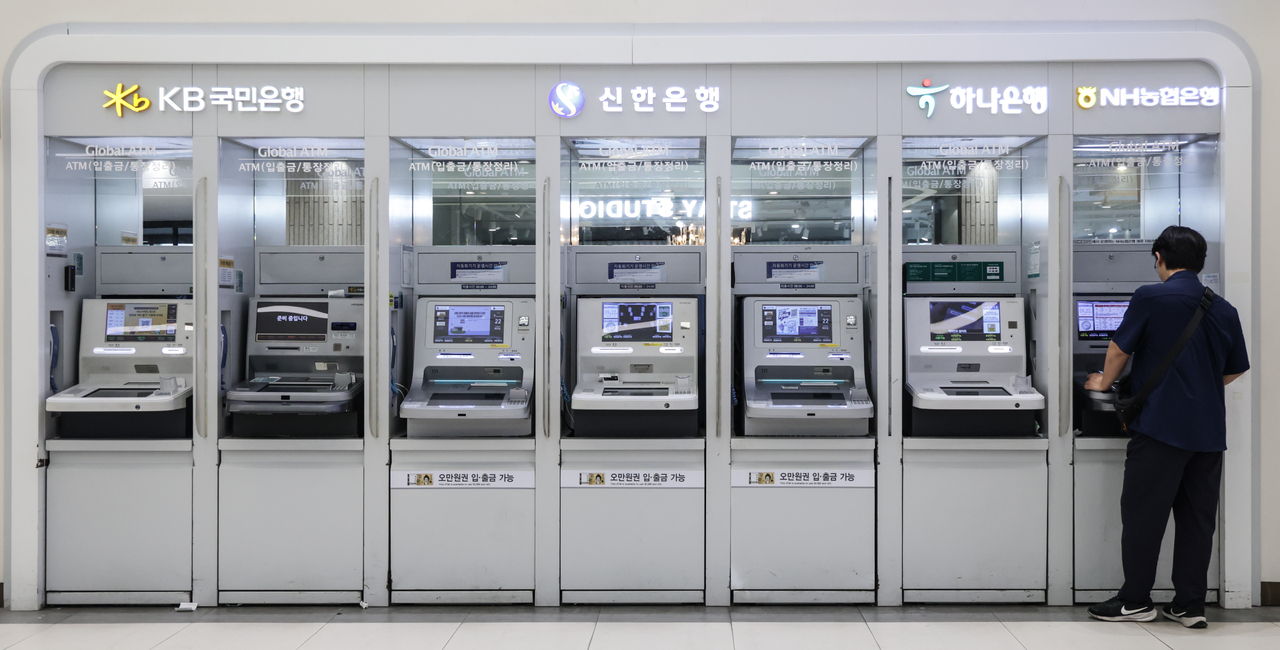
![An ATM at a bank branch in Seoul. [Yonhap]](https://wimg.heraldcorp.com/news/cms/2026/09/12/news-p.v1.20260910.aae2a3e12e1143e89804c851f78b7f40_P1.jpg)
Average one-year fixed-deposit rate at the Big 5 banks: 3.35% per annum vs. average one-year fixed-deposit rate at 79 savings banks nationwide: 3.74% per annum
The gap between commercial banks and savings banks on fixed-deposit rates has narrowed to less than 0.4 percentage points as major lenders have moved in quick succession to raise their deposit rates over the past several days. With stock market volatility rising and deposit rates growing more attractive, a "reverse money move" — a shift of funds into bank fixed deposits — continues to gain momentum.
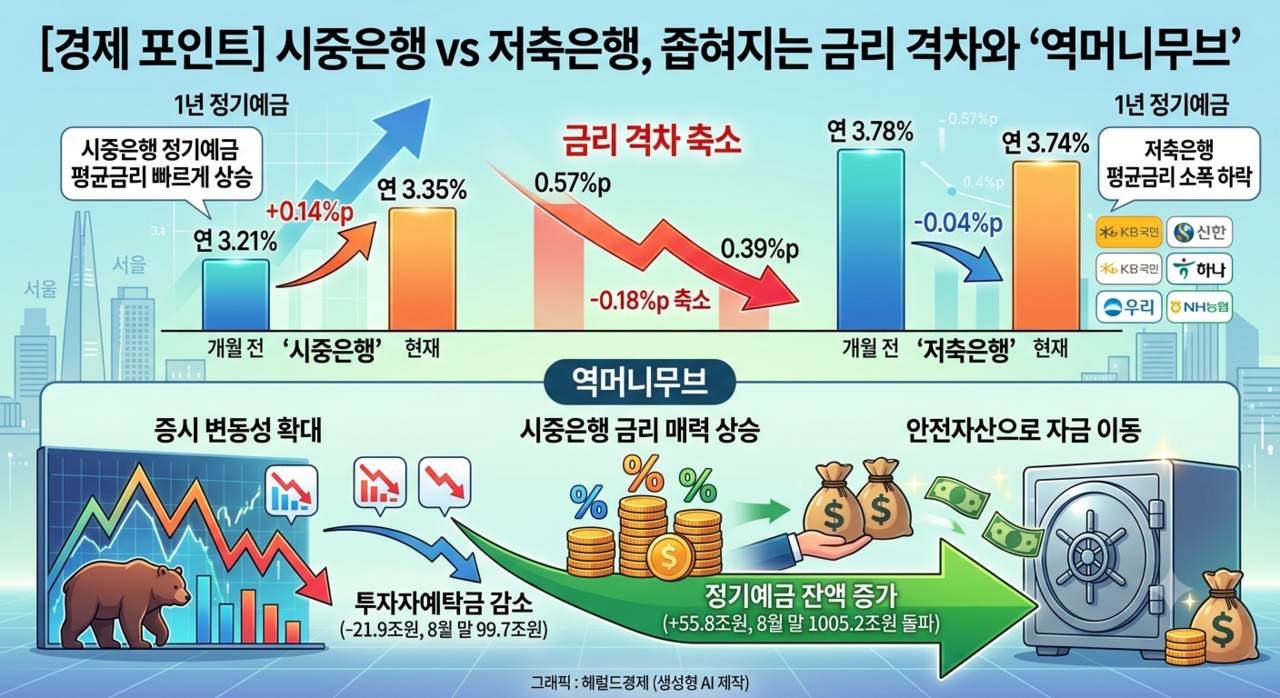
According to financial industry sources, the simple average of one-year fixed-deposit rates offered by the Big 5 banks — KB Kookmin Bank, Shinhan Bank, Hana Bank, Woori Bank and NH NongHyup Bank — stood at 3.35 percent per annum as of Saturday, up 0.14 percentage points from 3.21 percent on Aug. 10.
The increases have come in rapid succession over just the past few days. Shinhan Bank raised the one-year rate on its "Sol Pyeonhan" fixed deposit from 3.20 percent to 3.40 percent per annum on Wednesday. Woori Bank followed on Thursday, lifting its "WON Plus" fixed deposit from 3.20 percent to 3.40 percent, while Hana Bank raised its "Hana's" fixed deposit from 3.20 percent to 3.30 percent the same day. NH NongHyup Bank raised the rate on its "NH All-One e-Deposit" from 3.25 percent to 3.45 percent per annum — a 0.20-percentage-point increase — effective Friday. KB Kookmin Bank, which raised its flagship fixed-deposit rate by 0.30 percentage points from 2.90 percent to 3.20 percent in July, is now reviewing whether to raise it further.
Among the Big 5, NH NongHyup Bank now offers the highest one-year rate at 3.45 percent per annum, followed by Shinhan Bank and Woori Bank at 3.40 percent each, Hana Bank at 3.30 percent, and KB Kookmin Bank at 3.20 percent.
The increases look even larger when measured from the start of the year. Woori Bank's WON Plus fixed-deposit rate has climbed 0.75 percentage points — from 2.65 percent per annum on Jan. 13 to the current 3.40 percent. Hana Bank's rate rose 0.50 percentage points from 2.80 percent on Jan. 8 to the current 3.30 percent. KB Kookmin Bank raised its flagship fixed-deposit rate by 0.30 percentage points, from 2.90 percent to 3.20 percent, in July.
A commercial bank official said the recent string of deposit rate increases reflected "adjustments to deposit rates in response to the benchmark interest rate hike."
Savings banks, by contrast, have trimmed their rates slightly over the same period. According to the Korea Federation of Savings Banks' consumer portal, the average one-year fixed-deposit rate across 79 savings banks nationwide stood at 3.74 percent per annum as of Thursday, down 0.04 percentage points from 3.78 percent on Aug. 10.

Factoring in NH NongHyup Bank's Friday rate increase, the gap between the Big 5 banks' average one-year fixed-deposit rate and that of savings banks has narrowed by 0.18 percentage points — from 0.57 percentage points a month ago to 0.39 percentage points. Savings banks still offer higher average rates, but commercial banks are closing the distance fast.
The rise in commercial bank deposit rates has coincided with a sharp increase in funds flowing into fixed deposits. The combined fixed-deposit balance at the Big 5 banks reached 1,005.23 trillion won ($751 billion) at the end of August, surpassing 1,000 trillion won at a month-end for the first time in history. That marks an increase of 55.83 trillion won in just two months from 949.4 trillion won at the end of June, with 20.29 trillion won of that gain coming in August alone.
Over the same period, investor deposit accounts — funds parked on the sidelines of the stock market — fell by around 21.9 trillion won, from 121.63 trillion won at the end of June to 99.7 trillion won at the end of August. Analysts say the reverse money move into safe assets is continuing as rising stock market volatility combines with higher commercial bank deposit rates to push investors toward fixed deposits.

rim@heraldcorp.com