Payment funds from digital wallets
Approval through existing card networks
'Stablecoins are the payment layer for tokenized assets'
'Must connect to existing card and settlement networks'
Industry experts are calling for stablecoins to serve as the payment layer for tokenized assets — including real-world assets — and for those stablecoins to be connected to existing card and settlement networks if the tokenized asset market is to achieve meaningful scale. The argument is that on-chain assets must be easily usable through conventional payment infrastructure before tokenization can truly go mainstream.
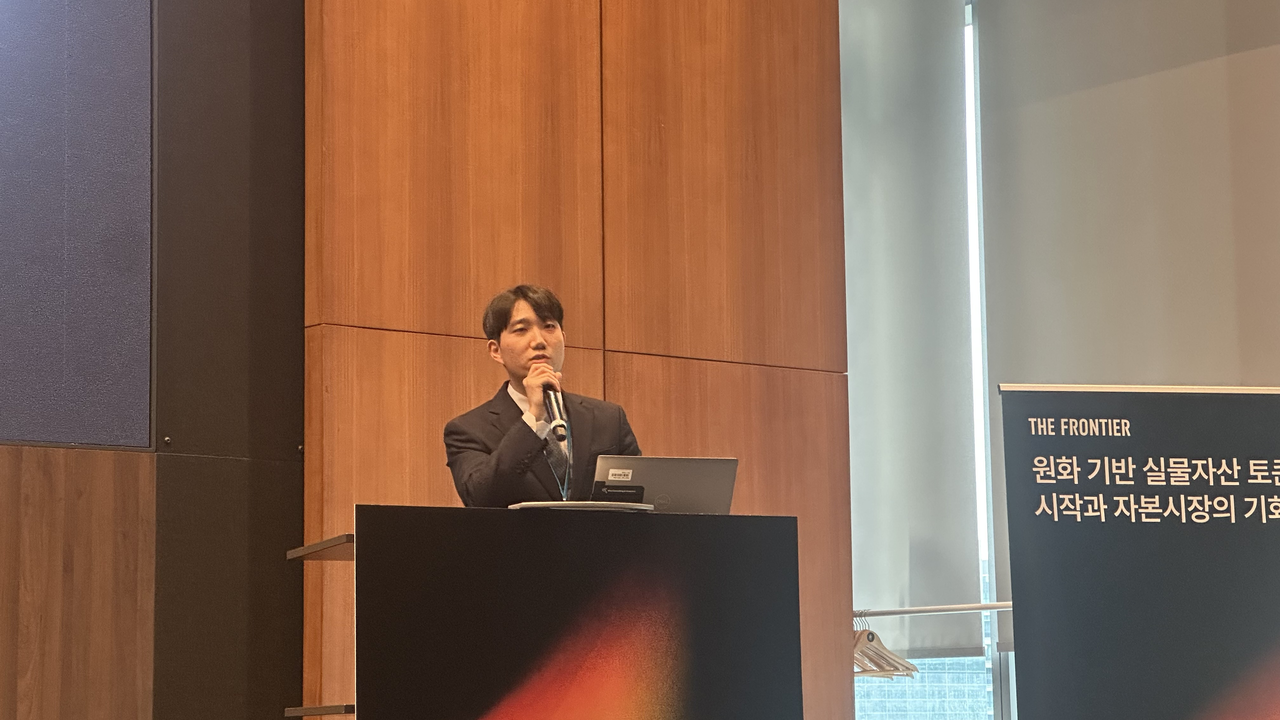
Moon Sung-gil, a director at Visa Korea, made the case at "The Frontier: The Start of Won-Based Real Asset Tokenization and Opportunities in Capital Markets" summit, hosted by Tiger Research and Deloitte at IFC in Yeongdeungpo-gu, Seoul, on Friday. "Simply putting real-world assets on-chain is not enough to fully capture the efficiency gains of tokenization," Moon said. "Efficiency is maximized when payment assets like stablecoins are connected to tokenized assets."
Moon cited three reasons stablecoins are essential to the real-world asset ecosystem: improving transaction and operational efficiency, enabling links to overseas-issued tokenized assets, and broadening the domestic investor base. He noted that stablecoins are highly liquid payment assets convertible into other currencies, and that they are well suited to sophisticated financial techniques such as leverage looping as well as around-the-clock trading.
Stablecoins have recently been expanding their role beyond digital asset trading into everyday payment and settlement. Monthly transaction volumes have roughly doubled year-on-year since late 2024, reaching a peak of around $1.8 trillion.
Their role as a payment instrument is also growing as stablecoin-linked card spending rises. Visa data show stablecoin card payment volumes increased roughly 15-fold compared with the previous year. "The absolute scale is still modest, but it has been growing sharply — doubling every half-year," Moon said. "That pace is far faster than the growth in stablecoin circulation itself."
Among the most prominent products currently on the market are the Redot Pay card, the Ether.fi Cash Visa and the KAST Visa card. These products have drawn on-chain asset holders into everyday spending by offering streamlined payment experiences, customer-tailored services and rewards such as points.
Stablecoin card services do not process every step of a transaction on the blockchain. When a consumer pays using stablecoins held in a digital wallet, authorization runs through the existing card network, and the stablecoins are converted into fiat currency at the settlement stage. The consumer spends on-chain assets while the merchant receives payment in the conventional way — the only change is that the source of funds shifts from a bank account to a digital wallet, while the card network itself remains intact.
"For stablecoins to establish themselves as a payment instrument in the real economy, integration with existing systems is critical," Moon said at the event. "But technical interoperability is only a necessary condition for connecting the on-chain world to the real economy — it is not sufficient on its own."
Ultimately, he argued, card issuers and intermediaries must expand consumer benefits and lower transaction costs to grow the user base. Moon proposed that stablecoin issuers share a portion of the returns earned from managing their reserve assets with distribution partners such as card companies, with those funds then channeled into card rewards.
Open Standard, a stablecoin issuance consortium launched in June, distributes operating returns based on each participant's contribution to distribution. The consortium counts more than 180 members — including Visa, BlackRock, Standard Chartered and Stripe — and plans to launch a dollar stablecoin called Open USD (OUSD) before the end of the year.
Open Standard operates as an independent entity overseen by a board made up of its members, with no single issuer holding ownership. Profits from managing reserve assets such as government bonds — after costs — are distributed to participants according to their contribution to the ecosystem. The consortium is also pursuing a fee-free model for OUSD issuance and redemption, regardless of transaction size.
"In South Korea, the relevant legislation and financial regulatory guidance would need to permit it, but once those regulatory constraints are resolved, domestic financial institutions will be able to enter the OUSD ecosystem through Visa's Visa Stablecoin Platform," Moon said. "Financial institutions that are not existing Visa members will also be able to onboard onto the platform."
He added that the on-chain economy need not insist on a purely blockchain-based framework. "The on-chain economy can spread quickly in the real world only by making the most of the systems and networks that traditional finance has already built," he said.

kyoung@heraldcorp.com