KB succession committee opts for change despite record earnings
Lee Jae-geun vows 'system- and process-driven' organization
Eyes on Kookmin Bank chief, key subsidiary CEO appointments
KB's generational shift expected to ripple across year-end banking appointments
![Lee Jae-geun, named as the next chairman of KB Financial Group, speaks to reporters Monday at the lobby of KB Financial's annex building in Yeouido, Seoul. [Yonhap]](https://wimg.heraldcorp.com/news/cms/2026/09/14/rcv.YNA.20260914.PYH2026091401190001300_P1.jpg)
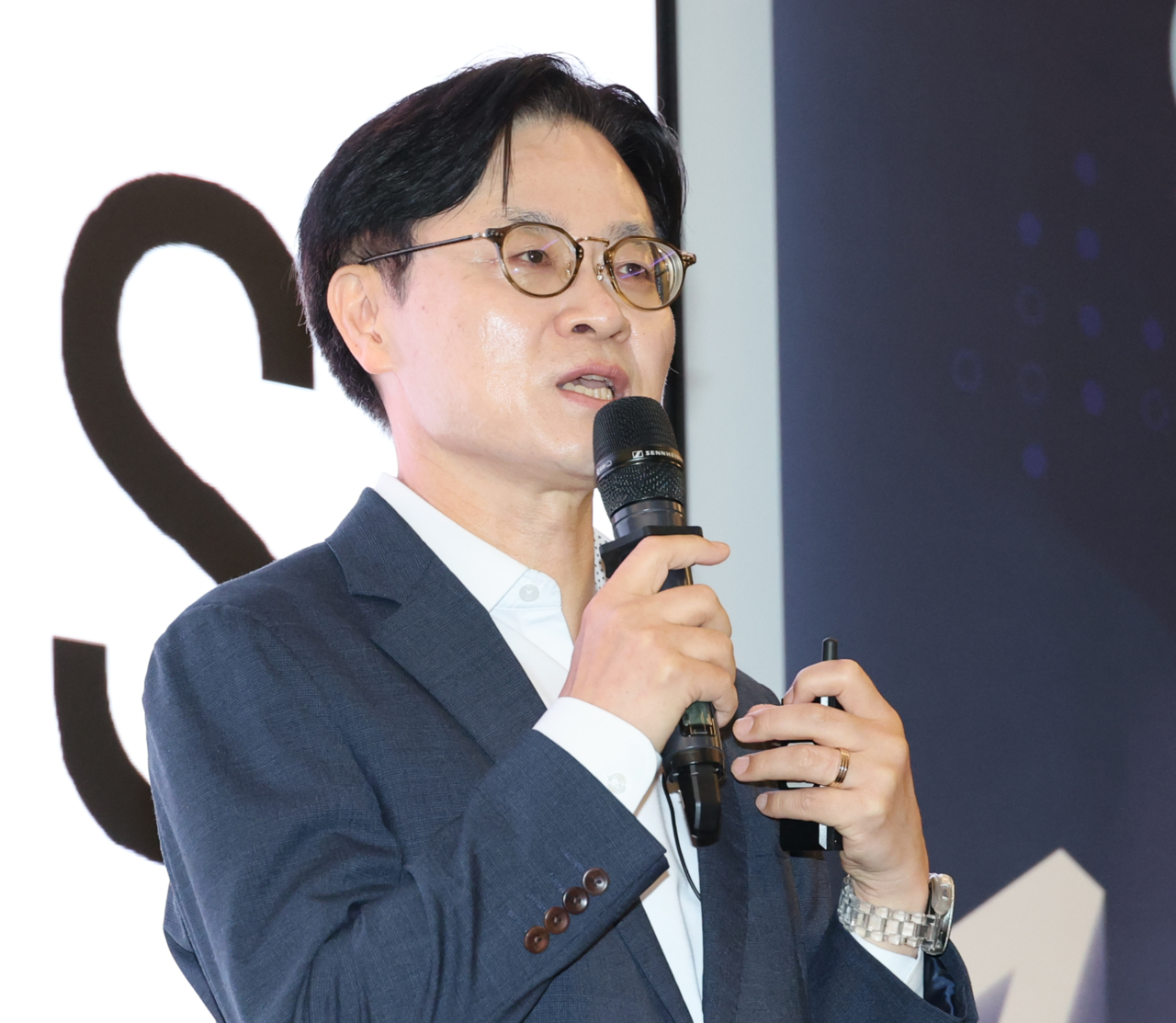
KB Financial Group is preparing to transition to a new era under Lee Jae-geun, even as the group posts record earnings. Lee, the group's head of global, wealth management and small and medium-sized enterprise divisions, was named the sole chairman candidate Monday. He outlined "systems and processes" as his organizational philosophy. With his inauguration set for November, attention is already turning to year-end leadership changes at KB Kookmin Bank and other key subsidiaries. The question now is whether Lee can cement the group's standing as the country's top banking group while pushing forward priorities such as productive finance and wealth management.
Speaking to reporters Monday morning at KB Financial's annex building in Yeouido, Lee said, "I believe the larger a financial group is, the more it must be driven by systems." He added that he would focus on building "an organization that moves through systems and processes rather than one where power is concentrated in the chairman — a decentralized, sustainable organization."
Asked about the possibility of year-end personnel changes, Lee said he had "not yet given it much thought." He said appointments of subsidiary chiefs would need to go through the relevant recommendation committees. On the "generational shift" cited by KB Financial's chairman candidate recommendation committee when it announced its decision, Lee said it was "not a generational shift defined by age, but about enabling faster and more accountable decision-making," emphasizing competence over seniority.
KB Financial's net profit for the period grew from 4.63 trillion won ($3.44 billion) in 2023 to 5.08 trillion won in 2024 and 5.84 trillion won last year. The group also posted 3.88 trillion won in the first half of this year, a record for any half-year period.
Despite that performance, the recommendation committee passed over incumbent Chairman Yang Jong-hee and selected Lee as its final candidate, emphasizing "change" and "generational renewal." Committee Chairman Jo Hwa-jun said the group had reached "a point where bold change and a generational shift are needed to strengthen the group's fundamental competitiveness and secure future growth engines, rather than resting on its current strong results." KB Financial also moved up the succession process by more than a month compared with previous years, extending the candidate vetting period and reducing the disadvantage faced by external candidates.
![Lee Jae-geun, named as the next chairman of KB Financial Group, speaks to reporters Monday at the lobby of KB Financial's annex building in Yeouido, Seoul. [Yonhap]](https://wimg.heraldcorp.com/news/cms/2026/09/14/rcv.YNA.20260914.PYH2026091401250001300_P1.jpg)
Lee served as president of Kookmin Bank for three years starting in 2022 and has overseen the group's global, wealth management and SME divisions at the holding company since last year. If approved at an extraordinary shareholders' meeting on Nov. 20, he will begin a three-year term as chairman the following day. Organizational restructuring and subsidiary CEO appointments are expected to begin in earnest from late November. KB Financial has typically convened its subsidiary CEO recommendation committee in mid-December to select candidates for positions expiring at year-end.
This year, the presidents of several major subsidiaries — including Kookmin Bank, as well as the securities, insurance, credit card and asset management units — are approaching the end of their terms. Lee's move to the chairmanship will also require a successor in his current divisional role at the holding company, potentially widening the scope of year-end personnel changes.
Alongside the year-end appointments, attention is turning to the business agenda Lee will need to tackle. KB Financial plans to deploy a total of 110 trillion won by 2030 — 93 trillion won in productive finance and 17 trillion won in inclusive finance.
Of the 93 trillion won earmarked for productive finance, 10 trillion won will go to a national growth fund, 15 trillion won to direct investment through asset management, securities and investment units, and 68 trillion won to corporate lending in strategic industries.
KB Financial's medium- to long-term strategy also includes redesigning its wealth management and pension business model, strengthening its competitiveness in small and mid-sized corporate banking, expanding group-wide corporate and investment banking collaboration, improving insurance competitiveness and advancing its AI transformation.
The central challenge will be sustaining stable bank-centered earnings while driving growth in capital markets, corporate finance and non-banking businesses. Particularly amid ongoing shifts of funds out of deposits, strengthening wealth management, pension and capital market capabilities — and translating the productive finance push into real profitability — are seen as the defining tasks for the incoming leadership.
![An ATM in Seoul. [Yonhap]](https://wimg.heraldcorp.com/news/cms/2026/09/14/rcv.YNA.20260913.PYH2026091307140001300_P1.jpg)
The failure of KB Financial Group Chairman Yang Jong-hee to secure a second term has cast uncertainty over the futures of other financial sector CEOs whose terms expire this year.
Convention in the banking industry has been for CEOs to serve an initial two-year term followed by a one-year extension. But KB Financial's abrupt break with that tradition has left bank chiefs and other financial executives with no guarantee of renewal, according to industry insiders.
A prominent case is Lee Chan-woo, chairman of NH NongHyup Financial Group, whose term ends in February next year. Lee took office in February last year. NongHyup Financial is expected to begin its search for a successor before year-end. The group has no precedent for a chairman serving beyond a two-year term, apart from former chairmen Kim Yong-hwan and Kim Gwang-su. Former chairmen Son Byung-hwan and Lee Seok-jun both stepped down after completing two-year terms.
Year-end appointments for bank presidents — the core subsidiaries of financial holding companies — are also on the horizon. The terms of Lee Hwan-ju of KB Kookmin Bank, Jeong Sang-hyeok of Shinhan Bank, Lee Ho-seong of Hana Bank, Jeong Jin-wan of Woori Bank and Kang Tae-yeong of NH NongHyup Bank all expire at year-end. Of the five, four are approaching their first renewal; only Jeong Sang-hyeok of Shinhan Bank has previously been reappointed, having received a one-year extension in 2023.
Lee Hwan-ju is widely seen as likely to be reappointed, given that his tenure has been shorter than those of other subsidiary chiefs who have served more than three years. Jeong Sang-hyeok is being discussed as a candidate for a divisional role at the holding company level. Lee Ho-seong, Jeong Jin-wan and Kang Tae-yeong are also considered likely to be renewed on the strength of their management track records.
However, with KB Financial's board having made "generational shift" a watchword, no one in the industry feels entirely secure, according to a broad consensus among financial sector officials. The ruling party and the government are also working toward announcing a plan to improve governance at financial companies by the end of this month, adding further pressure on incumbents hoping to follow established practice.
![KB Financial Group headquarters. [Provided by KB Financial]](https://wimg.heraldcorp.com/news/cms/2026/09/14/news-p.v1.20260821.eb448cef68574806a28a205fc184196c_P1.jpg)
An official at one financial holding company said the governance reform plan was focused on holding company chairmen, but noted "there is no reason it cannot apply to subsidiary CEOs as well," adding that Cheong Wa Dae's criticism of "entrenched positions" was "a message directed at the financial sector as a whole, not just financial holding companies."
A total of 54 CEOs across the five major financial groups have terms expiring at year-end: 10 at KB Financial Group, 12 at Shinhan Financial Group, 13 at Hana Financial Group, 12 at Woori Financial Group and seven at NongHyup Financial Group.
Korea Federation of Banks Chairman Cho Yong-byoung's term also expires in November. Former KB Financial Group Chairman Yoon Jong-kyoo, former SC First Bank President Park Jong-bok and Industrial Bank of Korea President Yoon Jong-won have been mentioned as potential candidates. Sh Suhyup Bank will select its final candidate for bank president on Sept. 22, with incumbent President Shin Hak-gi and Korea Financial Intelligence Unit Director Lee Hyeong-ju seen as the two main contenders.
rim@heraldcorp.com
hyuk@heraldcorp.com