SOC preliminary feasibility threshold raised from 50 billion to 100 billion won
Mandatory tender offer to be introduced to protect minority shareholders
Tax, financial support for SME succession included in talks
32 livelihood bills targeted for passage in regular session
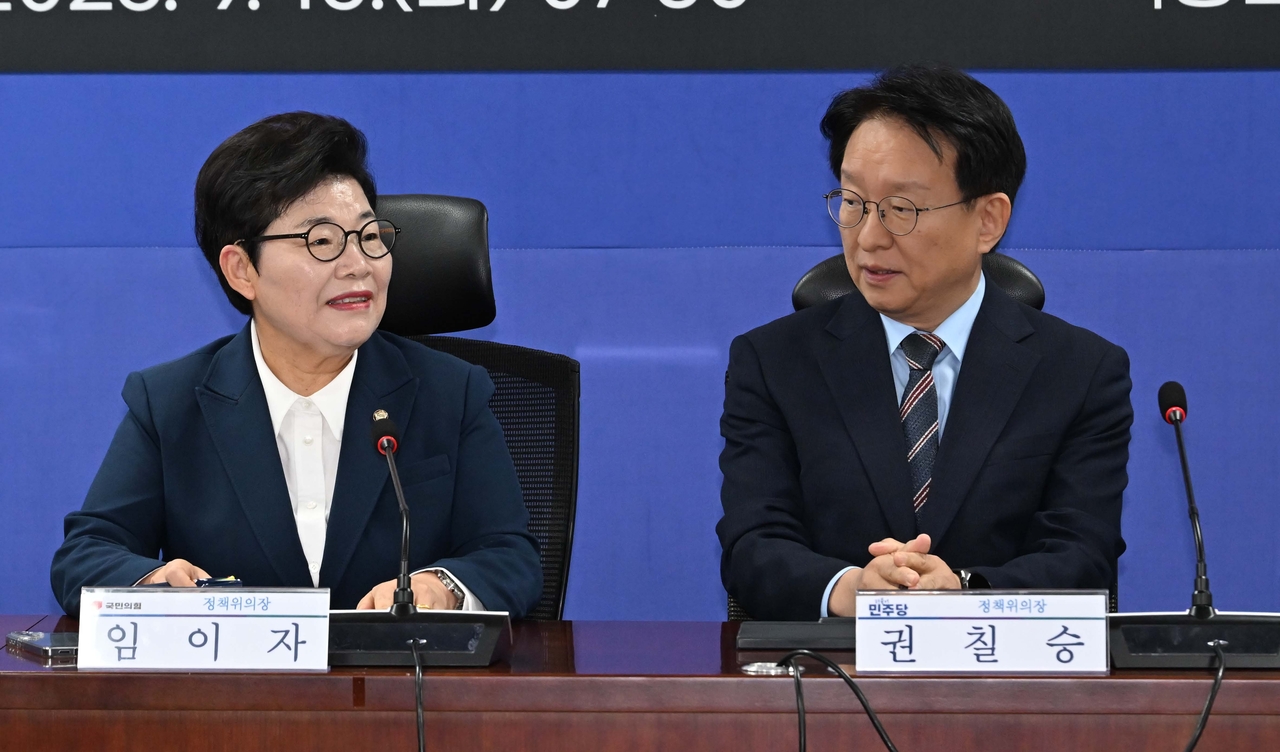
The Democratic Party of Korea and the People Power Party have concluded policy-level talks on raising the preliminary feasibility study threshold for social overhead capital projects and on introducing a mandatory tender offer system to protect minority shareholders.
The two parties' policy committees held a joint livelihood policy meeting at the National Assembly Members' Office Building in Yeouido on Tuesday morning, reaching agreement on both measures. They also agreed to push for passage of 32 livelihood bills — drawn from shared campaign pledges — during the current regular session, and to set up a one-on-one accountability consultative body between the deputy chairs of each party's policy committee to narrow differences on contentious issues such as real estate and taxation.
Democratic Party Policy Committee Chair Kwon Chil-seung said the two sides had identified 32 livelihood bills that both parties had jointly sponsored and were prepared to advance together, including the Emergency Medical Services Act, the Foreign Investment Promotion Act and a special bill on housing for the elderly. "I hope the leadership and standing committees of both parties will work closely together to pass these livelihood bills as quickly as possible," he said.
On infrastructure, the two policy committees agreed to raise the preliminary feasibility study threshold for social overhead capital projects from the current 50 billion won ($37.1 million) to 100 billion won in the interest of balanced regional development, and to increase the ceiling for central government funding from 30 billion won to 50 billion won.
The parties also agreed to push for a mandatory tender offer system to protect minority shareholders. They concluded talks on a special act on small and medium-sized enterprise succession that would broaden the existing concept of family business succession to "corporate succession," extending tax and financial support to third-party transfers and mergers and acquisitions — a response to the aging of SME owners.
Also included in the package is a Digital Disaster Safety Management Act, which would establish safety management obligations for AI-based digital infrastructure and require swift recovery plans and measures to prevent recurrence in the event of outages.
On the national pension, the two sides agreed to expand the childbirth credit recognition period and extend the military service credit from the current 12 months to 18 months. They also shared the view that structural pension reform must accompany these changes.
Kwon cautioned, however, that "the precise expression is that the two policy committees have concluded their consultations — not that a formal agreement has been reached," adding that the bills must still go through standing committee review and receive final sign-off from the floor leaders.
Issues on which the two parties have yet to close the gap are expected to be taken up in a separate consultative body. People Power Party Policy Committee Chair Im Yi-ja proposed at the meeting the creation of a standing "livelihood issues accountability consultative body," under which one deputy policy committee chair from each party would be designated as the point person for key issues including real estate, taxation and social policy.
The two parties agreed to further coordinate on the deputy chairs to be assigned, the agenda and the operating procedures for the consultative body. They are also considering expanding the discussion forum to include lead negotiators from the relevant standing committees if needed.
Im also said the two parties "must put their heads together on ways to expand housing supply — including private-sector reconstruction and redevelopment — to ease the burden of home prices and jeonse and monthly rent costs and deliver real estate solutions that people can actually feel."
Differences remain between the two parties over easing floor-area ratio limits for reconstruction and redevelopment projects. After the meeting, Im said the Democratic Party was willing to accept a ratio of 1.2 times the current limit while the PPP was pushing for 1.3 times. "Because we haven't been able to narrow that gap, we're proposing to set up a one-on-one deputy chair accountability body to work through it," she said.
Im also identified tax reform, police reform and criminal justice system restructuring, pension reform and supplementary legislation on the so-called yellow envelope bill as major issues on which the two parties need to find common ground.
The two parties agreed to coordinate their positions on key agenda items through joint policy forums and to work toward passing the 32 livelihood bills during the regular session. The next joint livelihood policy meeting is planned for after the national audit.
thanks@heraldcorp.com
raining@heraldcorp.com