Cloture vote falls short at 49-50; legislation likely pushed to next Congress
SEC, CFTC set to take lead on crypto regulation for now
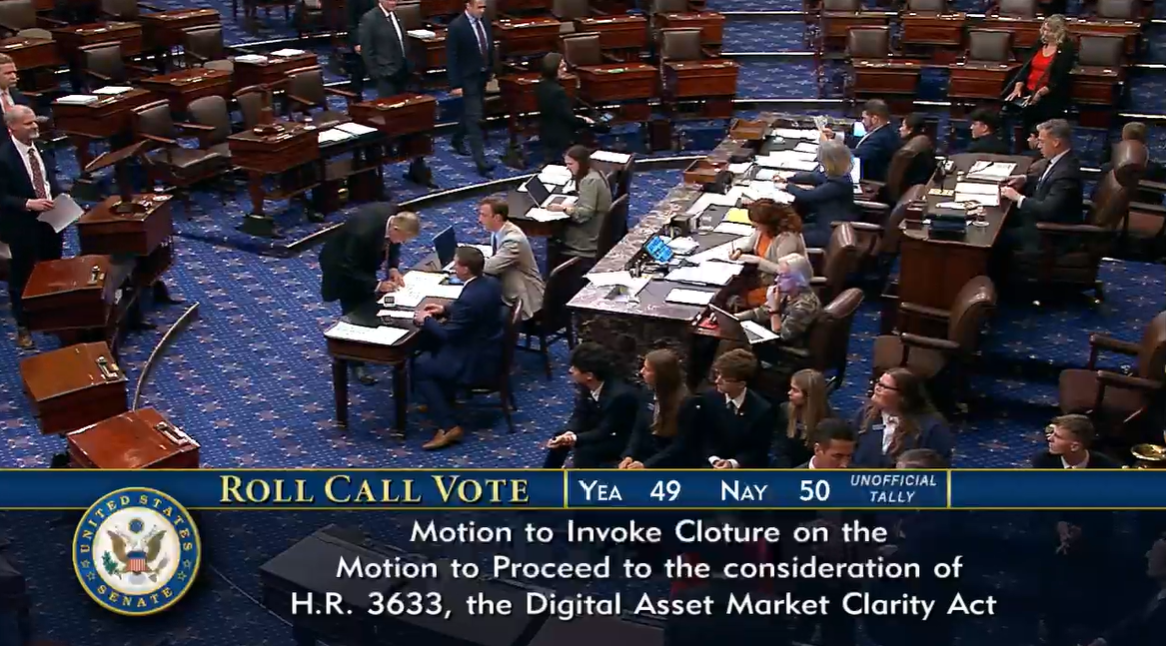
The Clarity Act, a sweeping US digital asset market structure bill, failed to clear the procedural threshold needed to advance to full Senate debate. Republicans had offered a revised version incorporating Democratic demands on government ethics rules, but the two parties could not reach a bipartisan agreement, sharply reducing the chances of the bill passing before the end of the year.
The Senate voted Tuesday (local time) on cloture for the Clarity Act but fell short, with 49 votes in favor and 50 against.
The vote was not a final passage vote — cloture is a procedural step that determines whether the Senate can end debate and proceed with consideration of a bill. With supporters failing to secure even a simple majority, prospects for reviving the legislation in the current session before the midterm elections appear slim.
The Clarity Act would define the jurisdictional boundaries between the SEC and the Commodity Futures Trading Commission, establish registration requirements for digital asset businesses, and set anti-money laundering rules. The US had already enacted the GENIUS Act last year to regulate stablecoin issuance and was seeking to use the Clarity Act to overhaul regulation of the broader digital asset market.
The 635-page final amendment that Republican Sen. Cynthia Lummis released Tuesday (local time) would bar public officials from directly issuing or endorsing digital assets for compensation and prohibit them from holding stakes above a certain threshold in related businesses. President Donald Trump was also said to have voluntarily agreed to the tightened ethics restrictions.
The amendment also expanded enforcement powers for state attorneys general, allowing them to seek injunctions against the US attorney general over ethics violations and to file suit directly against brokers such as exchanges that violate listing prohibitions.
Democrats, however, maintained that the revisions still fell short of addressing conflicts of interest surrounding Trump and his family's digital asset ventures. Democratic Sen. Elizabeth Warren criticized the Republican compromise as "a fig leaf that does nothing to stop President Trump from pocketing another $1.4 billion in crypto profits." She took particular issue with the enforcement structure of the ethics provisions and the potential for exceptions related to Trump family ventures such as World Liberty Financial.
With the vote's failure, US digital asset regulation is expected to advance for now through regulators — primarily the SEC and the CFTC — rather than through Congress. The SEC recently released a proposed framework for registration exemptions covering token issuances by digital asset projects, while the CFTC has also begun developing market structure rules using its existing authority.
Industry observers warn that regulatory rules alone cannot provide the long-term certainty the market needs, since a change in administration can easily shift regulatory direction, underscoring the need for clear statutory frameworks. With Congress effectively entering campaign mode in October ahead of the November midterm elections, the legislative debate is increasingly likely to carry over to the next Congress convening next year.

kyoung@heraldcorp.com