LH to buy vacant Greater Seoul industrial units for public housing
Seoul vacancy rate at 10.7%; 40.7% of units completed within 3 years sit empty
On the ground: 'Please, just buy them all'
Experts: heating, plumbing and parking redesigns pose major obstacles
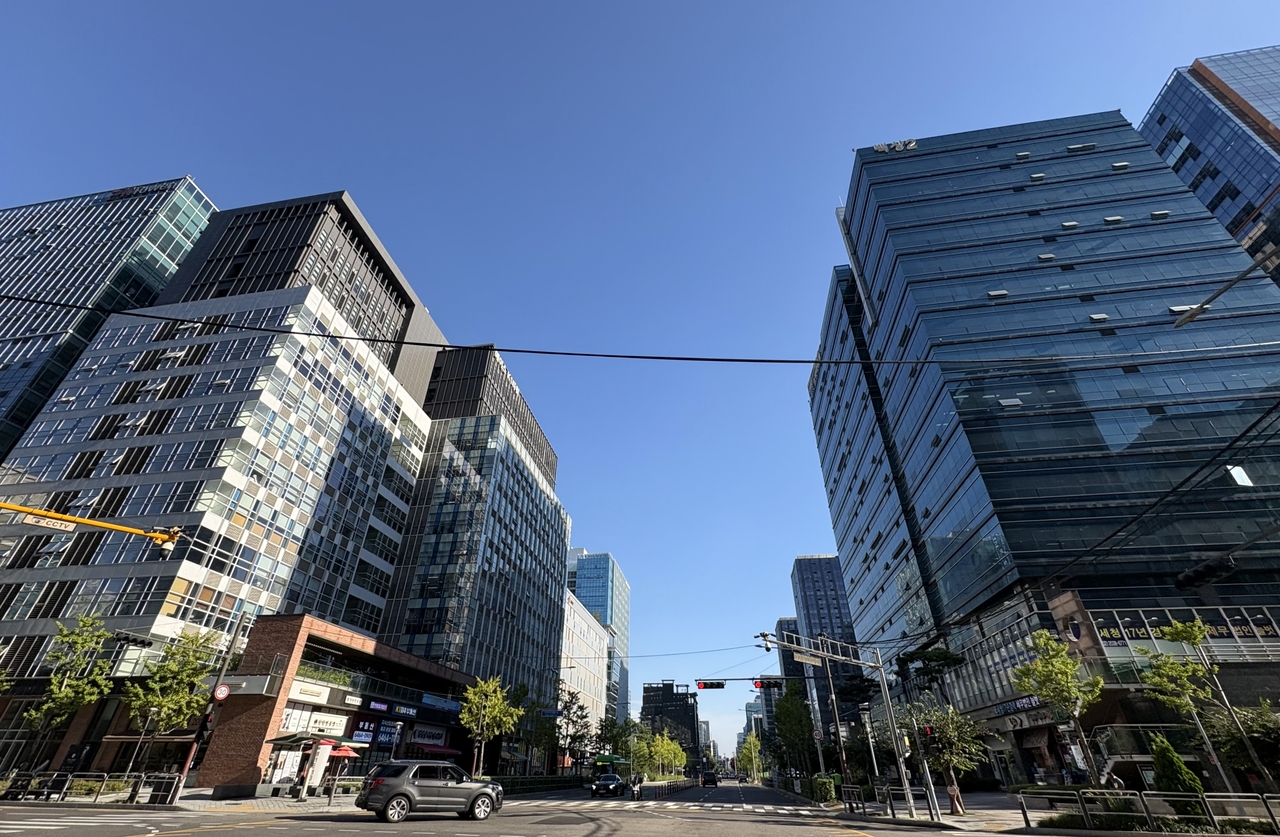
The government plans to convert some knowledge industry centers — multi-tenant commercial buildings that house manufacturers, IT firms and media companies — into public housing for young workers and newlyweds, as it scrambles to ease a deepening shortage of rental homes in the greater Seoul area. The move is designed to bring down the centers' high vacancy rates while adding to the housing supply in the short term.
The response from the field has been broadly positive, with both owners and prospective tenants welcoming the idea. But experts caution that the path from policy announcement to actual housing units is lined with obstacles — from the cost of retrofitting plumbing and parking facilities to the need for local governments to revise their district-unit plans.
Real estate industry sources said Wednesday that since the Ministry of Trade, Industry and Energy recently unveiled its plan to repurpose vacant knowledge industry center units in the greater Seoul area as public housing, market interest in the scope and feasibility of the scheme has been running high.
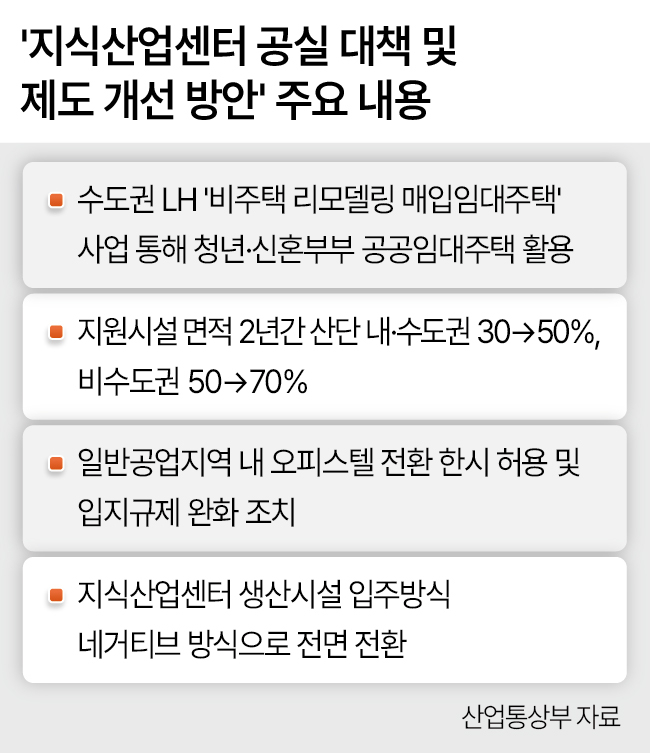
The ministry's reform package, announced Thursday, includes four measures: the Korea Land and Housing Corporation purchasing vacant knowledge industry center units in the greater Seoul area and supplying them as public rental housing for young workers and newlyweds; a temporary allowance to convert vacant and unsold units in general industrial zones into officetels; an exemption from the obligation to secure additional parking spaces and a deferral of acquisition tax recoupment triggered by a change of use; and a full shift to a negative-list system for regulating the types of businesses permitted to move in.
Built and empty: vacancy rate hits 41% for Seoul centers completed within 3 years
The government's push to repurpose non-residential knowledge industry centers as housing reflects a dual calculation: bring down vacancy rates while accelerating housing supply. With rental market pressures mounting across the greater Seoul area, officials see converting already-completed but empty buildings as faster than acquiring new land and building from scratch.
The greater Seoul rental market is facing a severe supply-demand imbalance. The designation of land transaction permit zones and regulated areas across all of Seoul and 15 districts in Gyeonggi Province, combined with tighter restrictions on jeonse loans, has shrunk the supply of jeonse listings and deepened housing insecurity for lower-income residents.
According to real estate platform Asil, Seoul apartment jeonse listings stood at 20,529 as of Wednesday — down about 12 percent from 23,320 a year earlier. A spillover effect has pushed demand into Gyeonggi Province, where apartment jeonse listings plunged 41.6 percent over the same period, from 21,054 to 12,309. Incheon also saw a 34.8 percent contraction, from 4,135 listings to 2,699.
The government has pledged, through its Aug. 13 housing package, to supply at least 1.47 million units in the greater Seoul area during the current administration's term. But proposed supply sites have drawn pushback from local residents, and experts say the front-loaded presale structure of Korea's housing market makes it difficult to move quickly from announcement to groundbreaking and completion. The Korea Construction Industry Institute said of the Aug. 13 package: "Most domestic housing supply relies on a presale structure that draws on buyers' own funds. Without effective demand-stimulation measures, developers' capacity to raise project financing will inevitably be constrained."
Repurposing existing knowledge industry centers could also relieve the financial strain on developers and unit holders whose capital has been tied up by unsold inventory. The centers — mixed-use commercial buildings that cluster businesses from manufacturing, IT and media under one roof — had attracted investors as an alternative asset class, partly because they faced lighter regulation and lower rents than residential properties. But a deteriorating economy and prolonged high interest rates have eroded their profitability and dampened demand.
As of last May, the national average vacancy rate for knowledge industry centers stood at 16.6 percent and the unsold rate at 9 percent, according to the ministry. Seoul's vacancy rate was a relatively contained 10.7 percent, but that figure jumped to 40.7 percent when narrowed to centers completed within the past three years.
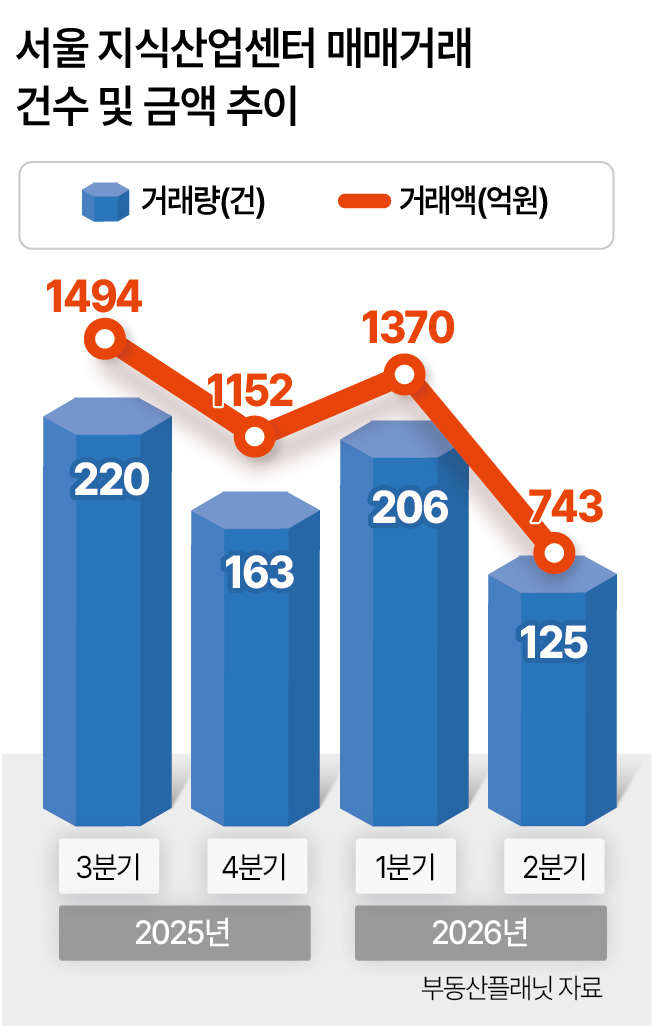
The sales market has frozen alongside rising vacancies. According to real estate data firm Real Estate Planet, transaction volume for Seoul knowledge industry center units in the second quarter of this year fell to 125 deals — down 39.3 percent from 206 in the first quarter. The total transaction value dropped 45.8 percent over the same period, from 137 billion won ($101 million) to 74.3 billion won.
'Please, just buy them all': owners welcome LH intervention as distressed sales pile up
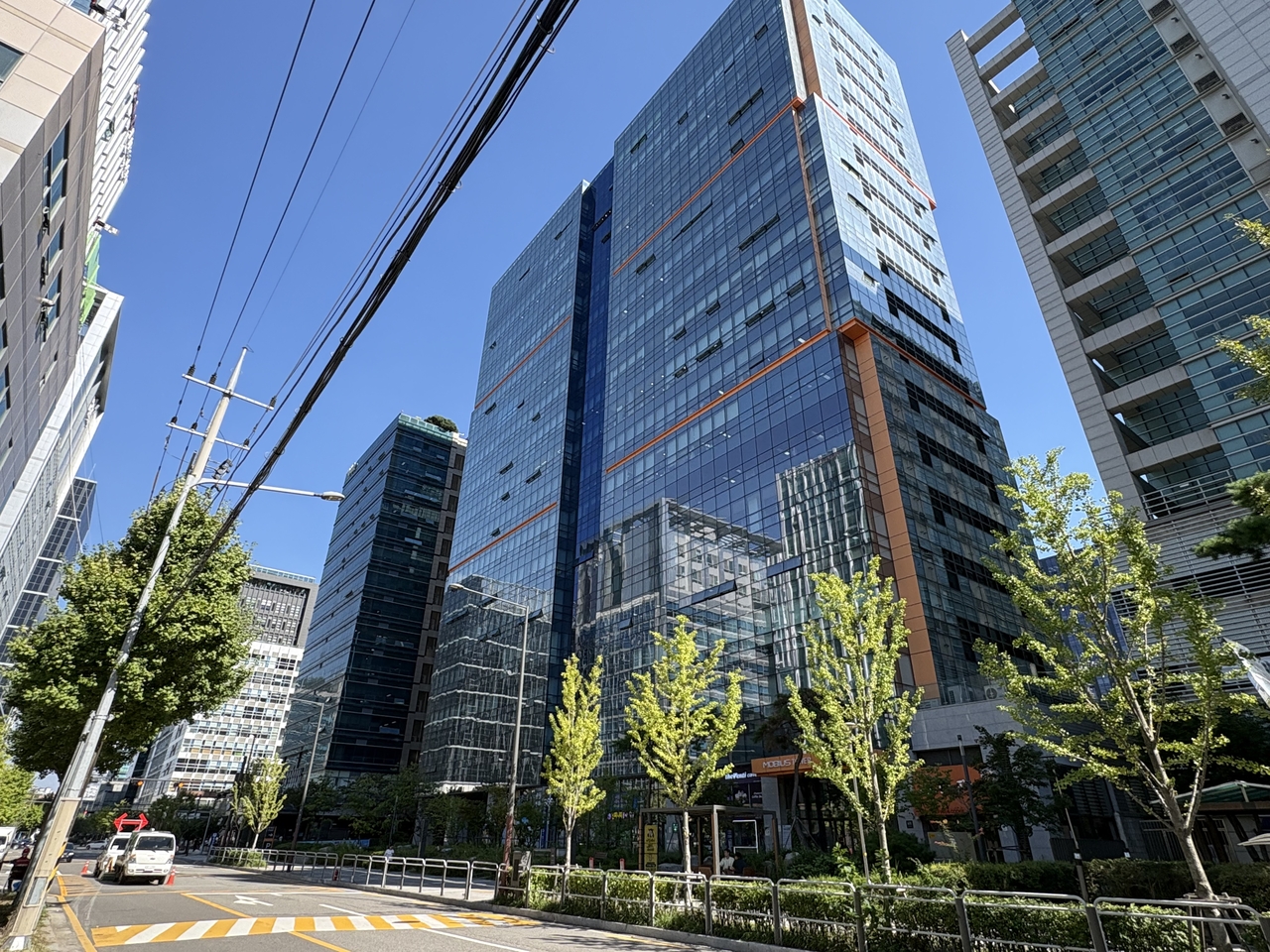
On the ground, expectations are growing that converting knowledge industry centers into public housing could provide meaningful near-term relief for the housing supply. Real estate agents near Gasan Digital Complex station in Geumcheon-gu, Seoul — visited Monday afternoon — said the policy would be welcomed by both center owners and the workers in the area looking for somewhere to rent.
"Four years ago prices reached 17 million won per 3.3 square meters, but now the market has completely collapsed — distressed listings are coming in at around 9 million won," said the head of real estate agency A in Gasan-dong. "If LH says it will buy, I think applications will flood in. I just hope they buy every single one."
The same agent added that even in Seoul, where vacancy rates are comparatively low, a fair number of owners who bought multiple units for their own use or to rent out are suffering from empty space. "These days it's hard enough to cover loan interest, and business conditions are tough, so the general mood is one of welcome," he said.
Distressed and auction listings are easy to find in the market. The head of real estate agency B, located inside a knowledge industry center about a 10-minute walk from Gasan Digital Complex station, said vacancies account for 10 to 20 percent of total units in the building, with auction listings — including those in progress or already awarded — making up another 10 percent or so. "Transactions have almost dried up. Only well-capitalized companies are stepping in to buy at the bottom, and even then it's rare and mostly for larger units," he said.
The building housing agency B had three vacant units even on its ground floor, which typically draws the highest foot traffic and tenant demand. "Owners who acquired units through auction sometimes list them for about 1 million won less than the going distressed price," the agent said. "If LH comes in to buy, negotiations should be fairly straightforward."
A shortage of worker housing in the Gasan area has added to the sense of anticipation. "Six or seven people a day come in looking for dormitory-style accommodation, but I often have nothing to show them and have to turn them away," the agent at agency B said. "As long as people don't mind being surrounded by offices, it should work out fine." The head of agency A agreed: "This neighborhood is severely short on residential space — workers are being pushed out to areas like Sindorim — so demand for housing close to work will be strong."
The proximity of many Seoul knowledge industry centers to subway stations is another factor fueling expectations of demand. An analysis of the 381 knowledge industry centers in Seoul as of February found that 234, or 61.4 percent, were within 500 meters of the nearest subway station. Another 139 were between 500 meters and 1 kilometer away, and only eight were more than 1 kilometer from a station.
By district, Geumcheon-gu — home to Gasan Digital Complex — had the most centers at 133, followed by Seongdong-gu with 72, Guro-gu with 60, Yeongdeungpo-gu with 48 and Gangseo-gu with 27.
On the ground, however, questions have emerged about how broadly the policy would actually apply. "After the announcement, I got quite a few calls from owners who had seen the news asking whether they were eligible," said the head of one real estate agency in Gasan-dong. "But Gasan and Guro are national industrial complexes where even move-in registration is strictly controlled. Realistically, I think the centers in Gyeonggi Province are the more viable candidates."
'Lifting regulations alone won't make homes': heating, plumbing and parking remain steep hurdles
Experts were united in saying that converting a building designed for commercial use into livable residential space involves far more than relaxing zoning rules. Simply lifting use restrictions, they said, will not automatically turn vacant units into homes.
"To use a space residentially, you need heating and bathrooms, so construction timelines and profitability both have to be factored in," said Seo Gwang-chae, a professor in the real estate department at Hanyang Cyber University. "There is also the potential for conflict between existing business tenants and new residents." A construction industry official with direct experience on knowledge industry center projects said the finishing requirements for residential and non-residential buildings differ substantially — covering heating pipes, water supply and electrical systems — making full remodeling necessary. "Construction could be completed within a year, but existing office tenants would likely face noise and dust during the work," the official said.
Kwon Dae-jung, a distinguished professor in the economics and real estate department at Hansung University, said that while government acquisition at current depressed prices was feasible, private owners carrying loan burdens would find it difficult to fund the conversion themselves. "Prices have fallen so far that government purchase and repurposing is entirely plausible, but it won't be easy for private owners burdened with debt to take on the additional cost of conversion," he said.
Concerns were also raised about the limits of remodeling alone as a path to stable residential environments. "Because the floor areas are larger than those of officetels, new walls would have to be built and bathrooms installed — and that means reworking the load-bearing design from the ground up," said Lee Eun-hyung, a senior researcher at the Korea Research Institute for Construction Policy.
Lee also flagged local government district-unit plans as a factor that cannot be overlooked. "District-unit plans drawn up by local governments to shape desirable environments are not something you can resolve with a single signature," she said. "There is nothing wrong with exploring every possible way to make use of vacant space, but the moment you start saying you will supply large numbers of homes through knowledge industry centers, you will find there are no easy answers."
Detailed criteria have yet to be established, and the number of variables to be worked through during actual conversion is considerable. Knowledge industry centers, for instance, are not subject to the per-household parking requirements that apply to apartment buildings. The standard for commercial facilities is one space per 150 square meters of floor area — a benchmark that would be difficult to meet if the buildings were reclassified as residential.
"There are quite a few regulations that apply to buildings where people live — from the number of elevators to parking requirements to unit sizes — and construction costs will vary enormously depending on what exemptions are granted and how far the relaxations go," said Jeon Yeong-jun, head of the research center at the Korea Construction Industry Institute.
Jeon added that while knowledge industry center developers struggling with unsold units had long been pushing for a change-of-use option, and both the government and the ruling party were actively backing housing supply expansion, the current policy still looked more like a statement of direction than a concrete plan. "This is also a matter that cuts across multiple departments within the Ministry of Land, Infrastructure and Transport, which will be responsible for drafting the subordinate legislation," he said.

shy@heraldcorp.com
hwshin@heraldcorp.com