Prime locations in Daegu's Suseong-gu and Daejeon's Dunsan-dong hit new price records
Investors shut out of Greater Seoul turn to top-tier regional apartments
Sharp contrast as some complexes sit unsold even after discounts of over 100 million won
![An apartment complex in central Daegu. [Herald DB]](https://wimg.heraldcorp.com/news/cms/2026/09/16/news-p.v1.20260103.f7ab3081be5a40708a56f83df1a3025d_P1.jpg)
Suseong Beomeo W, the top-tier complex in Beomeo-dong, Suseong-gu, Daegu, sold an 85-square-meter unit on Aug. 23 for a record 1.825 billion won. A unit on a similar floor in the same neighborhood sold for 1.325 billion won in February, meaning the price rose 500 million won in roughly six months.
Apartment complex A in Dalseo-gu, Daegu, which still has unsold units, is currently offering discounts of up to 90 million won off the original pre-sale price, along with interest-free installment financing and a free balcony extension — but buyer sentiment remains frozen and sales have been slow.
As tax tightening and lending restrictions deepen the price divergence between mid-range and high-end housing in Seoul, a similar polarization is sharpening in regional real estate markets — between prime locations and outlying areas. Top-tier apartments in major regional cities are changing hands at prices rivaling Greater Seoul and setting new records, while elsewhere developers cannot clear unsold inventory even after discounts of more than 100 million won.
Record-price transactions have been reported across major regional cities including Gwangju, Daegu, Daejeon and Busan, according to the real estate industry Wednesday. Some prime complexes have gained hundreds of millions of won in a matter of months, a pace comparable to the metropolitan area.
A 187-square-meter unit at Trump World Marine in U-dong, Haeundae-gu, Busan, sold on Aug. 29 for a record 2.91 billion won ($2.15 million), putting it within reach of the 3 billion won mark. The same floor plan sold for 2.7 billion won in July last year, a gain of 200 million won in roughly a year. Nearby, an 84-square-meter unit at Centum Martian also set a record on Aug. 28, selling for 725 million won.
A 59-square-meter unit at The Beach Prugio Summit in Daeyeon-dong, Nam-gu, Busan, set a new high on Aug. 25 at 1.075 billion won, up more than 100 million won from its actual transaction price of 950 million won in January. That figure far exceeds the average sale price for 59-square-meter apartments in the metropolitan area last month — 635.28 million won, or 10.77 million won per square meter, according to KB Real Estate data.
In Dunsan-dong, Seo-gu, Daejeon — widely regarded as the city's top school district — a 92-square-meter unit at Hanmaru crossed the 1 billion won threshold for the first time on Aug. 20. A 101-square-meter unit in the same complex also set a record on Sept. 4, selling for 1.2 billion won.
Record transactions have also been rolling in across the Jeonnam-Gwangju Special City, which has drawn strong attention in recent months over plans for an 800 trillion won southwestern semiconductor cluster. An 84-square-meter unit at Naju Station Xi River Park in Songwol-dong, Naju, sold for a record 440 million won on Aug. 29. In Gwangsan-gu, adjacent to the planned cluster site, an 84-square-meter unit at Eunbit Maeul Moa El'ga sold Saturday for 650 million won — crossing the 600 million won mark for the first time. The same unit type had sold for 570 million won on June 12, a gain of 80 million won in three months.
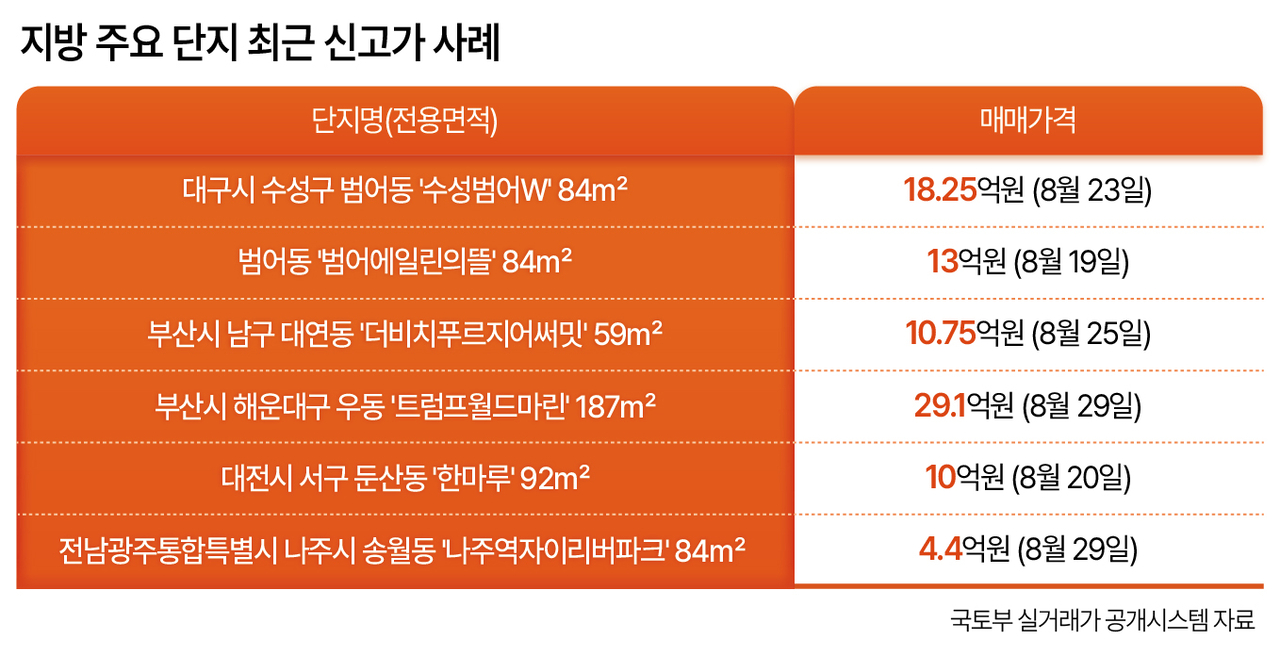
The record-price run at prime regional complexes reflects a sustained preference for a single high-quality property over multiple holdings. Analysts say that as owner-occupancy requirements and other restrictions on gap investment — buying with a jeonse tenant to cover the purchase — have effectively shut investors out of apartments across Seoul and 15 regulated areas in Gyeonggi Province, wealthy regional buyers are funneling their capital into the best addresses in their own cities.
"Just as demand from wealthy buyers concentrates on Apgujeong and Banpo in Seoul, demand in regional markets is converging on the top complexes in prime locations," said Ko Jun-seok, a professor at Yonsei University's Sangnam School of Management. "Because buying Seoul apartments for investment purposes is now difficult, buyers are turning their attention to top-tier regional complexes, and that is driving prices higher."
Outside those prime addresses, however, the picture is starkly different. The leading complexes have pulled the overall regional apartment sale price index — tracked by the Korea Real Estate Board — out of its decline since the first week of June, leaving it flat or edging up. But conditions on the ground for housing projects are deteriorating.
The Housing Industry Research Institute's regional housing business outlook index tumbled 11.2 points in September to 77.9, a sharp contrast with Seoul, where the equivalent index rose 4.4 points from 92.8 to 97.2 last month. Unsold regional units stood at 48,758 as of July, including 24,708 units classified as hard-to-sell inventory — units that remain unsold after completion. That compares with 17,229 such units at the end of 2024, a jump of 43.4 percent in roughly a year and a half.
Construction companies have responded with steep discounts and generous financing terms in a push to clear inventory, but progress has been slow. One apartment complex in the Jeonnam-Gwangju area cut its pre-sale price by 130 million won below the original asking price in an attempt to move unsold units.
The preference for a single prime property in regional markets is expected to persist for now.
"Unlike in Seoul, where record-price news tends to lift prices across the board, the buying concentration in regional markets will remain focused on prime complexes rather than spreading citywide," Ko said. "Unless incentives such as tax benefits for rental business operators are extended to unsold regional housing, clearing that backlog will not be easy."
hwshin@heraldcorp.com