Interview with Jusung Engineering Chairman Hwang Chul-joo
Set to speak at Herald Business Forum 2026
'Need infrastructure that recognizes the 1% of true innovation'
'We must now be the ones who set the standard'
A first-generation venture entrepreneur who achieved equipment localization
Has walked the path of innovation guided by the spirit of self-reliance
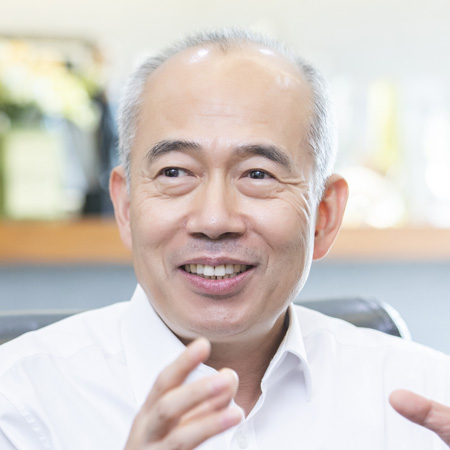
"The goal of being No. 1 and the goal of being No. 2 are fundamentally different. Korea has now reached the point where it must aim for first place. We have to travel a road no one has taken before. The path of an innovation economy and the path of an imitation economy are 180 degrees apart."
Jusung Engineering Chairman Hwang Chul-joo doubled down on the distinction between innovation and imitation in an interview Thursday. "Unlike imitation or incremental improvement, innovation cannot be planned," he said. "Innovation creates new markets, and it can only bear fruit when the demands of the era, the environment, the market and technological goals all converge at once."
He said Korea's semiconductor industry stands at exactly such an inflection point. Where the core competitive edge once lay in raising production efficiency and cutting costs, the ability to create products that command greater value in the market — even at higher cost — has become what matters most.
"Until now, someone else had already gone ahead and set the standard, and all we had to do was follow it," Hwang said. "But now there are fields where no one is out in front. We have to be the ones who set the standard."
He identified "the ability to create new standards" as the central challenge Korean industry must solve going forward. Korea grew by following the technologies and markets that advanced countries and leading companies had already built — but in the fields where Korea has now taken the lead, those existing standards to follow have disappeared. He cited HBM as the prime example.
"When you are No. 2, you just chase No. 1, so you do not need to take on great risk," he said. "But when you are No. 1, there is no one to chase. You ultimately have to forge a new path yourself and overcome the risks that arise along the way."
He said Korea's industrial environment must also shift to suit innovation rather than imitation, and he placed particular emphasis on what he called "incubating time" — the period a company must endure before the fruits of innovation appear.
"Korea lacks the capital-market support, financial firepower and economic environment needed to sustain that incubating time," Hwang said. "Because of that, there are many heartbreaking cases where innovation never reaches fruition and simply disappears."
He went on to say that infrastructure must be built to ensure that the 1 percent of genuine innovation receives proper recognition in the market, backed by a system that protects and nurtures it.
"The state must be capable of correctly identifying and cultivating innovative companies," he said. "Investors, too, must look beyond immediate sales and profit and ask what kind of markets and value a company can create in the future."
He said innovative products in particular require institutional mechanisms that open the door to market entry. "Innovation is not something to be managed — it is something to be nurtured," Hwang said. "If you block the market, innovation dies."
He added that the government's own perspective must change for Korea to become a technology powerhouse. "You cannot cross over into an innovation economy simply by working a little harder or doing a little better within the imitation-economy framework," he said.
Hwang, regarded as a first-generation venture entrepreneur, founded Jusung Engineering in 1993 with the dream of achieving technological independence for Korea. After witnessing a domestic industry that could not even produce a single screw for semiconductor manufacturing equipment, he threw himself into entrepreneurship driven solely by a passion for homegrown technology.
More than 30 years on, Jusung Engineering has grown into a front-end process equipment maker serving the semiconductor, display and solar cell industries. Having succeeded in localizing key semiconductor front-end process equipment, the company is now leading the globalization of Korean semiconductor equipment, with atomic layer deposition equipment among its flagship products.
A framed inscription reading "jagangbulsik" — meaning "strengthen yourself ceaselessly, never rest" — hangs in Hwang's office, a reflection of his management philosophy: never settle for existing methods, but innovate and challenge without pause.
Hwang is scheduled to deliver a lecture titled "New Standards Create New Growth!" at the Herald Business Forum 2026, to be held at the Shilla Hotel in Jung-gu, Seoul, on Sept. 29.
go@heraldcorp.com