Ministry of Land finds 'false and misleading advertising' most common violation in year-long review of online platforms
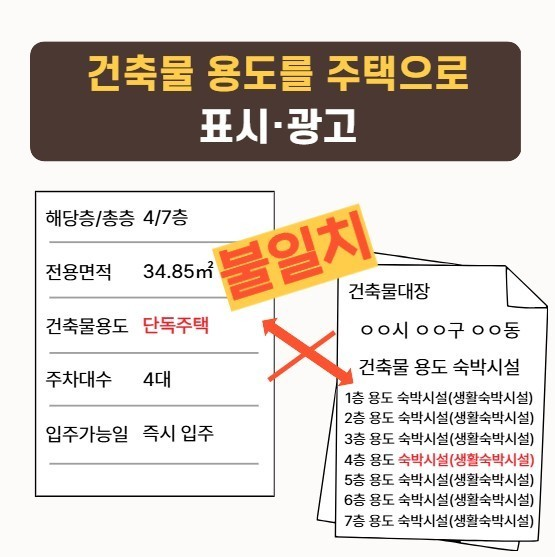
More than 10,000 illegal real estate advertisements were flagged over the past year, including cases where lodging facilities were falsely listed as single-family homes.
The Ministry of Land, Infrastructure and Transport said Friday it had reviewed real estate listings posted on online platforms — including Naver Pay Real Estate, Zigbang and Dabang — from July 2025 through June this year, identifying 10,412 suspected violations and calling on local governments to impose fines or refer cases for investigation.
The vast majority of cases — 9,383 — were flagged through ongoing public tip-offs, while a further 1,029 were uncovered through targeted monitoring of repeat offenders and specific individuals. Under the Licensed Real Estate Agents Act, false or misleading advertising can carry fines of up to 5 million won ($3,650), while violations of mandatory disclosure requirements can result in fines of up to 500,000 won.
Among the cases identified through ongoing monitoring, false or misleading advertising — such as misrepresenting a property's designated use, floor area or included amenities — accounted for 5,201 cases, or 55.4 percent. Violations of mandatory disclosure requirements, including the omission of essential information such as floor area and price, made up 3,753 cases, or 40 percent. Advertisements placed by unlicensed individuals, rather than registered real estate agents, accounted for 429 cases, or 4.6 percent.
In specific cases, properties officially classified in building registers as neighborhood living facilities, lodging facilities or office buildings were openly advertised as multi-unit homes, single-family homes or apartment complexes. False disclosures about financial encumbrances such as mortgage loans were also common. In one example, a listing stated "no mortgage" while the property's registry showed a collateral mortgage of more than 1 billion won.
To help consumers avoid falling victim to such illegal listings, the ministry said buyers should verify that key property details — including designated use, floor area, outstanding loans, address and any building code violations — match official records such as building registers and property registry documents before signing a contract. The ministry also urged consumers to confirm whether the listing agent is a registered real estate broker through the relevant local government or the V-World real estate brokerage lookup service, and to exercise particular caution when a listed price is significantly higher or lower than the surrounding market price.
In addition, the ministry called on the public to actively report suspected illegal online real estate listings through the Real Estate Illegal Activity Integrated Reporting Center.
Shin Yun-geun, the ministry's land policy director, said the government would continue to strengthen monitoring of false and exaggerated real estate advertising. "We will do our utmost to create a transparent real estate market environment where anyone can transact with confidence," he said.
Meanwhile, the ministry said it had revised the system in the second half of this year to exempt advertisers from fines if a listing was removed within three days of a request from the registering authority due to a simple mistake. At the same time, the revisions introduced fines for deceptive practices such as using a sold property to lure prospective buyers toward other listings.
smh@heraldcorp.com