The Kospi, which climbed as high as 9,385 during intraday trading in June, could fall below the 5,200 level in the first half of next year, according to a market forecast.
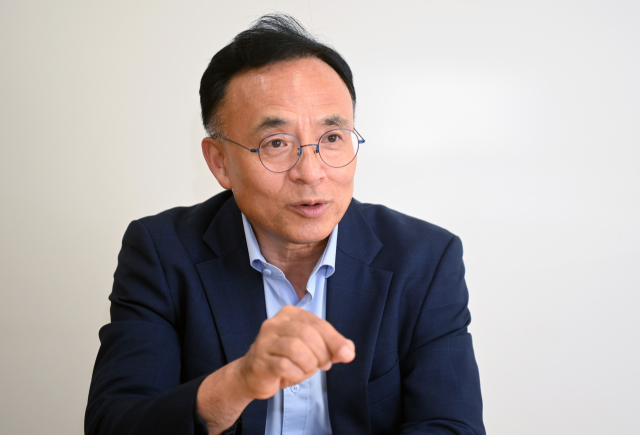
KBS's YouTube channel "Money Olla" released an interview with Kim Young-ik, adjunct professor at Sogang University's Graduate School of Economics, on Tuesday. In the video, Kim assessed recent global economic trends and offered his outlook on the domestic stock market and exchange rates.
Kim identified the Kospi's intraday peak of 9,385 in June as the top of the current rally cycle, saying the index has since entered a downward phase. Factoring in typical stock market cycles, he said the decline could last more than a year.
Kim said further losses are possible even after the Kospi recently slipped to the 5,200 level during intraday trading. He said the bottom of this down cycle has yet to be reached, adding, "It could fall even further below that level in the first half of next year."
Kim pointed to US government bond yields as one factor behind the outlook. He said the 10-year US Treasury yield's recent intraday move above 5 percent could weigh on risk assets such as shares. International oil prices, which have topped $106 per barrel, were also cited as a source of uncertainty for the inflation and interest rate outlook. He additionally flagged the so-called "AI semiconductor slowdown theory" — the idea that growth in the AI semiconductor industry may be losing momentum — as another risk to the market.
Kim also raised the possibility of a bubble in AI-related stocks. "In the late 1990s, a bubble formed in the NASDAQ market and then burst, with the index falling 80 percent from its peak in the 2000s," he said. "Right now, too much money has poured into the stock market on AI expectations, creating a bubble. There is a chance this bubble will burst soon — I think it will start in the fourth quarter of this year."
On the won-dollar exchange rate, Kim forecast a short-term rebound followed by a medium- to long-term decline. "The exchange rate has fallen sharply from 1,550 won to 1,340 won, and it will bounce back," he said, while noting that "from a trend perspective, a medium-term decline from 1,550 won toward the 1,200-won range has begun."
On asset allocation, Kim said investors should increase their holdings of cash and cash equivalents. "When the leading index was rising, I advised boldly increasing equity exposure, but now that it is falling, investors should reduce their share holdings and build up cash assets," he said. "The benchmark is Statistics Korea's composite leading index cycle variation, which appears to have peaked in August and is now turning down."
min3654@heraldcorp.com