![Visitors browse exhibits at the Next-Generation Semiconductor Packaging Industry Exhibition held at Suwon Convention Center in Suwon, Gyeonggi Province, on Aug. 26. [Yonhap]](https://wimg.heraldcorp.com/news/cms/2026/09/22/rcv.YNA.20260826.PYH2026082607480006100_P1.jpg)
Semiconductor stocks, which had been shaken by concerns over a deceleration in AI investment, are staging a comeback — and ETFs tied to the sector swept the top return rankings over the past week.
After chipmaker AMD surged nearly 10 percent overnight in the United States, Samsung Electronics and SK hynix both climbed in early trading Tuesday, signaling a shift in market sentiment from caution to optimism. The rally is also broadening beyond the memory chips that Samsung and SK hynix specialize in, with related ETFs now expanding into materials, equipment and power infrastructure.
According to Koscom ETF Check data released Tuesday, all of the top-performing ETFs over the past week (Sept. 15–21) were leveraged semiconductor products. Single-stock leveraged ETFs tracking Samsung Electronics and SK hynix dominated the top 10 spots, each posting returns exceeding 20 percent.
Other products — including TIGER US Philadelphia Semiconductor Leverage, TIGER Semiconductor TOP10 Leverage and KODEX Semiconductor Leverage — also posted returns approaching 20 percent.
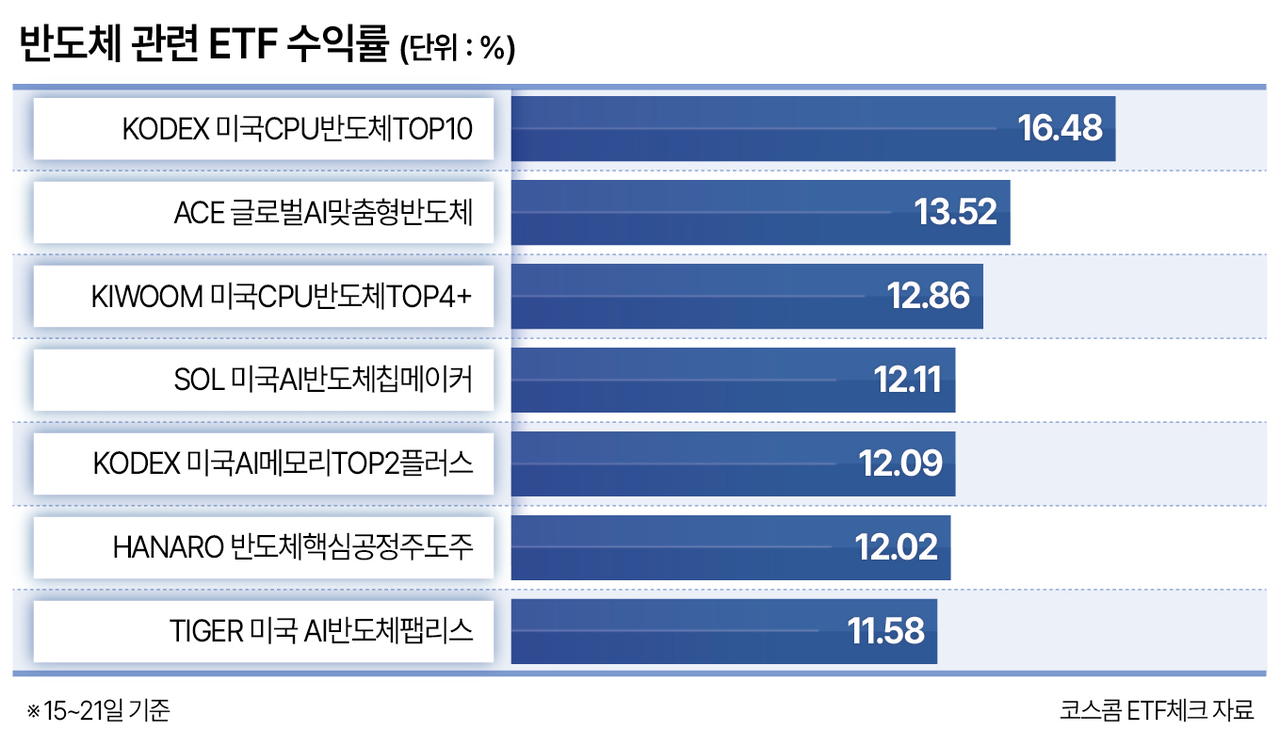
Non-leveraged ETFs told a similar story. KODEX US CPU Semiconductor TOP10 led all non-leveraged ETFs with a one-week return of 16.48 percent.
Several others also cleared the 10 percent mark: ACE Global AI Custom Semiconductor (13.52 percent), KIWOOM US CPU Semiconductor TOP+ (12.86 percent), SOL US AI Semiconductor Chipmaker (12.11 percent), KODEX US AI Memory TOP2 Plus (12.09 percent), HANARO Semiconductor Core Process Leader (12.02 percent) and TIGER US AI Semiconductor Fabless (11.58 percent).
The gains were driven by broad strength in individual semiconductor stocks. Samsung Electronics rose nearly 5 percent Monday, recovering the 270,000 won ($195) level for the first time in 10 trading sessions since Sept. 7. SK hynix (up 0.59 percent), Hanmi Semiconductor (0.21 percent), Wonik IPS (6.17 percent), EO Technics (6.73 percent) and DB HiTek (4.60 percent) also advanced, lifting the KRX Semiconductor Index 3.44 percent — the highest gain among all sector indexes.
The momentum carried into Tuesday. As of 10 a.m., Samsung Electronics and SK hynix were up 2 percent and 3 percent, respectively. The Kospi was up 1.89 percent at 7,140.04. Foreign and institutional investors were net buyers of 162.8 billion won ($118 million) and 337.8 billion won, respectively, while retail investors were net sellers of 776.8 billion won.
Retail investors were also channeling money into semiconductor ETFs. Over the past week, they made net purchases of 9.7 billion won in TIGER US Philadelphia Semiconductor NASDAQ, followed by 6.1 billion won in PLUS AI Semiconductor Materials & Equipment Active, 3.6 billion won in KODEX US AI Memory TOP2 Plus, 3.1 billion won in SOL AI Semiconductor Materials & Equipment, 2.3 billion won in SOL Semiconductor Back-End Process and 1.6 billion won in TIGER China Semiconductor FACTSET.
Market attention is increasingly shifting from chips themselves to the components and equipment that address bottlenecks in AI infrastructure, and new ETFs are emerging to reflect that trend. Hanwha Asset Management recently listed two new products: PLUS Korea HBM Semiconductor, which allocates 50 percent of its holdings to Samsung Electronics and SK hynix with the remainder in domestic equipment, materials, components and substrate companies; and PLUS AI Semiconductor Materials & Equipment Active, which spreads exposure evenly across front-end and back-end processes rather than concentrating on any single process or stock.
In the United States, four ETFs focused on multilayer ceramic capacitors — a key passive component used to stabilize power supply — have launched within the past month. AI servers are known to require far more MLCCs than conventional servers. The primary holdings in these products are Samsung Electro-Mechanics and Japan's Murata Manufacturing.
"Domestically, the ETF lineup has expanded to cover Korean and US memory chipmakers as well as domestic semiconductor materials and equipment companies," said Han Su-jin, an analyst at Samsung Securities. "In the US, the AI investment theme is also broadening from core semiconductors into materials and components."

jiyun@heraldcorp.com