Share of sub-600 million won deals rises from 17% to 22%
Policy loans unavailable above 600 million won threshold
Demand pushes up prices of cheaper units, experts warn of 'disappearing affordable apartments'
More than one in five Seoul apartments sold this year changed hands for 600 million won ($433,000) or less, as homebuyers priced out by soaring jeonse costs and tighter lending conditions have flocked to units eligible for government-backed policy loans.
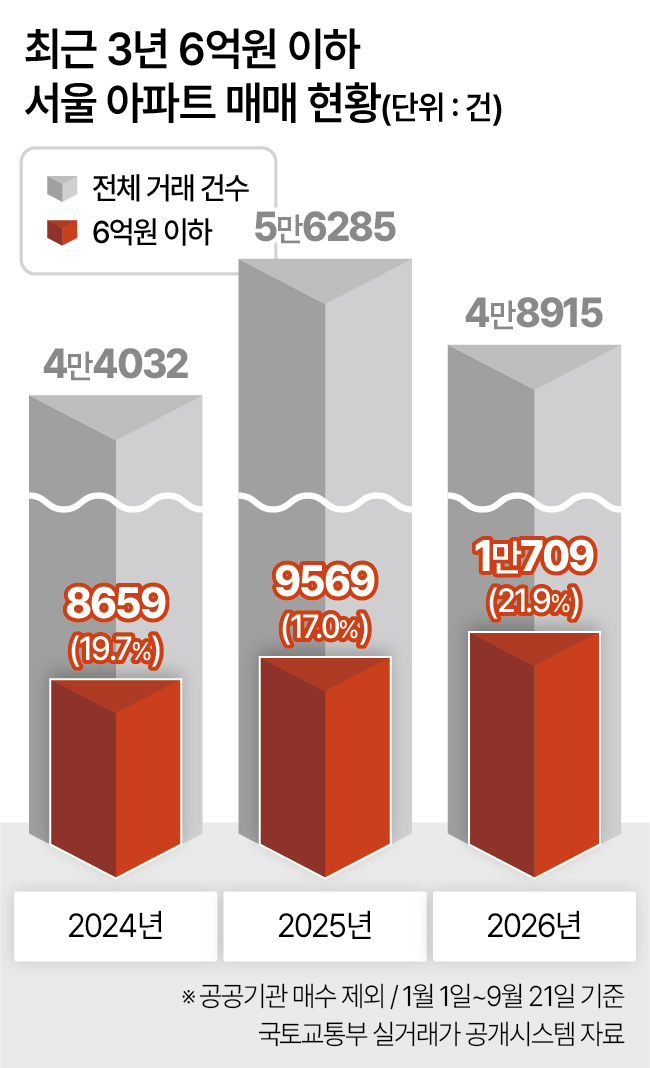
An analysis of the Ministry of Land, Infrastructure and Transport's actual transaction price disclosure system found that of the 48,915 Seoul apartment deals registered from Jan. 1 through Monday — excluding purchases by public institutions — more than half, or 27,041 transactions representing 55 percent, were priced at 1 billion won or below. That share is up 8 percentage points from the same period last year, when it stood at 47 percent.
Demand was particularly concentrated in apartments at or below 600 million won, the ceiling for most policy loans. The number of such transactions reached 10,709 this year, up more than 11 percent from 9,569 in the same period a year earlier. Their share of total deals widened from 17 percent to 21.9 percent.
The surge in lower-priced purchases is striking given that Seoul apartment sale prices have risen for 84 consecutive weeks, according to the Korea Real Estate Board. Data from KB show the average Seoul apartment sale price climbed from 1.52 billion won at the start of this year to 1.61 billion won last month.
Market watchers attribute the concentration of buying activity below 600 million won to households without homes who have turned to peripheral apartments in the 500 million to 600 million won range that qualify for the government's Didimdol loan program. Under current rules, households in which all members are non-homeowners and whose combined annual income does not exceed 60 million won can use the Didimdol loan to buy apartments priced at up to 500 million won. Newlyweds and households with two or more children are eligible for units up to 600 million won. Loan limits are set at a loan-to-value ratio of 70 percent and a debt-to-income ratio of 60 percent, with a maximum of 200 million won — rising to 240 million won for first-time buyers and 320 million won for newlyweds or households with two or more children.
Demand for policy loans, which are exempt from broader lending restrictions, has grown steadily as those restrictions have tightened. Data submitted by the Korea Housing and Urban Guarantee Corporation to the office of People Power Party lawmaker Song Eon-seog show that as of July, 3,265 Didimdol loans had been executed in Seoul — already 61.5 percent of the 5,306 loans issued in all of last year. The total amount disbursed, 845.1 billion won, equaled 55 percent of the full-year figure for the previous year.
Rapidly rising jeonse prices have also pushed buyers to act quickly on whatever affordable units remain. The average Seoul apartment jeonse price tracked by KB last month hit a record high of 711.78 million won. In the 14 districts north of the Han River, the average stood at 593.51 million won, approaching the 600 million won mark, while the 11 southern districts averaged 818.77 million won.
The actual number of lower-priced transactions is likely higher than the data show. Since October last year, all areas of Seoul have been designated land transaction permit zones, meaning even apartments priced below 600 million won require supporting documentation to obtain a permit. The permit process can take up to three weeks, and actual transaction registration must be completed within 30 days.
The rush of demand into the sub-600 million won segment has pushed prices in that bracket higher by the day.
A 49-square-meter unit at Sinnaee 11 Daemyung Apartments in Sinnaee-dong, Jungnang-gu, traded in the 400 million won range as recently as May, but sold for 630 million won on the 10th floor on Friday, crossing the 600 million won threshold. A 59-square-meter unit at Gireum Hyundai Apartments in Gireum-dong, Seongbuk-gu, which changed hands for 598 million won in February, set a new record high when it sold for 757 million won on the fifth floor on Sept. 3.
Experts have raised concerns about the disappearance of apartments within reach of ordinary buyers. Seo Jeong-yeol, a real estate professor at Youngsan University, said the trend reflects "the last-resort demand of people who feel they must secure a home of their own, even at the lower end of the market." He added that prices among so-called affordable apartments below 1 billion won are converging upward "because there is a steady stream of people who cannot find jeonse and want to own their own home." He went on to say that "affordable apartments are inevitably disappearing."
hss@heraldcorp.com
shy@heraldcorp.com