Accident-related injuries also rise from 3,833 to 5,013 cases
1,015 post-support violations found over three years
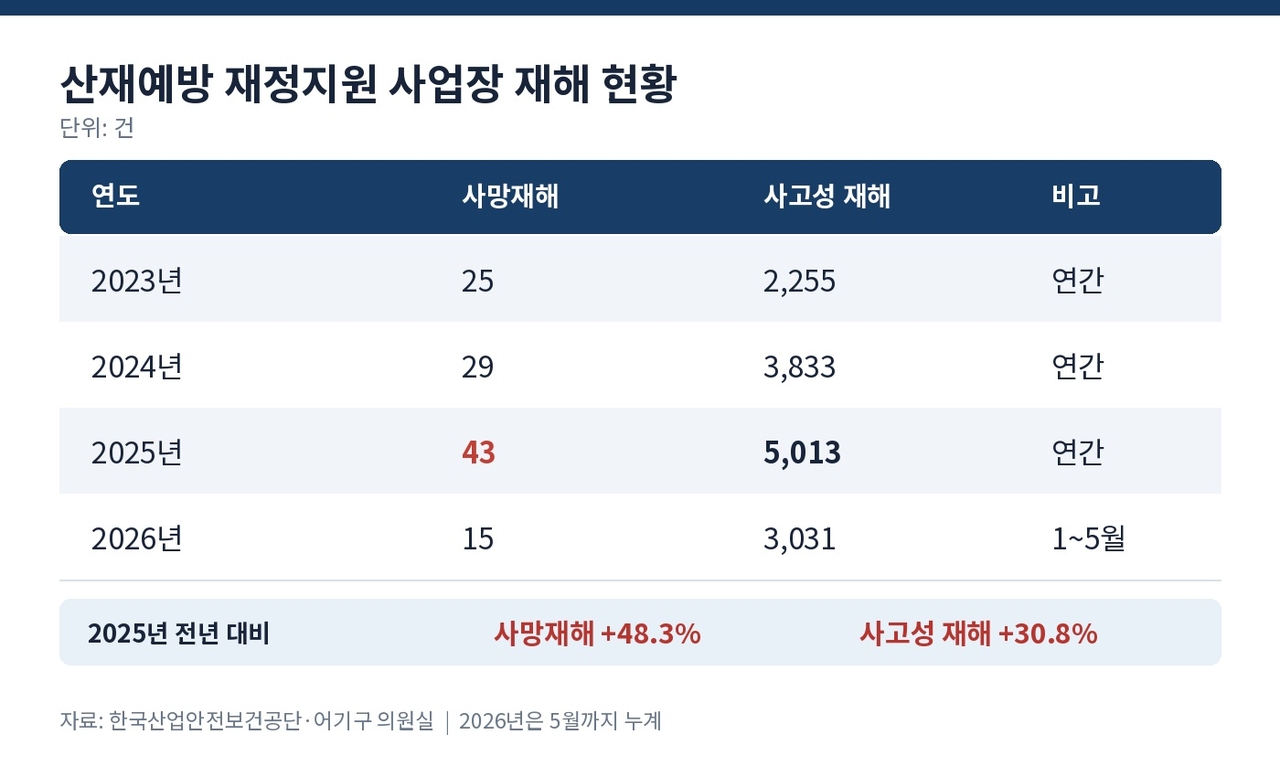
Fatal workplace accidents at businesses receiving government support for industrial accident prevention rose to 43 cases last year, a 48.3 percent increase from the previous year. Authorities also found 1,015 cases over the past three years in which supported equipment was misused, lost or sold off.
Data obtained from the Korea Occupational Safety and Health Agency by Eo Gi-gu, a Democratic Party of Korea lawmaker on the National Assembly's Climate, Energy, Environment and Labor Committee, showed that fatal accidents at workplaces receiving fiscal support for industrial accident prevention climbed from 25 cases in 2023 to 29 in 2024 and 43 last year. Accident-related injuries at the same workplaces rose from 2,255 cases in 2023 to 3,833 in 2024 and 5,013 last year, a 30.8 percent increase year on year.
This year, 15 fatal accidents and 3,031 accident-related injuries were recorded through May. Cumulative figures from 2023 through May of this year stand at 112 deaths and 14,132 accident-related injuries.
The agency runs several programs, including workplace safety improvement support, a safety partnership program, industrial accident prevention facility loans, and healthy workplace development support. The combined budget and loan scale for these programs from 2023 to 2026 totals 3.41 trillion won ($2.46 billion). However, the agency cautioned that the four-year budget and loan figures cannot be directly compared with accident tallies to assess program effectiveness, as the scale of supported workplaces and workers, as well as the timing of support, must also be considered.
Post-support management violations were found in 278 cases in 2023, 554 in 2024 and 183 last year. The violations included equipment going unused, lost, damaged or sold. Of the 1,015 cases identified over the three years, 158 resulted in clawbacks totaling 2.26 billion won.
"Industrial accident prevention programs should be evaluated not by how much money was spent, but by how much workplace risk was actually reduced," Eo said. "We need to strengthen performance management and post-support oversight systems that examine how much accident rates and risk factors have actually improved before and after support is provided."
fact0514@heraldcorp.com