
[Editor's note] For 45 years, the Korean National Police University has produced mid-level police officers. In that time, the social and political landscape has shifted dramatically, and the structure of criminal investigations has been overhauled. This series examines how the identity of the "elite police officer" has evolved — and whether the institution is still producing the right kind of leaders for a new era of criminal justice.
Exclusivity broken as entry paths diversify
Automatic rank appointment sparks equity debate
Alternatives range from starting as constable to fast-track promotion
Experts also argue for stronger leadership role
![The main building of the Korean National Police University in Asan, South Chungcheong Province. [Yonhap]](https://wimg.heraldcorp.com/news/cms/2026/09/24/news-p.v1.20260922.0c465cdc9b804de2be201ff56f1c8dc0_P1.png)
Officer A joined the police through the general open-competitive exam, starting as a constable. In 2023, he enrolled as a third-year student at the Korean National Police University through a program that allows serving officers to transfer in, and completed two years of study. He now works as an inspector on an investigative team at a local police station. He is considerably older than classmates who entered straight from high school, but he stood out as one of the most exemplary students — particularly in coursework and mock investigations. He led a team of younger students to first place in the university's mock investigation competition.
Officer A's case illustrates how much the institution has changed. Lee Dong-hee, a professor at the university, described the shift this way: "The old Police University was a homogeneous elite group of students similar in age and background. Today it is a mixed platform for police education, blending people with different careers and experiences."
Founded in 1981 as a military-academy-style institution for police, the university was caught up in debates over its very existence almost from the start — praised for cultivating a police elite, but criticized for granting excessive privileges to its students.
The transformation from those early days became reality during the Moon Jae-in administration. A police reform committee of 19 outside experts, launched in June 2017, drew up recommendations to cut the incoming class size and eliminate various benefits. A university official said the successive reforms had largely resolved concerns about insularity and exclusivity.
Reformed enough? The automatic inspector appointment remains
Article 8 of the Act on the Establishment of the Korean National Police University: Graduates who complete the bachelor's degree program at the university shall be appointed as inspectors under the Police Officers Act.
Article 10 of the Police Officers Act (excerpt): (1) New appointments to the ranks of superintendent and constable shall be made through open competitive examination. (2) New appointments to the rank of inspector shall be made from among those who fall under any of the following: 1. Graduates of the Korean National Police University. 2. Persons who meet the qualifications prescribed by presidential decree, are selected through open competitive examination, and pass a designated test upon completing training.
Yet one thing has survived every round of reform discussions: the automatic appointment of graduates to the rank of inspector. Students who complete the four-year undergraduate program enter the police as inspectors without sitting any graduation or appointment exam. Their academic performance or conduct during those four years has no bearing on the outcome. The system was designed this way from the outset, on the premise that the university exists to produce capable police officers ready for supervisory roles.
In a 2024 paper titled "A Study on the Direction of Police University Reform: Focusing on Solutions for the Inspector Appointment of Graduates," Lee Sang-hoon, a professor in the police studies department at Daejeon University, concluded that current law keeps open what he called a "royal road" for graduates.
In terms of the Korean National Police Agency's official staffing table, inspectors account for 12 to 14 percent of all officers. In practice, however, the rank has become far more common — exceeding 30 percent of actual serving officers as of 2024. The old equation of "inspector equals junior supervisor" no longer holds. One investigator who graduated from the university and is still within the mandatory six-year service period said he felt like "just one of countless working officers," while adding that he saw no fundamental problem with the university's core purpose of training prepared mid-level officers.
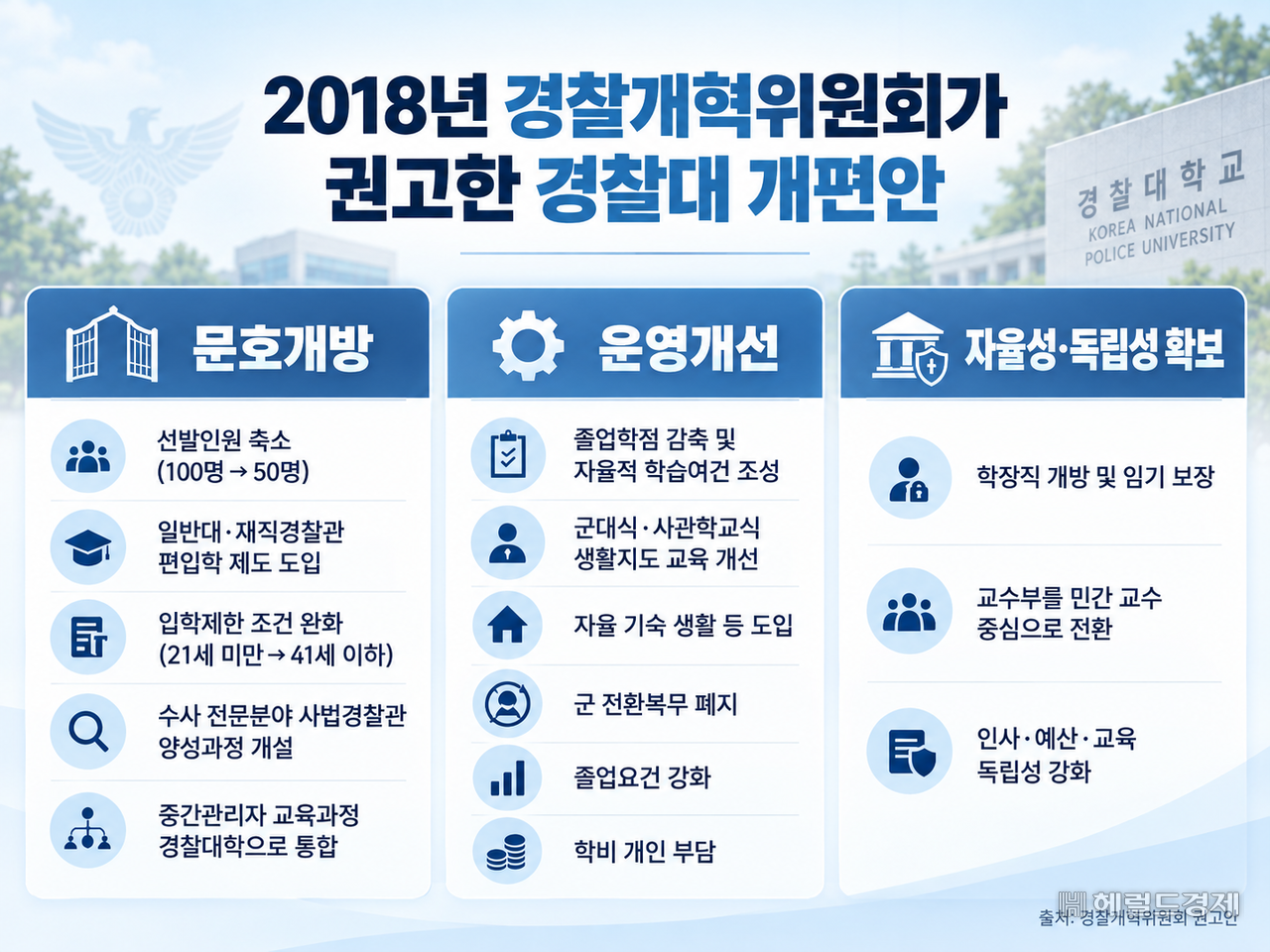
The automatic appointment of graduates to the inspector rank was also a central issue during the 20th National Assembly, when debate over revising the laws governing the university was at its most intense.
A review report prepared by the National Assembly Research Service at the time shows that lawmakers proposed sharply different approaches. Rep. Lee Jong-geol called for abolishing the appointment system altogether. Rep. Jin Sun-mee proposed restructuring the university into a graduate school, with master's graduates appointed as inspectors and doctoral graduates as senior inspectors. Rep. Pyo Chang-won took a different approach, proposing that students be designated as constables from the moment they enroll and spend four years training before starting their careers on the same footing as other officers.
The specific details of the bills varied, but the underlying thrust was consistent: transform the university from an institution that takes high school graduates and supplies them directly into junior supervisory roles into one that provides specialized education to serving officers and levels the playing field.
Since then, no further progress has been made on the question of how graduates should be appointed. The Korean National Police Agency and the university itself have both said they are not actively reviewing the issue. Nevertheless, concern persists — fueled by the growing number of graduates who choose law school each year — that the university has become a gateway for officers to enter the legal profession with inspector-level credentials.
What alternatives exist to the direct inspector appointment?
![President Lee Jae Myung and his wife attend a ceremony in March at the Korean National Police University in Asan, South Chungcheong Province, marking the appointment of new inspectors and senior inspectors in 2026. [Yonhap]](https://wimg.heraldcorp.com/news/cms/2026/09/24/news-p.v1.20260922.8ff218fbe48d4ddd9beeae9728b7efea_P1.jpeg)
Police experts are divided. Some argue that all officers should start from the same point and advance on experience; others emphasize the need for a specialized entry path that cultivates professional expertise and leadership from the outset.
Lee Yun-ho, an emeritus professor of police administration at Dongguk University, said graduates should start as constables. "That is the only way to truly learn and experience what police work is," he said. Lee Sang-hoon also favored starting at the constable rank, but proposed a fast track allowing Police University students to advance quickly — moving through constable, senior constable, sergeant and inspector after gaining direct experience in patrol, first response and investigative units.
Seo Jun-bae, a professor at the Police University, argued for the opposite approach: strengthening the incentives for graduates rather than reducing them. "I think graduates should be appointed not as inspectors — a rank that has become crowded — but as senior inspectors or superintendents," Seo said. "In exchange for that level of treatment, one option worth considering is requiring 10 years of mandatory service."
A criminal defense attorney who graduated in the 21st class of the Police University said the inspector appointment system is not the real issue. "The priority should be reforming the personnel system so that officers can build expertise by staying in one field and earn promotion on that basis," he said. "The goal is to create an environment where Police University graduates and those who entered through the open inspector exam can exercise genuine professional leadership."
The university currently trains not only undergraduates but also those who entered through the open inspector competitive exam — formerly known as the officer candidate program — and through a separate track for licensed attorneys. Together, roughly 180 to 190 people enter the police each year at the inspector or senior inspector rank through these various routes.
A police official said the number of graduates automatically appointed as inspectors after completing the undergraduate program had fallen from 120 in the past to 50 today. "The structure has become more diverse in terms of entry paths," the official said. "We need to watch and see what kind of synergy emerges when trainees from such varied backgrounds come together at the Police University."
A university official said the institution believed mid-level managers have an outsized influence on any organization. "We can fully play the role of training officers in leadership qualities and proactively educating them on legal and institutional changes, so that knowledge spreads throughout the entire police organization," the official said.
![Students attend the entrance ceremony for the 36th class of the Korean National Police University in Asan, South Chungcheong Province, in February 2016. It was the first official event held after the university relocated from Yongin, Gyeonggi Province, to Asan. [Yonhap]](https://wimg.heraldcorp.com/news/cms/2026/09/24/news-p.v1.20260922.c5cb07b6c5ca451f81b4466a404af8fb_P1.jpg)
jookapooka@heraldcorp.com
nyang@heraldcorp.com





