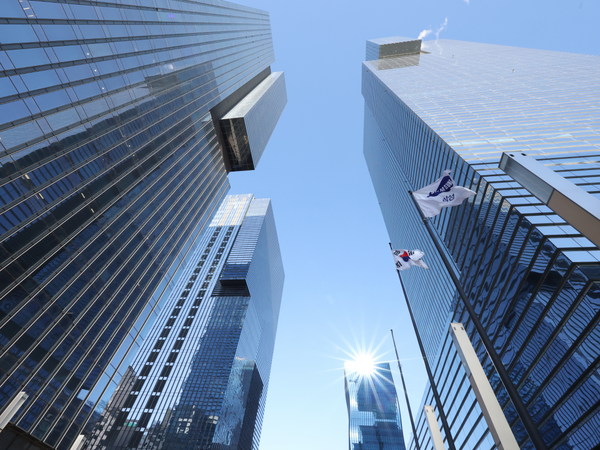
Samsung Electronics is expected to pay a per-share dividend of around 4,600 won for the third quarter, with Monday marking the last day investors can buy shares and still qualify for the payout. The cash dividend is projected to reach about 30 trillion won ($22.2 billion) — more than 12 times the 374-won per-share dividend paid in the second quarter. Despite the record payout, Samsung shares were trading slightly lower Monday morning, as the market's attention has shifted to the memory chip sector outlook and the company's upcoming third-quarter preliminary earnings, leaving analysts divided on the share price outlook.
According to Korea Exchange, Samsung Electronics opened Monday down 1,000 won, or 0.35 percent, at 284,500 won, compared with Sunday's close. The third-quarter dividend record date is Sept. 30. Because domestic stock settlements take two business days from the purchase date, investors must buy Samsung Electronics or Samsung Electronics preferred shares by Monday to secure dividend rights. Trades executed through the Korea Exchange after-hours market, which operates until 8 p.m. Monday, will also count as Monday purchases.
The payout far exceeds Samsung's typical quarterly dividend. The company's regular quarterly dividend had been about 2.45 trillion won, but the third-quarter distribution is expected to reach approximately 30 trillion won. Eugene Investment & Securities estimated the third-quarter dividend per share at 4,604 won — more than 12 times the second-quarter figure of 374 won.
Shareholder returns could expand further through year-end. Samsung Electronics is pursuing total shareholder returns of 90 trillion won to 110 trillion won over the three years from 2026 to 2028. Eugene Investment & Securities estimated that if the remaining 55 trillion won to 75 trillion won in shareholder return funds are paid out entirely as dividends by year-end, the annual dividend per share could reach 13,046 won to 16,115 won. Assuming a share price of 240,000 won, that would imply an annual dividend yield of 5.4 to 6.7 percent.
Market attention is now turning to the third-quarter preliminary earnings release scheduled for early next month. Based on a consensus of eight brokerages that published reports within the past month, Samsung Electronics' third-quarter sales and operating profit are expected to reach 200.28 trillion won and 106.99 trillion won, respectively. That would represent roughly a 20 percent increase from the second-quarter operating profit of 89.4 trillion won and, if realized, would mark the first time the company has posted quarterly operating profit exceeding 100 trillion won.
"Rather than mechanically anticipating profit-taking ahead of the earnings release as we saw at the end of June, the key question this time is how much the results ease market concerns already priced into the share price regarding memory demand and the price outlook," said Lee Sang-yeon, a researcher at Shinyoung Securities. "Whether the rebound is sustained will depend on whether earnings expectations translate into actual upward revisions to profit forecasts, and on whether interest rates and oil prices hold without rising further."
Analysts are split on the share price outlook. Bears point to a slowdown in conventional memory chip price gains, while bulls argue that HBM-driven supply shortages will persist for an extended period.
Park Yu-ak, a researcher at Kiwoom Securities, forecast that price increases for conventional DRAM and NAND flash in the fourth quarter would slow to around 3 percent and 12 percent, respectively, cutting his conventional DRAM price growth estimate from 20 percent to 12 percent. He projected Samsung's third-quarter operating profit at 107 trillion won and fourth-quarter operating profit at 111 trillion won, and said HBM4's share of sales would exceed half of total HBM revenue, identifying HBM and foundry as new growth drivers.
On the other side, some analysts argue that expanding HBM production and growing demand for AI inference are absorbing conventional memory supply as well, potentially extending the memory upcycle beyond initial expectations.
Baek Gil-hyeon, a researcher at Yuanta Securities Korea, forecast DRAM and NAND prices rising 18 percent and 16 percent, respectively, with tight supply and demand conditions continuing through 2027 and 2028. He argued that HBM production expansion is eating into conventional DRAM capacity while the spread of AI inference is driving demand for high-capacity memory, making supply constraints difficult to resolve. "Given HBM's encroachment on conventional DRAM capacity and the surge in high-capacity memory demand driven by the spread of AI inference, the point at which supply constraints ease is likely to come later than expected," Baek said.

kacew@heraldcorp.com