'Redevelopment isn't finished when residents move in — we need transit, childcare and more'
Lawmaker pushes to close gaps in youth housing policy and build jeonse fraud prevention networks near universities
From stray cats to old-growth trees, he seeks to institutionalize what redevelopment leaves behind
'I want to be remembered as the council member who made this neighborhood a better place to live'
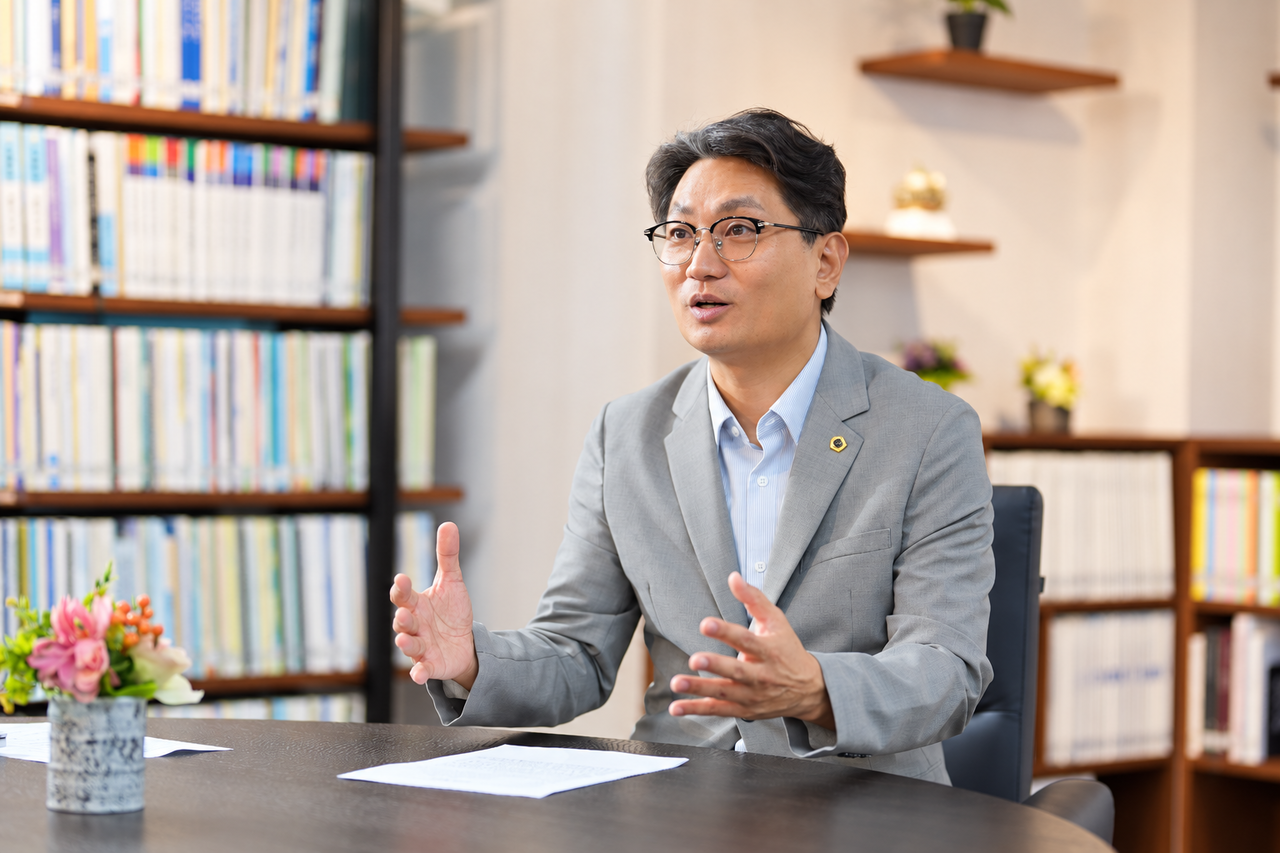
A large-scale redevelopment project reaching completion does not mean a city's transformation is finished. When new apartment complexes go up and the population grows, demand for childcare, education, transit, green space and elder care grows with it. How to redesign a changed residential area after housing supply arrives becomes the next challenge for any urban renewal effort.
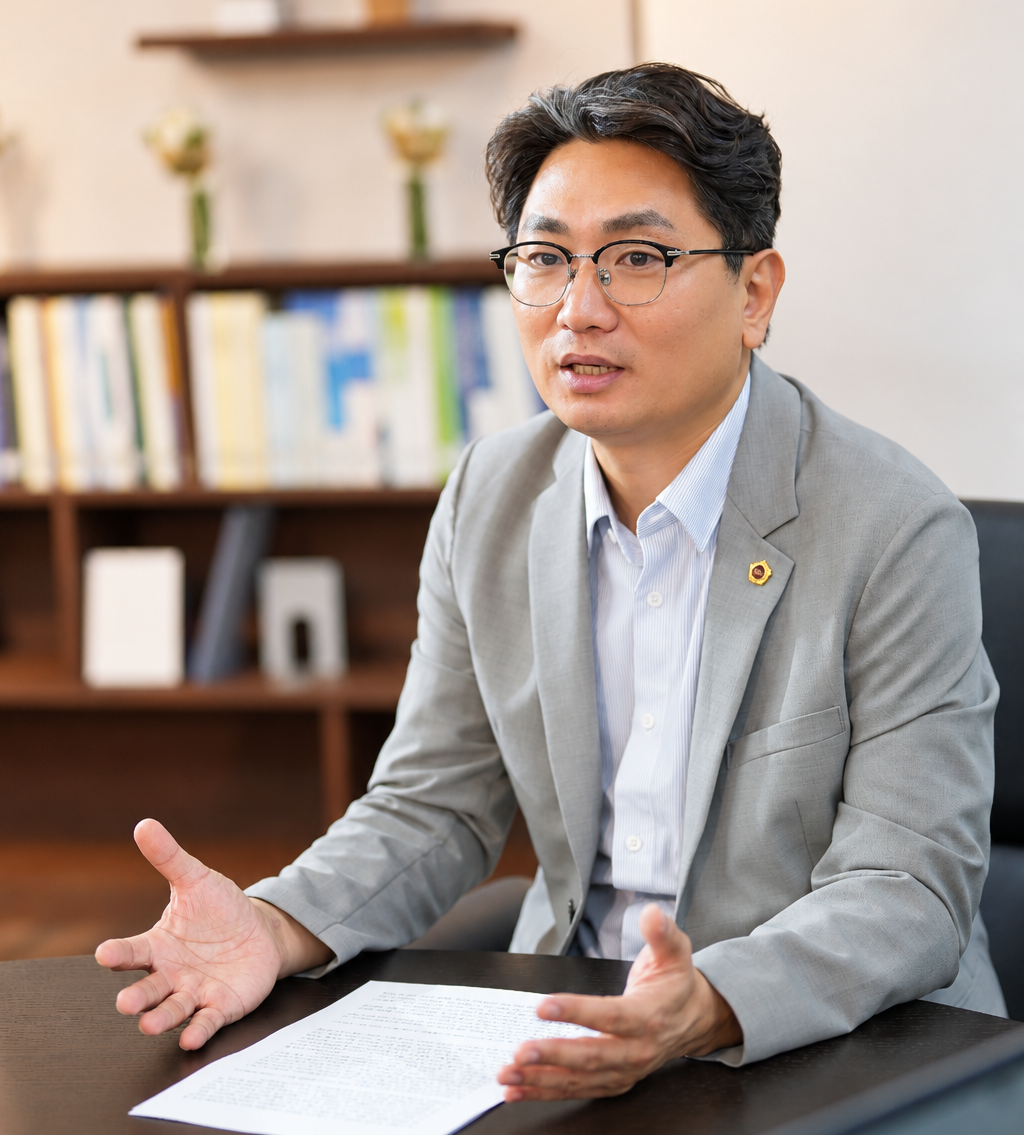
Oh Jung-seok, a Seoul Metropolitan Council member representing Dongdaemun District 2 for the Democratic Party of Korea, sat down Monday to discuss the challenges cities must address after redevelopment, focusing on changes unfolding in the Imun-Hwigyeong area of Dongdaemun-gu. He emphasized that urban planning must not only accelerate renewal projects but also carefully anticipate the living-infrastructure demands that arise once large numbers of residents move in.
"Redevelopment and reconstruction are ultimately issues directly tied to residents' time," Oh said. "We need to be transparent about why delays occur at each permitting stage and find ways to shorten them."
More homes, not enough childcare or transit — what comes after the new town matters
The Imun-Hwigyeong New Town is rapidly reshaping not just the built environment but the demographic makeup of the area as well.
The Imun, Hwigyeong and Hoegi neighborhoods — home to Kyung Hee University, Hankuk University of Foreign Studies and the University of Seoul — have long been shared by young people drawn to the university district and longtime elderly residents. Now, as new town move-ins accelerate, young couples and households with infants and toddlers are arriving in growing numbers.
The problem is that housing supply is outpacing the expansion of supporting infrastructure. Demand for daycare centers, kindergartens and elementary schools is rising, but existing facilities are struggling to keep up.
Oh said that when renewal plans are drawn up, projections should go beyond the number of housing units to include more precise forecasts of how the age distribution of residents will shift and what education and childcare needs will follow.
Transit is already an area where residents feel the change in their daily lives.
"Ten thousand households have moved in, but the roads are the same as before," Oh said. "It's not enough to supply housing and call it done — we have to plan together for how the larger population will move around and live."
Easing bottlenecks and congestion on Imun-ro and other major roads will require not only road improvements but also adjustments to bus and other public transit networks to match the new residential patterns, he said.
Walkability also needs attention. His vision connects the Jungnangcheon riverside park — to be created after the Dongbu Expressway is put underground — and the green corridors around Baebongsan to residential areas, while making pedestrian routes between schools, subway stations and commercial zones safer.
Large-scale housing supply can translate into genuinely improved living conditions only when parks, walkways, care facilities and youth spaces are all in place alongside it, he said.
Youth housing policy must go beyond supply to close the gaps in the system
Given Dongdaemun-gu's concentration of universities, youth housing is an area Oh keeps a close watch on.
He is particularly focused on whether existing housing support programs adequately reflect the life-stage transition from single youth to newlywed couple.
As household lending regulations tighten, some tenants find it harder to secure a jeonse deposit when renewing a lease. After marriage, a couple's combined income can push them above the thresholds for policy loans and other forms of support.
Reducing what he calls the "marriage penalty" — the loss of support that kicks in the moment a young person marries — requires policy design that weighs actual housing costs and life stage rather than applying income and asset thresholds mechanically, he said.
In Dongdaemun-gu, efforts are also underway to build a local cooperative network aimed at preventing jeonse fraud before it happens.
The initiative would bring together student councils from Kyung Hee University, Hankuk University of Foreign Studies and the University of Seoul, along with local licensed real estate agents, to provide university students and young workers just entering the workforce with the legal and contractual information they need when signing a lease.
Rather than stopping at after-the-fact relief for jeonse fraud victims, the focus is on building a prevention system that helps young people check in advance the key details they must verify — including property registration records, deposit amounts and landlord information — before signing a contract.
Private rental developments such as youth-safe housing complexes also need scrutiny beyond their unit counts, he said. Continuously monitoring whether developers' financial health and deposit protection mechanisms are functioning properly is essential to building trust in youth housing policy, he added.
Stray cats, old trees — what the development process leaves behind
Oh's attention does not rest solely on the scale or pace of renewal projects. He also takes up issues that tend to go unheard in the development process.
A prominent example is the stray cats left behind in areas being cleared for redevelopment or reconstruction. When residents relocate and demolition begins, animals that lived in those neighborhoods risk being abandoned. He is exploring ways to incorporate their rescue and care into the formal procedures of renewal projects.
Old trees in redevelopment zones present a similar problem.
Among the trees that have grown alongside a community for decades, even those with recognized preservation value are sometimes removed because of transplanting costs. Oh is examining whether a legal basis could be established for local governments to partially subsidize the cost of relocating such trees to parks or other public spaces.
His aim is to broaden the conversation around renewal projects beyond how many units were delivered or how much time was saved — to include how the existing assets of a neighborhood can be preserved while a new urban environment is being built.
As a member of the Seoul Metropolitan Council's Housing and Space Committee, he also keeps a close eye on residential safety and urban management.
Buildings already completed — such as those acquired for public rental housing — face structural constraints when it comes to retrofitting modern safety equipment. Where building conditions make it impossible to install identical systems, a management framework that regularly verifies the performance and actual operation of substitute equipment must be in place, he said.
He also sees Seoul's digital twin initiative through the lens of urban safety.
Accumulating data on the design, construction and maintenance of buildings can serve not only facility management but also rapid response when disasters strike. The key question is how to connect architectural and spatial data currently scattered across individual projects and agencies and put it to practical use in public administration, he said.
What matters is not simply that digital technology has been adopted, but demonstrating in concrete terms how the accumulated data is being used to improve facility safety, disaster response and administrative efficiency, he said.
Four years outside politics — a different lens on policy
Oh spent four years away from the National Assembly and local councils.
After working as a legislative aide in the National Assembly and serving as a local council member, he moved into external affairs roles at companies focused on youth employment and at professional associations. Where his council work had given him experience in crafting policy and legislation, his time in the private sector showed him how those policies were received on the ground.
At a youth employment company, he was able to see job policy through the eyes of the young people actually using it. At a professional association, he witnessed firsthand how a single law or regulation could reshape an entire industry and the working conditions of those in it.
Stepping away from the role of policy supplier and hearing directly from those on the receiving end has shaped how he approaches his work since returning to the council.
His first connection to politics came more than 20 years ago, when he worked as an intern in a National Assembly member's office.
Early in his career, he watched as research and reviews he had contributed to became bills, and those bills became budgets and government policy. It was his first encounter with how a single decision made in the National Assembly could ripple out to change citizens' daily lives, business activity and the character of communities.
He went on to serve as a legislative aide and local council member, gained experience in the private sector, and returned to the Seoul Metropolitan Council. Having moved through legislation, administration and the field, he has come to believe that what determines the quality of a policy is less the moment it is written than the ongoing work of ensuring it functions properly where it is applied.
A fourth-generation Dongdaemun native — focused on life after development
Oh was born and raised in Dongdaemun-gu — a fourth-generation native of the district.
He has watched the Imun-Hwigyeong area transform rapidly through the new town project. As old homes and alleyways gave way to large apartment complexes and new residents arrived, he experienced alongside the community the emergence of fresh demands for transit, childcare, education and green space.
Going forward, he plans to focus his council work on creating conditions for newly arrived young people and newlywed couples to put down stable roots in the area, while ensuring that longtime elderly residents of Dongdaemun-gu are not left behind by urban change — building a foundation where generations can live side by side.
Asked what he hopes to be remembered for when his term ends, Oh said: "I want to be known as the council member who made this neighborhood a better place to live. Ultimately, the results of council work should be judged by how much residents' daily lives have improved."
Accelerating redevelopment and filling in the quality of life that follows are not separate tasks. Connecting housing supply to transit, childcare, youth housing, safety and green space — that is the legislative agenda Oh is working through amid the transformation of Imun and Hwigyeong.
7toy7@heraldcorp.com