Measures include minimizing workers riding outside freight cars and strengthening on-site safety
The government has announced a set of safety measures after a series of accidents during rail shunting operations.
The Ministry of Land, Infrastructure and Transport said Tuesday it would pursue a "rail vehicle shunting safety reinforcement plan" aimed at preventing accidents during shunting work. The plan calls for minimizing workers' exposure to hazardous zones on tracks, banning workers from riding on the outside of freight cars in principle, and enabling workers to monitor and guide vehicle movements from safe positions.
Shunting — the connecting, separating and repositioning of rail vehicles — takes place at 115 stations nationwide, averaging about 1,370 operations per day. About 41.4 percent of all shunting work involves workers riding on vehicles.
Over the past decade, three fatal accidents and seven injuries classified as serious safety incidents occurred during shunting operations. All three fatalities happened while workers were riding on the outside of freight cars during reversals — when the engineer's field of vision is limited — or while working under conditions of insufficient communication with the engineer or local control. The accidents include a fatal incident at Uiwang Station in August, as well as deaths at Obong Station in November 2022 and at Gwangwoon University Station in 2017.
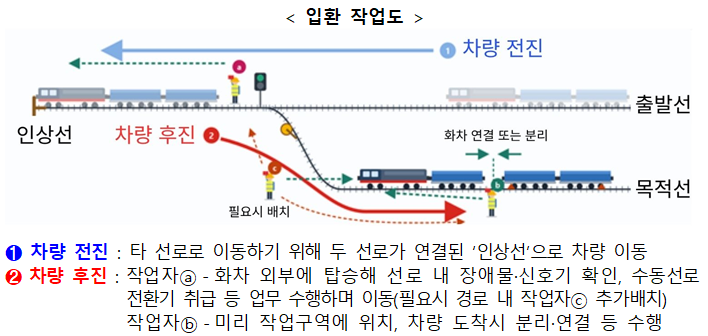
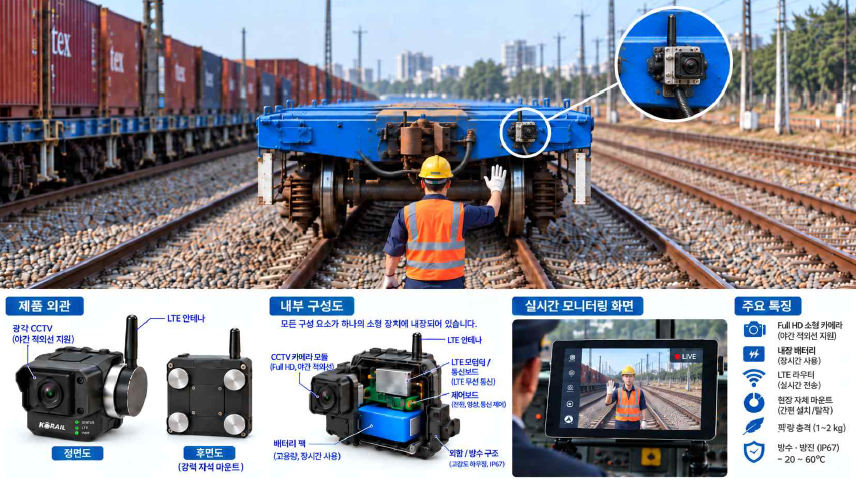
In response, the ministry said it would overhaul the existing practice in which workers personally check a vehicle's reverse movement and path while standing near the vehicle and tracks. Workers will be kept as far as possible from hazardous zones — with riding on the outside of freight cars banned in principle — and technology such as detachable rear-view cameras and local control systems will be upgraded so workers can monitor and relay vehicle movements from safe positions.
The ministry also said it would strengthen oversight to ensure the safety measures take hold on the ground. Rail safety inspectors will conduct intensive compliance checks, and feedback from workers as well as problems identified during operations will be fed back into the safety measures and work procedures on an ongoing basis.
In addition, the ministry plans to actively identify and standardize best practices proven effective in the field and share them across other worksites. It is also reviewing awards and incentives for employees with strong safety records to encourage voluntary safety improvements and compliance with safety rules.
Kim Tae-byeong, Director General of the Ministry's Railroad Bureau, said the measures focus on changing the way workers operate — moving away from a system that requires them to go into dangerous areas to check conditions themselves. "We will continuously monitor and refine how the measures work in actual operations so that workers can feel a real difference in safety on the ground," he said.
Meanwhile, after the fatal shunting accident at Uiwang Station on Aug. 29, the ministry — which had already been pursuing preventive measures — said serious accidents of a similar nature kept recurring and vowed to conduct a thorough investigation, impose strict zero-tolerance penalties, and draw up safety reinforcement measures to root out structural problems.
smh@heraldcorp.com