Transaction volume plunged 15.6%, according to the Ministry of Land, Infrastructure and Transport and the Korea Real Estate Board
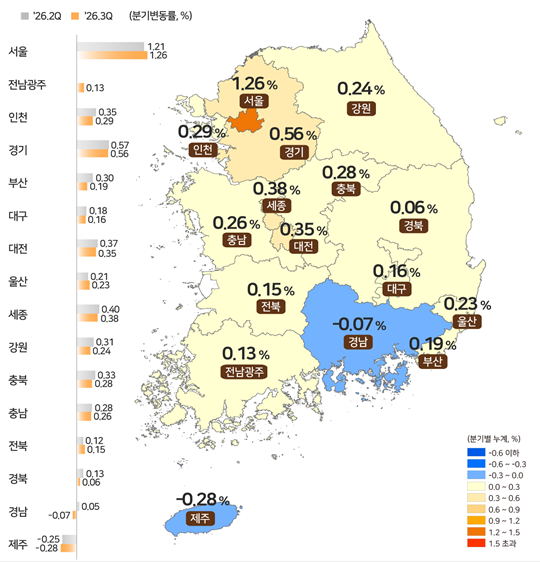
Land prices across South Korea rose 0.62 percent quarter-on-quarter in the third quarter of this year, extending a streak of gains that has now run for 14 consecutive quarters since March 2023. Transaction volume, however, plunged 15.6 percent.
The Ministry of Land, Infrastructure and Transport and the Korea Real Estate Board released the findings Tuesday.
The third-quarter increase was 0.01 percentage point narrower than the 0.63 percent recorded in the second quarter, but 0.04 percentage point wider than the 0.58 percent posted in the same period last year.
Seoul saw an overall gain of 1.26 percent, with particularly strong increases in Yongsan-gu at 2.24 percent, Seongdong-gu at 2.03 percent and Seongbuk-gu at 1.69 percent. The Greater Seoul metropolitan area rose 0.88 percent, far outpacing the 0.14 percent gain in regional areas outside the capital.
By zoning category, commercial zones posted the highest increase at 0.79 percent, followed by residential zones at 0.75 percent. By land use, commercial land rose 0.77 percent and residential land 0.71 percent, both outpacing farmland, forest land and industrial land.
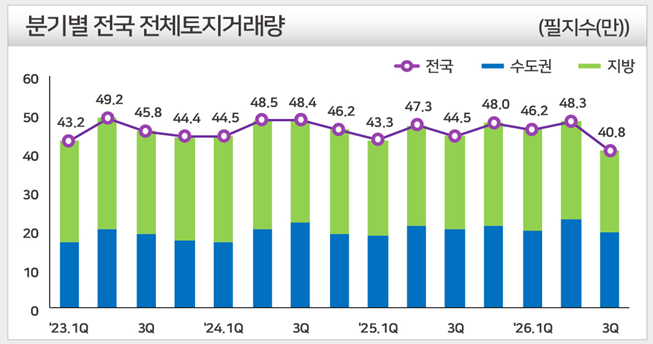
About 408,000 parcels of land totaling 219.7 square kilometers changed hands in the third quarter, down 15.6 percent, or roughly 75,000 parcels, from the second quarter. Compared with the third quarter of 2025, transactions fell 8.4 percent, or about 37,000 parcels.
Transactions in pure land — excluding plots attached to buildings — came to 124,000 parcels covering 196.1 square kilometers, a decline of 15.5 percent, or about 23,000 parcels, from the second quarter and 12.9 percent, or about 18,000 parcels, from the third quarter of 2025.
Thirteen of the country's 15 metropolitan and provincial jurisdictions recorded transaction declines. Daejeon and Incheon were the only exceptions, posting increases of 9.6 percent and 3.0 percent, respectively.
The drop in transactions was spread across all zoning categories and land classifications, but the steepest declines were in non-urban land — agricultural and forestry zones fell 37.6 percent and paddy fields 30.1 percent.
A ministry official said there was no notable change in the land price index, and that the decline in transaction volume appeared to reflect a base effect following the increase recorded in the previous quarter.
smh@heraldcorp.com