Ministry picks two large cities for new metropolitan urban convergence zone program
Jeonju to specialize in AI reliability certification, Changwon in defense and nuclear industries
Innovation hubs designed to attract businesses and young talent are set to be built in the city centers of Jeonju in North Jeolla Province and Changwon in South Gyeongsang Province. Jeonju will specialize in AI reliability testing and certification, while Changwon will focus on the defense and nuclear industries.
The Ministry of Land, Infrastructure and Transport announced Tuesday that it had selected Jeonju and Changwon as candidate sites for its "metropolitan urban convergence zone" development project, which creates innovation spaces in large cities with populations of 500,000 or more. Urban convergence zones are hub-type innovation spaces built in city centers by combining industrial, residential and cultural facilities.
The selection marks the first step in expanding the urban convergence zone program — previously centered on five metropolitan cities — to larger provincial cities. The ministry designated Daegu, Gwangju, Daejeon, Busan and Ulsan as pilot projects between 2020 and 2022. Those cities were officially designated as urban convergence zones in November 2024 and are currently working through follow-up procedures including implementation plans. In December last year, the government introduced a new category — "zones for large cities with populations of 500,000 or more" — under the First Comprehensive Urban Convergence Zone Development Plan (2026–2035).
The ministry said the selection of the two sites is intended to support the government's "five-pole, three-special balanced national growth strategy."
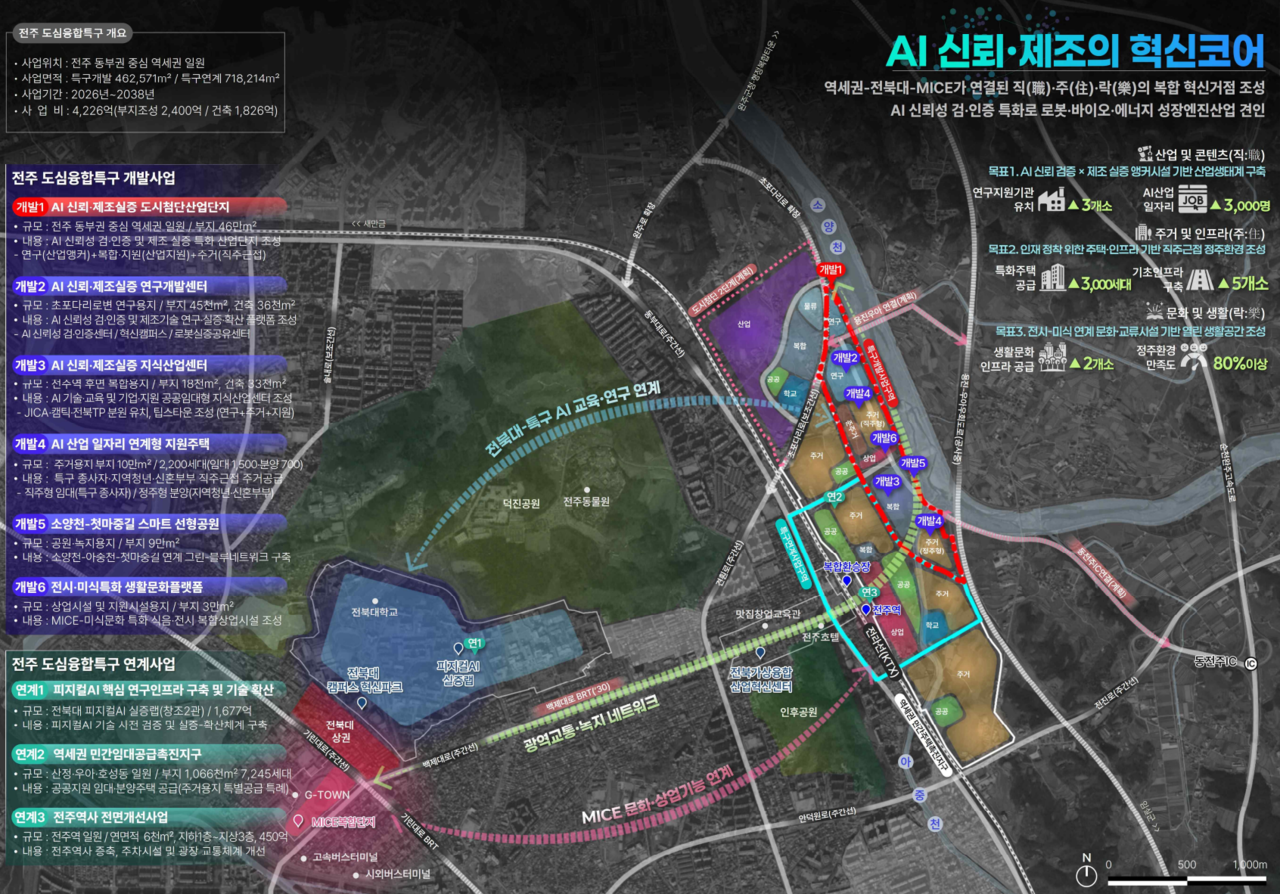
The candidate zone in Jeonju covers approximately 460,000 square meters. It sits at a major regional transportation node near KTX Jeonju Station and the Saemangeum-Jeonju connector road. The estimated project cost is 422.6 billion won ($314 million).
With robotics, energy and biotech as its core industries, the zone will be developed into an AI reliability testing and certification hub linking Jeonbuk National University for research, Wanju for demonstration and Saemangeum for production. AI reliability testing and certification refers to the process of verifying the safety and reliability of AI products before commercialization and supporting their certification.
The entire zone will be developed as an advanced urban industrial complex, housing research and development centers, knowledge industry centers, and residential and commercial facilities. Related projects include a full renovation of Jeonju Station by Korea National Railway and public-supported private rental housing in the transit-oriented area by Korea Land and Housing Corporation. The project developer, Jeonbuk Development Corporation, will oversee financing and implementation. North Jeolla Province plans to consider issuing development bonds and making additional capital contributions if needed.
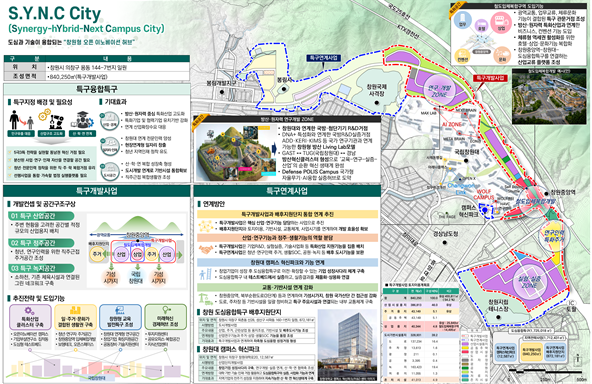
The Changwon candidate site spans approximately 840,000 square meters around KTX Changwon Central Station and Changwon National University. The estimated project cost is 474.5 billion won. The plan combines the city's defense and nuclear industrial base — anchored by the Changwon National Industrial Complex and the SMR National Research Institute — with research and development capabilities from universities, corporate research institutes and government-funded research institutions to create a research, demonstration and commercialization hub for the southeastern region.
Within the zone, the "Changwon Urban Convergence Technology Complex" — designated as a national and regional strategic project in February last year — will be established. The complex will include corporate research and development spaces, a shared equipment and technology support center, and an urban demonstration space, all tied to the defense and nuclear industries. The city will also pursue a mixed-use transit-oriented development above Changwon Central Station in partnership with Korea National Railway. Changwon plans to establish an SPC with a stake of at least 51 percent and is considering inviting private-sector participation.
Both candidate sites are currently at the conceptual planning stage, meaning details may change during the preparation of basic and implementation plans. Once the relevant local governments submit draft basic plans for their urban convergence zones, the sites will go through a review by the Urban Development Committee before receiving official designation.
Shin Gwang-ho, the ministry's land policy director, said the candidate selection "is the starting point for a new metropolitan urban convergence zone model to become a growth engine for the region."
The selection process began with the distribution of guidelines in June and preliminary consulting by specialist agencies, followed by an application period in August. Expert panels then conducted written reviews, on-site inspections and in-person evaluations from September through November. The panels assessed that Jeonju and Changwon demonstrated a well-balanced combination of growth potential, industrial linkage and project feasibility.
smh@heraldcorp.com