Keynote address by Jung Eun-seung, Samsung Electronics advisor
Speed emphasized for fabs in Yongin, Icheon and South Jeolla-Gwangju
Supply shortages driving price volatility
Semiconductors described as core technology enabling human imagination
Samsung Electronics must create its own 'inflection point' to reclaim global leadership
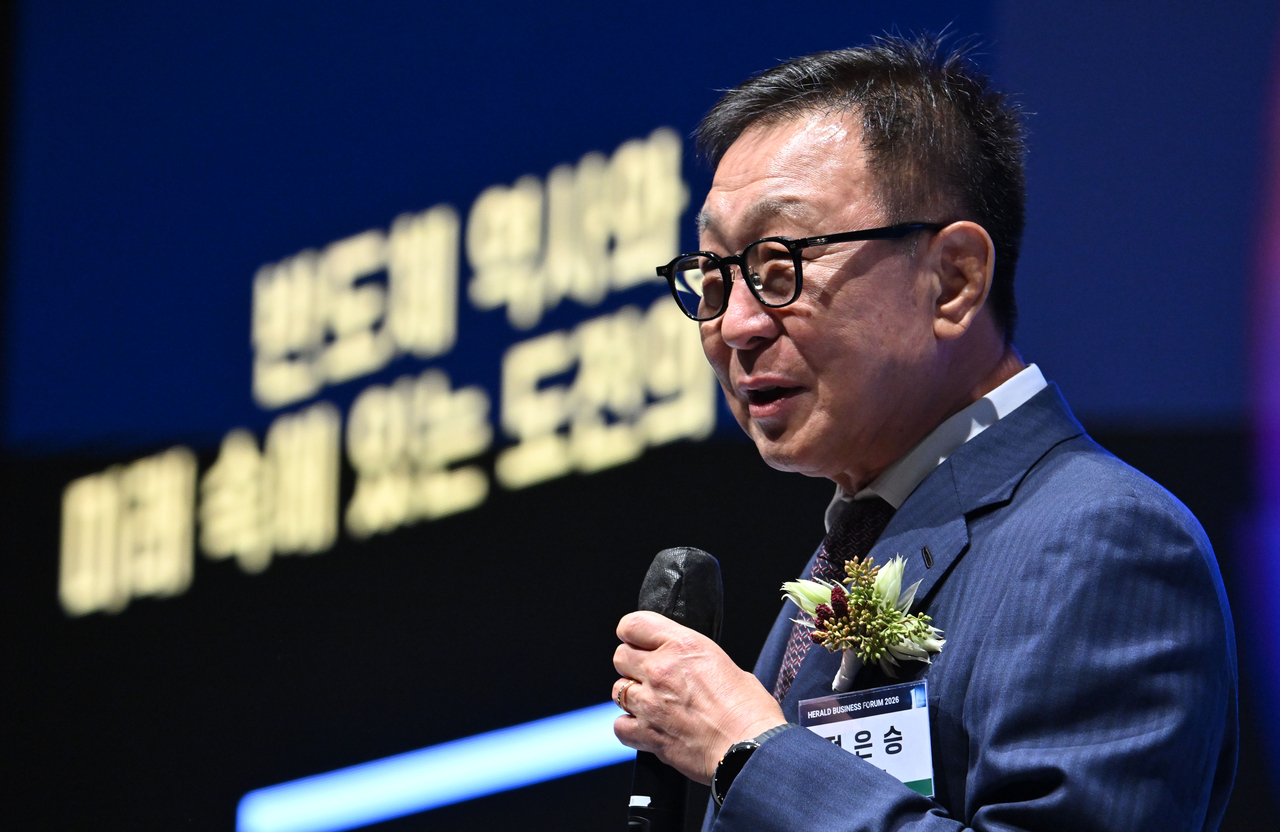
"South Jeolla-Gwangju, with a population of 3.2 million, can transform into a city like Shenzhen — China's big-tech hub of about 18 million people. To build that kind of city 30 years from now, the semiconductor industry must take root here."
Jung Eun-seung, an advisor to Samsung Electronics, drew a parallel Tuesday between Samsung's own entry into the semiconductor business and the vision for building a semiconductor industry in the newly integrated South Jeolla-Gwangju Special City. Speaking at the Herald Business Forum 2026 at the Dynasty Hall of Shilla Hotel in Jung-gu, Seoul, he said the goal is not to chase opportunities that have already been proven, but to create the inflection points that open new ones.
Jung took on the role of transition committee chair after Mayor-elect Min Hyeong-bae won the South Jeolla-Gwangju Integrated Special City election in June. He later became chair of the city's semiconductor strategy committee as a semiconductor mega-project began to give concrete shape to investment plans for the southwestern region.
"I asked Mayor Min why he was calling on me — a position that usually goes to a university president," Jung said. "He told me he wanted to do for South Jeolla-Gwangju what semiconductors had done for Korea's industrial growth."
He said that given an industrial structure in which nothing is now possible without semiconductors, every region — including South Jeolla-Gwangju — must accelerate semiconductor investment without delay.
"The reason Nvidia's GPUs are so expensive is that supply still covers only 60 to 70 percent of what AI companies want — the shortage is that severe," Jung said. "The same is true of the HBM that Samsung Electronics and SK hynix produce." He added that whenever he meets anyone connected to the semiconductor industry, his message is the same: build the factories in Yongin, Icheon and South Jeolla-Gwangju as fast as possible.
He said price volatility, too, is a problem that will ease once supply stabilizes. "Right now, prices are surging because there isn't enough supply, and the market swings wildly even when it looks like there's a surplus," he said, stressing the need to expand the supply base.
Jung described semiconductors as the core technology that makes human imagination possible, citing the film "2001: A Space Odyssey" as an example. The 1968 film featured scenes evoking AI, video calls and tablet computers — ideas that were pure fantasy at the time but have since become reality. "I believe everything you can imagine will come true," he said, "and semiconductor technology is the foundation that makes it possible."
He saw the position Korean companies have secured in memory chips as a springboard for new opportunities. "The fact that we pulled off memory is what has given us the chance to play an important role on the world stage," Jung said. "We have to make the most of that opportunity."
The word Jung returned to most often throughout his presentation was "inflection point." Reflecting on the period when Samsung Electronics first entered the memory chip business, he said: "There are no ready-made opportunities in the world. An inflection point is something you find and create out of nothing."
"When Samsung started in semiconductors, nobody knew it would work," he said, adding that the industry's competitive strength today was not gained by following existing markets.
He said the same approach had worked in technology development, citing efforts such as increasing wafer sizes and converting NAND flash from a planar to a three-dimensional structure.
On 3D NAND, he said the breakthrough combined "innovation in materials, innovation in structure, and innovation in integration technology" — the product of years of research and a true technological inflection point.
He also argued that making individual chips well is no longer sufficient on its own. "We have moved from selling discrete components to selling integrated products like SSDs and HBM," Jung said, adding that new opportunities must be found at the intersection of memory, foundry and packaging. He also pointed to combining technology with software to raise the value that semiconductors deliver.
He identified collaboration and trust as essential conditions for that journey. Drawing on his experience co-developing technology with global companies, he said: "I never knew trust could be such a powerful word in business." The point, he explained, is that partners must believe you will stay the course even when times are hard.
He also shared an anecdote involving Nvidia CEO Jensen Huang. When Samsung Electronics was set to take on production of Nvidia's 8-nanometer GPU, a marketing executive told Huang, "We're in the same boat." Huang pushed back. "If we're in the same boat, that means you can swim away when things get dangerous," Huang said. "We're in the same spaceship." Jung cited the exchange to underscore the sense of urgency that business partnerships demand.
He also shared lessons from the organizational culture he absorbed at Samsung Electronics — mantras he said he returned to whenever things got difficult: "Set big goals," "Give more than you think is necessary," and "Understand everything in numbers."
"When you give everything you have, your teammates are moved by it, and that energy is what gets you through the hardest challenges," Jung said. "Don't waste time talking to people who only say it can't be done. When people believe something is possible, they come up with the ideas that make it happen."
Jung said the next chapter of the semiconductor industry will also be opened through new challenges. "Now, only the best will have a chance to survive," he said, stressing that both business and technology must reach their own inflection points.
jeongwan@heraldcorp.com