'Korea Premium Week 2026'
Market to be divided into Select, general and watch-list tiers
Public hearing planned for Q4 to gather feedback
NASDAQ segment overhaul cited as model
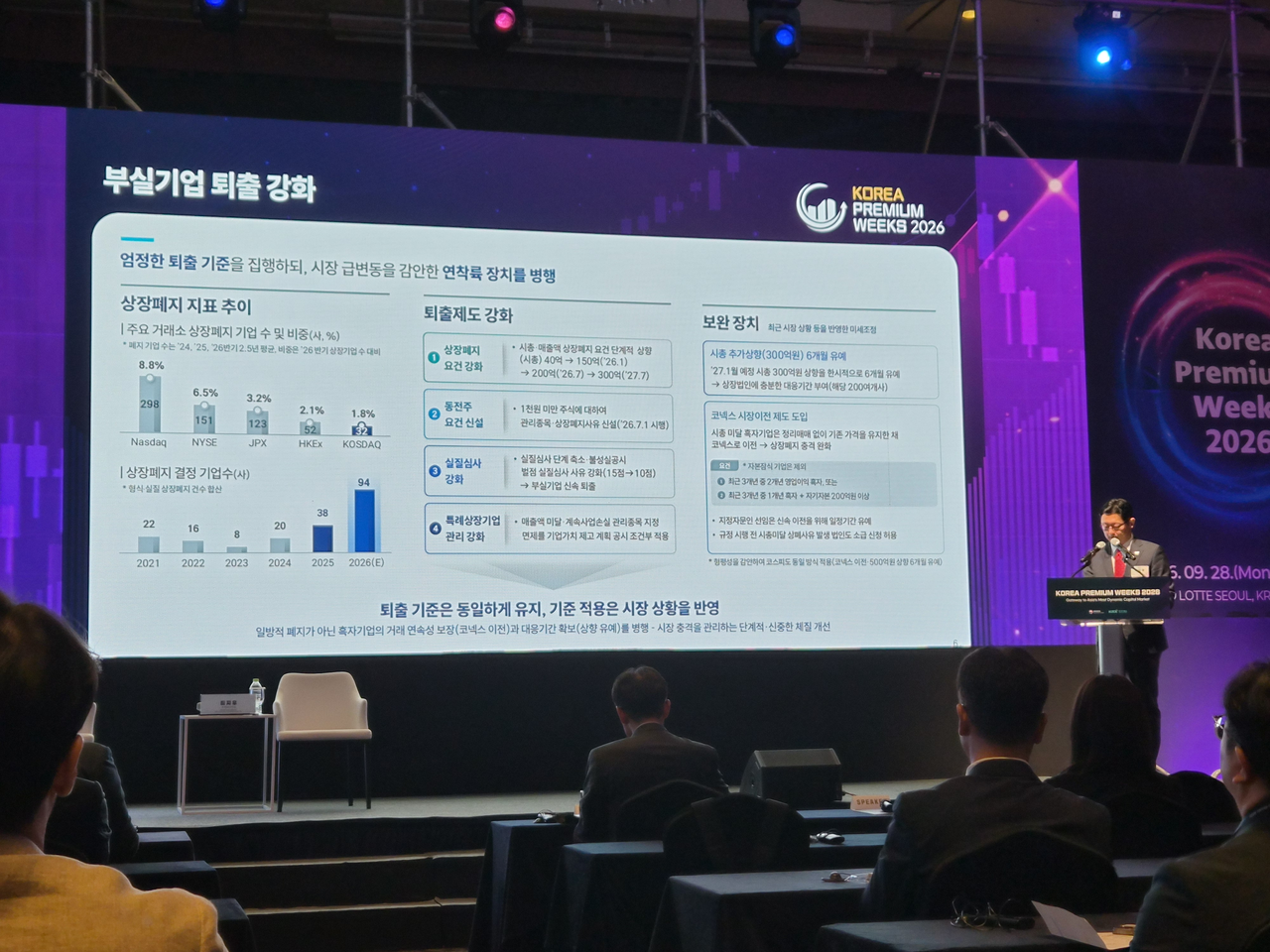
Korea Exchange plans to introduce a Kosdaq segment system next year to address the market's persistent valuation discount and foster high-quality innovative companies. The exchange will first gather public input and revise relevant regulations through a hearing in the fourth quarter of this year.
The overhaul aims to break up Kosdaq's single-tier structure by classifying listed companies according to their capabilities, with the goal of drawing in institutional investment from pension funds and other major investors.
Choi Ji-woo, executive director of Korea Exchange's Kosdaq Market Division, laid out the implementation timeline Tuesday at the "Enhancing Kosdaq Market Competitiveness" session of Korea Premium Week 2026, a joint event organized by the Financial Services Commission and Korea Exchange.
Under the proposed segment system, companies that grow into leading players would move up to a tier tentatively called "Kosdaq Select," while financially troubled firms would be placed in a separate watch-list category.
The initiative draws on NASDAQ's 2006 segment restructuring, which helped the exchange emerge as a global technology market on par with the New York Stock Exchange. Korea Exchange hopes a similar overhaul will allow Kosdaq to cultivate a tier of flagship companies.
Since its launch in 1996, Kosdaq has grown rapidly over the past three decades into a market with a capitalization of 514 trillion won ($378 billion) and more than 1,700 listed companies, boasting one of the world's highest liquidity ratios at around 2.3 percent.
However, critics have long noted that lumping innovative companies with strong growth potential together with financially distressed firms makes it difficult for institutional and foreign investors to identify quality stocks.
The government and the exchange announced plans to introduce a tiered promotion-and-relegation system for Kosdaq, but the criteria and methodology have remained contentious. Concerns have been raised that relying solely on quantitative metrics such as market capitalization and short-term earnings could leave companies with genuine technological potential undervalued, while relegation to a lower tier could carry a severe stigma.
Min Kyung-wook, head of Korea Exchange's Kosdaq Market Division, said the reform process may involve some growing pains. "There may be some friction as we work to improve the market's fundamentals, but we will press forward on the basis of clear principles while actively listening to the views of market participants on the issues at hand," he said.
Choi said the segment system is designed as a positive-sum policy rather than a zero-sum reshuffling of existing liquidity. "The goal is to identify high-quality innovative growth companies and channel new global liquidity into Kosdaq," she said, adding that the exchange would develop segment-based indexes and a range of financial products including ETFs.
Hwang Seung-taek, head of research at Hana Securities, who also presented at the event as an industry expert, echoed the urgency of improving Kosdaq's fundamentals. "More than 30 percent of Kosdaq-listed companies have been unable to cover even their interest expenses for three consecutive years," Hwang said. "Even accounting for early-stage growth companies that continue to invest in research and development, that proportion is far too high."
However, Hwang said strict standards are needed when it comes to delisting companies. "It is right to push ahead swiftly with removing insolvent firms, but there are also many companies in the field that feel they have been treated unfairly," he said. "It is essential to carefully assess the qualitative aspects of each company to properly identify those with the potential to survive and grow in the market."
He added that a fair and neutral body dedicated solely to this screening process must be established, and that swift, decisive action through such a body is necessary to reduce market uncertainty.
To support a smooth rollout, Korea Exchange has already activated a Kosdaq Segment Advisory Panel comprising academics, industry representatives and institutional investors. The exchange is also conducting research into overseas precedents and plans to hold a public hearing in the fourth quarter to gather broad market input.
jiyun@heraldcorp.com