![SpaceX's Starship rocket conducts a test flight at Starbase in Texas on Monday (local time). [AP/Yonhap]](https://wimg.heraldcorp.com/news/cms/2026/09/29/rcv.YNA.20260929.PAP20260929114401009_P1.jpg)
SpaceX's next-generation Starship rocket achieved its first orbital flight, yet the company's share price fell on the day. While the milestone marked a significant technical advance, investors appear more focused on whether Starship can establish itself as a viable commercial launch vehicle. How quickly the company's AI infrastructure business can grow sales and profit has also emerged as the next key variable for the stock.
Starship lifted off from Starbase in Texas at 8:49 a.m. Monday (local time) and reached orbit roughly 30 minutes later. It then deployed 26 Starlink V3 satellites at approximately one-minute intervals. During the deployment sequence, SpaceX shares climbed as high as $150.80 during trading, but the stock gave back those gains once the primary mission was complete. Shares closed down 2.16 percent at $145.47 as pre-priced optimism drained out of the stock.
Industry watchers say investor expectations will only be met once SpaceX demonstrates it can launch Starship repeatedly and drive down costs. While the flight proved the rocket's ability to reach orbit and deploy satellites, the technology for recovering and reusing the booster is still under development. Orbital refueling and catching the upper stage with the launch tower are among the remaining engineering challenges. The key question is how much the per-launch cost can fall as launch frequency increases.
"Hardware accounts for 90 percent of rocket costs, while propellant such as fuel is no more than 0.7 percent," said Kim Seong-eun, a researcher at Hana Securities. "Recovering and reusing parts that would otherwise be discarded after launch is the core of bringing down launch costs." With the Falcon 9 — the reusable rocket SpaceX developed earlier — the first stage and fairing account for $35 million, or 70 percent, of the $50 million cost of a new launch. After recovery and refurbishment, the cost of a subsequent launch falls to $15 million, a 70 percent reduction compared with a new launch.
Lowering Starship's launch costs is also critical to SpaceX's ambition to extend its AI infrastructure business into space. The company is currently expanding its business of leasing computing capacity from large-scale data centers to AI firms. Samsung Securities estimates cloud sales from contracts confirmed in the second half of this year at $15.62 billion, rising to $44.51 billion in 2027. Over the longer term, SpaceX is pursuing a "space data center" business that would place computing infrastructure in orbit. Given the need to lift large volumes of computing equipment into orbit, Starship's heavy-lift capacity and low launch costs are essential.
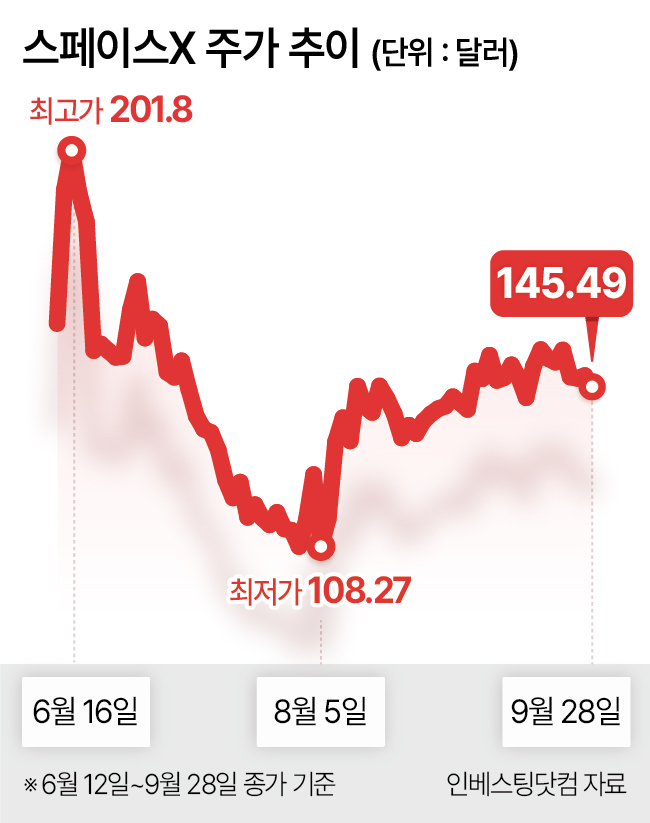
The concern is the steep run-up in SpaceX's profit forecasts. The company's EBITDA outlook climbed nearly 60 percent from $12 billion at the end of June to $19.6 billion in September, while the 2027 estimate jumped roughly 75 percent, from $25.5 billion to $44.6 billion. Meanwhile, the 12-month forward price-to-sales ratio has retreated from a post-listing peak of 40 times to around 25 times. With lock-up expiry selling weighing on the share price, the gap between the stock and the rapidly rising profit forecasts has widened.
Industry observers say a stock re-rating will require SpaceX to back up its elevated profit forecasts with actual results not just in the second quarter but through the third quarter and beyond.
"EBITDA estimates have been revised up continuously, but the share price has not reflected this," said Park Jun-gyu, a researcher at Samsung Securities. "From SpaceX's perspective, the priority at earnings releases is to demonstrate EBITDA growth that supports the market's expectations."
The remaining development milestones for Starship are another variable the stock will need to clear. "The results of the remaining Starship test launches this year could have a significant impact on the share price," Park said. "Major tasks still remain before development is complete, including orbital refueling and catching the upper stage with the tower."

kacew@heraldcorp.com