
Civil servants aged 35 and under made up 20.4 percent of Jung-gu's workforce in 2016; that share has grown to 35 percent this year — prompting the district to invite the author of 'The Millennials Are Coming' to help staff understand generational change rather than just dismiss it as a 'kids these days' problem
"It was jarring at first — they would not even say hello when we passed in the hallway." So goes the complaint of a team leader in his 50s watching a younger colleague walk by.
Yet employees who grew up in the 1990s now find themselves saying much the same thing about colleagues born in the 2000s — pulling out their own version of "back in my day."
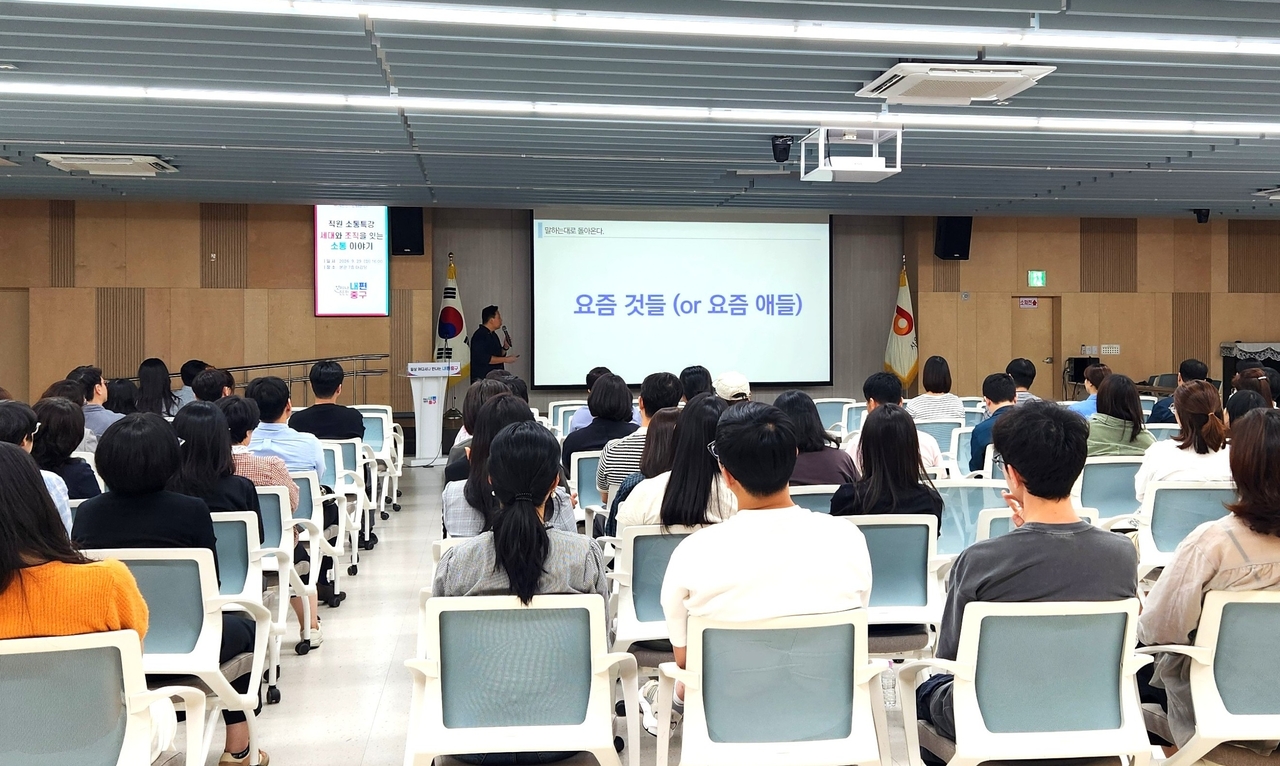
To address that generational friction, Jung-gu invited Im Hong-taek — author of the bestsellers "The Millennials Are Coming" and "Gen Z Is Coming" — on Tuesday to speak with staff on the theme of "communication across generations and organizational ranks."
The district's workforce has grown noticeably younger over the past decade. Civil servants aged 35 and under accounted for 20.4 percent, or 226 people, of the total in September 2016; by this September that number had risen to 440, or about 35 percent of the 1,256-strong workforce. With employees ranging from senior officials in their 50s to newly hired civil servants born in the 2000s, understanding different mindsets and working styles has become increasingly important.
Im said the key was understanding the era itself, not just the generation. Drawing on examples such as shifts in scientific terminology and the way battery levels are displayed on mobile phones, he said organizations need a workplace culture suited to the present age — not one tailored to any single generation.
He walked through how attitudes that once seemed out of place — having a drink at lunch, wearing earphones at a desk, or coming in with hair rollers still in — are perceived today, tracing how norms have shifted. Staff laughed and nodded along whenever a familiar scene came up.
Im also spoke about the mindset needed for cross-generational communication. Just as a driver signals before changing lanes, he said, mutual consideration and respect are essential. He also said that instead of dismissing new perspectives as typical "kids these days" behavior, managers should learn to distinguish between reasonable requests and unreasonable ones.
Attendees said the session resonated. "The realistic analogies delivered with such wit really hit home," one staff member said. Another called it "a meaningful time to understand how the times have changed through so many real-life examples."
Jung-gu has consistently expanded opportunities for staff to understand one another's thinking and working styles. The district has run communication training covering conflict resolution and conversation techniques across different ranks, as well as onboarding programs to help new civil servants settle in and team-building initiatives.
The district plans to continue improving its organizational culture so that better internal communication leads to stronger cross-departmental collaboration — and ultimately to better public services for residents.
Jung-gu District Mayor Kim Gil-sung said smooth communication among staff "not only builds mutual understanding but also drives collaboration across departments and better administrative services." He added that the district would "create an environment where employees can freely exchange opinions within clear principles and work with conviction, leading to changes in public administration that residents can actually feel."
seouldream01@heraldcorp.com





