Samsung AI Forum 2026 held in Seoul
Theme: 'Agentic Shift: From Intelligence to Impact'
Samsung Electronics co-CEO delivers welcome address
OpenAI's hardware chief gives keynote
AI experts and academics from home and abroad attend
Forum charts direction for agentic AI development
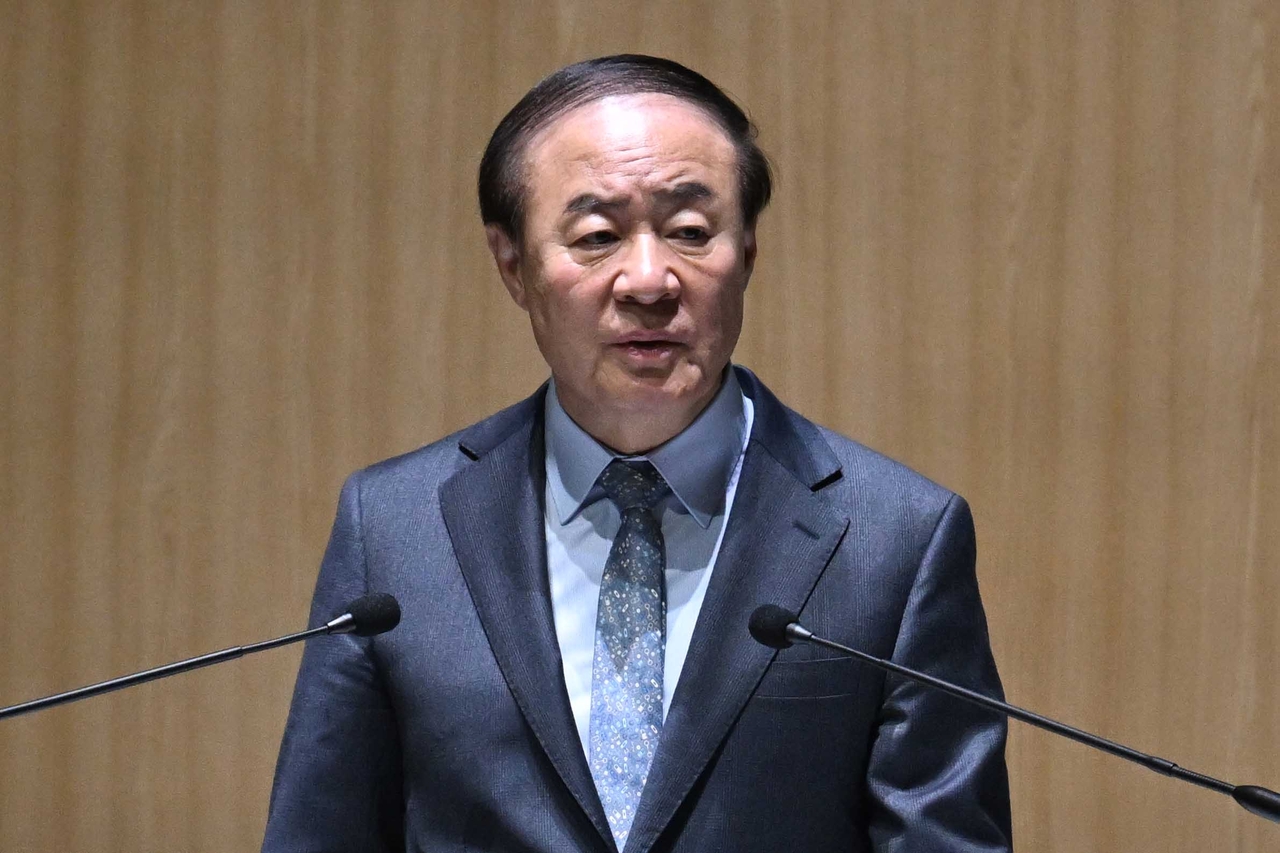
Samsung Electronics held Samsung AI Forum 2026 to share technology and application strategies for translating agentic AI and physical AI into real-world work outcomes.
This year's forum drew particular attention as the head of in-house AI chip development at OpenAI, the maker of ChatGPT, delivered the opening keynote — his first visit to Korea — raising expectations that cooperation between the two companies could become more concrete.
Samsung Electronics held the forum Wednesday at its Seocho office in Seocho-gu, Seoul. Now in its 10th year, the event was held under the theme "Agentic Shift: From Intelligence to Impact." About 400 people attended, including 100 professors and researchers from domestic AI graduate programs and 300 Samsung Electronics employees working in AI.
Samsung Electronics Vice Chairman and co-CEO Jeon Young-hyun said in his welcome address that "agentic AI will bring fundamental changes to the way we work and to organizational culture, going beyond simple technological innovation," adding that the company would "work with global AI leaders to chart the direction forward and drive meaningful AI technology innovation."
Both Jeon, who heads the DS (Device Solutions) division, and co-CEO Roh Tae-moon, who heads the DX (Device Experience) division, emphasized AI transformation — or AX — in their new year addresses this year. Jeon said the company must "develop AI solutions specialized for semiconductors by leveraging the latest AI technology and high-quality data, and apply them across semiconductor design, R&D, manufacturing and quality control to achieve technological innovation." Roh called on employees to "use AI to innovate not just the way we work but the way we think, raising the speed and productivity of everything we do."
In line with that push, Samsung Electronics officially adopted ChatGPT, Gemini and Claude in June as part of its AX drive to reshape work around AI.
![Samsung Electronics holds Samsung AI Forum 2026 at its Seocho office in Seoul. [Samsung AI Forum website]](https://wimg.heraldcorp.com/news/cms/2026/09/30/news-p.v1.20260930.bbc7c525096f4bd8a60ba499eb1b1b77_P1.png)
In the morning session, experts from global technology companies including OpenAI and Amazon Web Services, along with academics from Korea and abroad, outlined the direction of AI development.
Richard Ho, OpenAI's vice president of hardware, delivered the opening keynote for one hour on the theme "From Chatbots to Agentic Workflows," presenting how agentic AI — systems capable of making independent judgments and taking actions based on large language models — will transform businesses and industries.
Ho was one of the core early developers of Google's AI accelerator chip, the TPU (Tensor Processing Unit), and joined OpenAI in November 2023. He also leads the "Jalapeño" project, OpenAI's first AI inference chip co-developed with Broadcom, unveiled in June. Given the deepening ties between the two companies, attention is turning to whether Samsung Electronics' foundry business could play a role in producing OpenAI's next-generation in-house AI chips.
David Green, AWS's AI technology leader for the Asia-Pacific and Japan region, also presented security and governance strategies for deploying agentic AI safely and cost-effectively in enterprise environments.
Ranjay Krishna, a University of Washington professor and physical AI researcher, outlined approaches to overcoming the reasoning limitations of vision-language models and achieving high-performance robotics AI using smaller models.
Kim Yun-hyung, a senior vice president at Samsung Research and a professor at MIT, shared directions for next-generation "agentic intelligence" architecture innovations aimed at expanding the capabilities and scope of AI agents.
Last year's Samsung AI Forum ran over two days, but this year's event was consolidated into a single day. In the afternoon, the DX and DS divisions presented Samsung Electronics' AI research achievements and real-world business applications under the respective themes of "AI Technology" and "AX Innovation."
The AI technology track covered efficient AI, physical AI and continual learning. The efficient AI session introduced device design principles and optimization techniques for improving user experience, along with product case studies featuring on-device AI platform applications.
The physical AI session explored "world models" — systems that learn how the real world operates to predict future situations and the outcomes of actions — as well as the potential and limitations of robot foundation models and Samsung Electronics' related research achievements.
The continual learning session introduced two technologies: a personalized AI capable of learning new information while retaining existing knowledge and editing memories, and a self-evolving AI that autonomously analyzes user complaints arising from real-world product use after launch and improves its own performance.
The DS division's AX Innovation track showcased cases of AI applied directly to the semiconductor business. Global partners including Dell Technologies and Anthropic presented how trusted AI agents can be deployed in workplace settings and shared examples of building enterprise AI factories.
Samsung Electronics' DS division AX/PI (Process Innovation) Center also introduced innovation cases applying AI across operations including semiconductor design and manufacturing. Samsung Electronics said it plans to expand work innovation across its semiconductor business by using AI to address a wide range of challenges that arise on the ground.
go@heraldcorp.com