Five crops, 25 varieties including 2,400 tons of wheat and 1,756 tons of hulled barley
Feed crop seed production up 34.9% from prior plan; first-ever integrated supply plan
The government plans to produce and supply 5,685 tons of government-certified seeds covering five crops and 25 varieties — including wheat, barley and feed crops — for the 2027 winter harvest. The supply of "Heukdahyang," a black barley variety, will more than quintuple from the previous year's plan, and feed crop seed production will also expand to offset disruptions in imported roughage supplies.
The Ministry of Agriculture, Food and Rural Affairs announced Thursday that it would for the first time integrate the winter crop government-certified seed production and supply plans that the National Seed Institute and the Korea Agriculture Technology Promotion Agency had previously drawn up separately.
Until now, the National Seed Institute handled large-volume supplies of major crops such as rice, soybeans, barley and wheat, while the Korea Agriculture Technology Promotion Agency supplied newly developed Rural Development Administration varieties and feed crops in smaller, more diverse quantities. Because each agency published its plan independently, it was difficult to get a clear picture of total government-certified seed volumes at a glance.
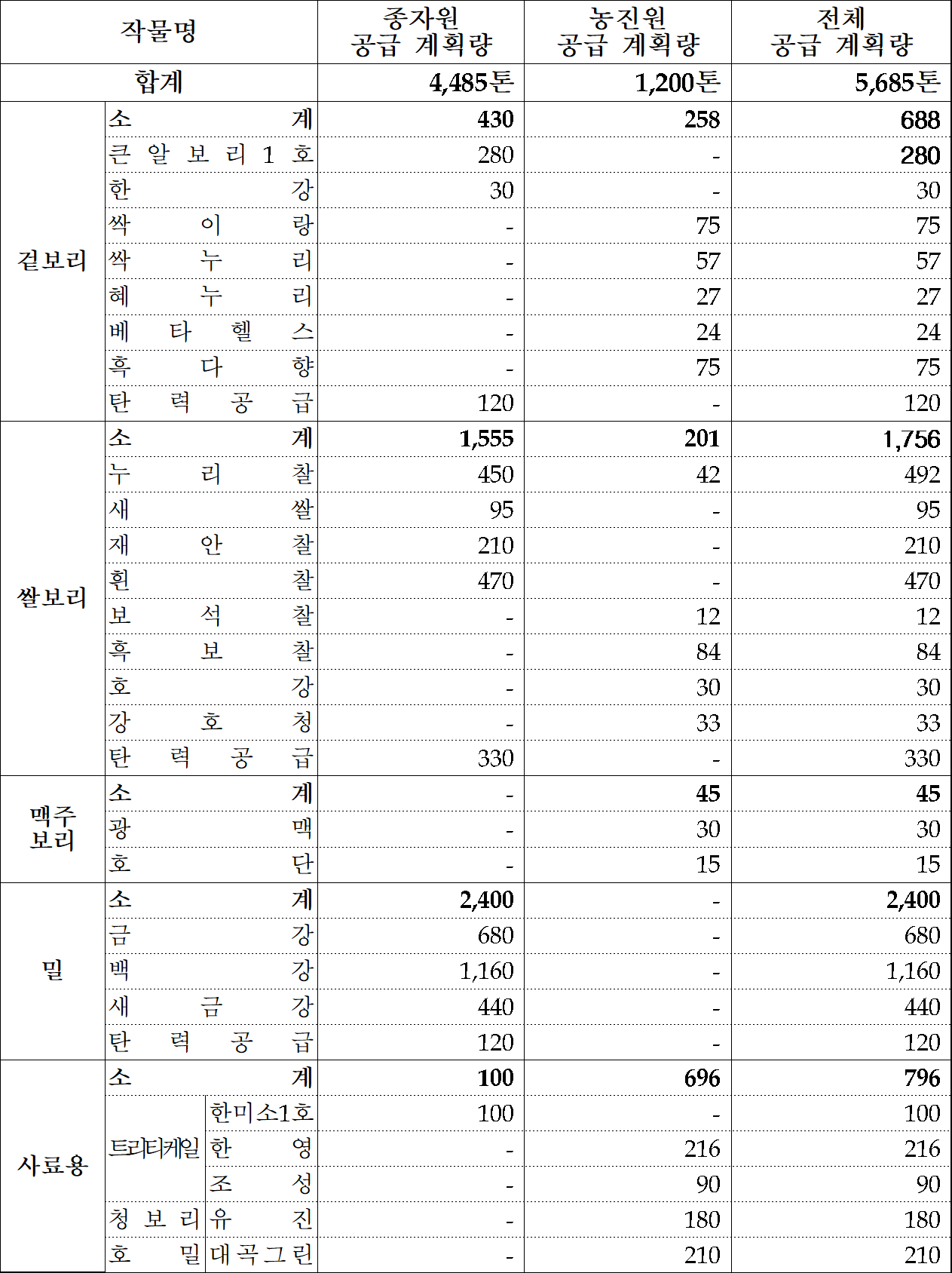
Under the integrated plan, next year's winter crop government-certified seed supply will cover five items — hulled barley, hulless barley, malting barley, wheat and feed crops — across 25 varieties, totaling 5,685 tons. The National Seed Institute will supply 4,485 tons, or 78.9 percent of the total, while the Korea Agriculture Technology Promotion Agency will supply 1,200 tons, or 21.1 percent.
By crop, wheat accounts for the largest share at 2,400 tons, followed by hulless barley at 1,756 tons, feed crops at 796 tons, hulled barley at 688 tons and malting barley at 45 tons.
The total wheat supply will be held at 2,400 tons in line with efforts to raise domestic wheat self-sufficiency and expand bread-making varieties. By variety, the plan calls for 1,160 tons of Baekgang, 680 tons of Geumgang and 440 tons of Saegumgang, among others, to meet shifting demand.
For edible barley, volumes will be adjusted to focus on varieties with strong actual demand while expanding the supply of new colored and functional varieties. The supply of Heukdahyang black barley will rise from 13.5 tons in the previous year's plan to 75 tons — more than a fivefold increase.
Feed crop supplies will also expand. The ministry plans to supply a total of 796 tons — including 406 tons of triticale, 210 tons of rye and 180 tons of green barley — reflecting growing demand for domestically produced seed amid a rising exchange rate and import supply disruptions stemming from the Middle East war.
The Korea Agriculture Technology Promotion Agency's feed crop seed production plan will grow 34.9 percent, from 687.8 tons to 928 tons. The National Seed Institute will also increase output of the triticale variety Hanmiso 1 by 42.9 percent, from 70 tons to 100 tons.
The production and supply system for government-certified seeds will also be managed in an integrated manner. The ministry formed a government-certified seed policy consultative body in August after holding working-level consultations with the Rural Development Administration, the National Seed Institute and the Korea Agriculture Technology Promotion Agency. The body will convene regularly each spring and fall to discuss seed production and supply plans for summer and winter crops, address current issues and review each agency's role.
Starting this year, government-certified seed varieties produced by the Korea Agriculture Technology Promotion Agency that overlap with those of the National Seed Institute will be priced in line with the institute's rates, reducing the financial burden on farmers. The ministry plans to compile the newly integrated winter crop government-certified seed production and supply plan into a booklet and distribute it to provincial governments and agricultural technology centers.
"By bringing together seed information that had been scattered across agencies, local governments and farmers can now check and prepare the seeds they need in advance," said Lee Si-hye, the ministry's director general for agro-industry innovation policy. "We will strengthen inter-agency communication through the policy consultative body and respond appropriately to complaints from the farming community."
adastra@heraldcorp.com