[Part 2: The state of employment for older women] ①
Women account for 66% of senior job program participants
Concentrated in public-service roles, underrepresented in private-sector positions
Korea Senior Citizens Association tracks vulnerable elderly employment for first time
[Editor's note] South Korea's elderly poverty rate is 2.7 times the OECD average. Older women face even greater hardship than older men. For much of their lives, they were expected to devote themselves to caring for family, setting aside careers outside the home. That career interruption eroded their professional identity and made financial independence harder to achieve. In old age, many now struggle to cover daily living costs. This series examines how the sacrifices women made in their younger years have come due — in the form of poverty and insecurity.
![An older job seeker receives employment counseling at a job fair held in Hanam last year. [Yonhap]](https://wimg.heraldcorp.com/news/cms/2026/09/30/rcv.YNA.20250611.PYH2025061112090001300_P1.jpg)
Growing numbers of older women are returning to work because their retirement income falls short. For five consecutive years, women have made up two-thirds of all participants in South Korea's senior employment program — yet a closer look at the data reveals that women are concentrated in lower-paying public-service roles, while their share drops sharply in the higher-paying private and corporate-linked positions.
Data obtained from the Korea Senior Employment Agency covering the past five years show that women's share of senior job program participants stood at 67.2 percent in 2022, 66.7 percent in 2023, 66.2 percent in 2024, 66 percent in 2025, and 66.2 percent as of August this year. Women have accounted for roughly two-thirds of all participants throughout that period. The number of female participants also rose by more than 150,000 — from 652,990 in 2022 to 808,559 as of August this year.
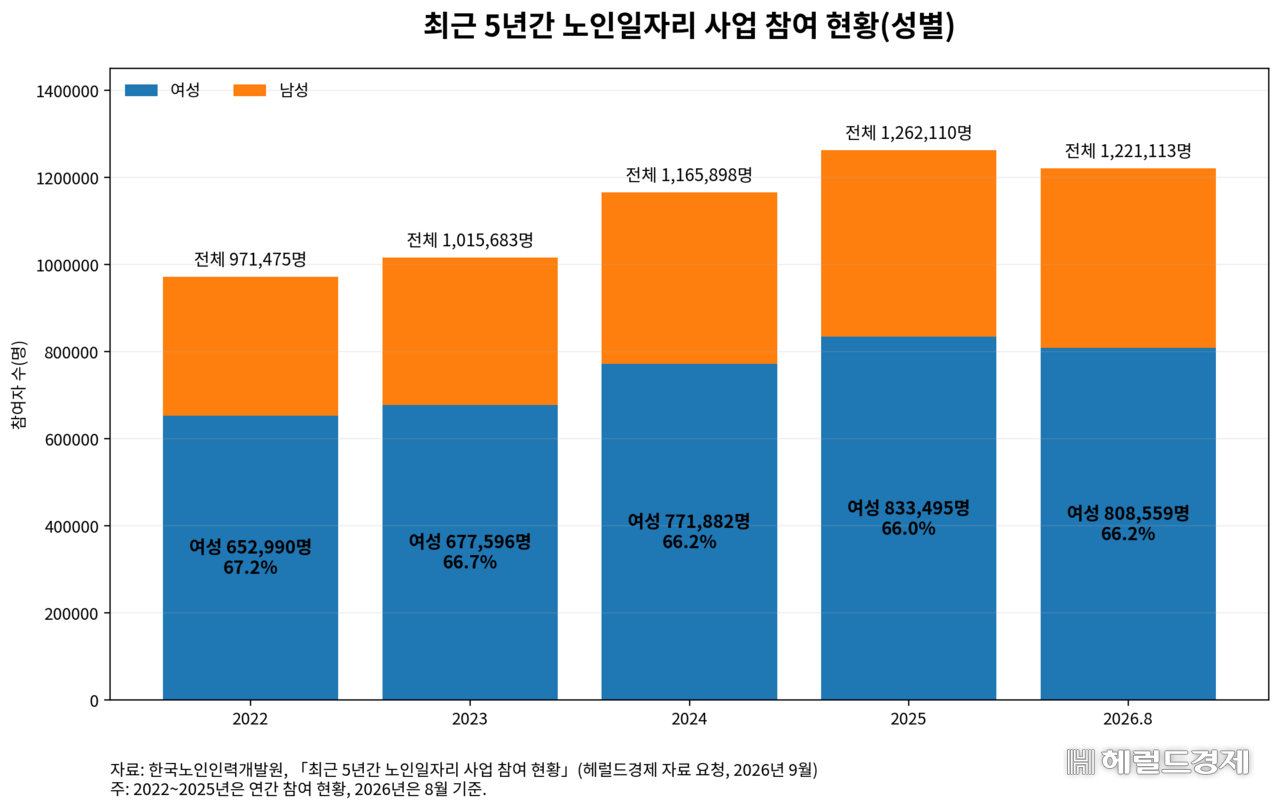
High female participation, however, does not mean equal job quality. The public-service positions where women are most heavily represented tend to require little prior career experience or specialized skills. Private-sector employment, which pays considerably more, offers a wider range of roles in manufacturing, office work and professional fields — positions that draw on the career histories participants built earlier in life.
The gap is clear when the numbers are broken down by job type. In 2024, women made up 70.8 percent of participants in the public-service activity program. Their share was limited to 48.1 percent in employment support programs linked to private-sector jobs, 30.5 percent in on-site training programs where participants gain hands-on work experience at companies, and 43.5 percent in senior-friendly enterprise and institutional programs.
Women lead in senior jobs, but the quality gap tells a different story
The same disparity emerged in the Korea Senior Employment Agency's 2025 survey on the state of senior employment. The survey covered about 3,000 active participants drawn from those enrolled in or waiting for the senior job program as of the end of June 2025.
Among female respondents, 70.6 percent were in the public-service activity program, while participation in employment support programs was limited to 4.0 percent and on-site training programs to 2.6 percent. Male participants were in employment support programs at 8.6 percent and on-site training programs at 14.1 percent — roughly twice and more than five times the female rates, respectively.
The difference in job type translated directly into an income gap. The public-service activity program paid an average of 231,000 won ($170) per month, while the employment support program paid 1.58 million won and the on-site training program paid 1.02 million won. Across all senior job programs, men earned an average of 538,000 won per month compared with 349,000 won for women — a gap of 189,000 won.
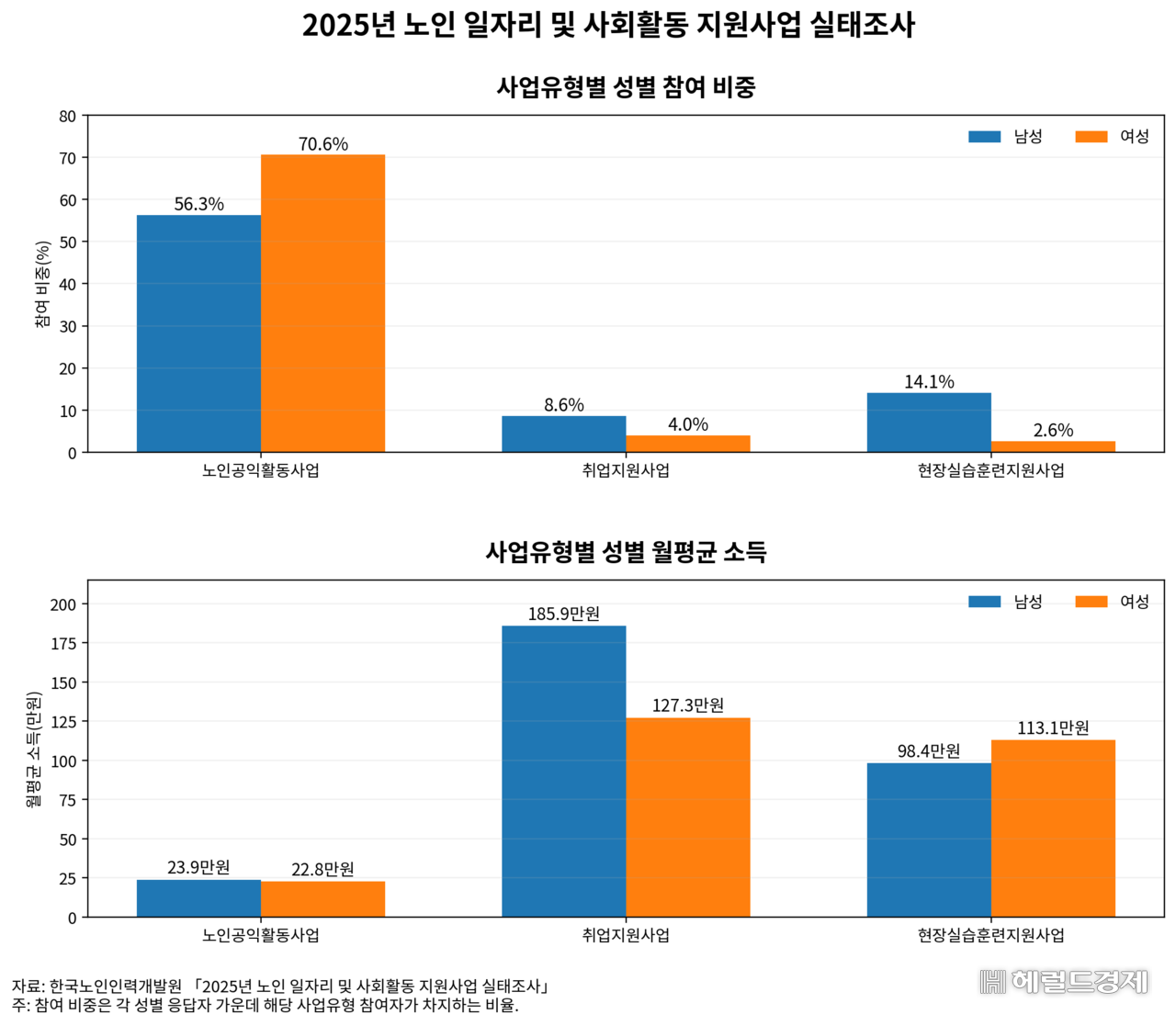
Cheon Jae-young, a researcher at the Korea Senior Employment Agency, said the income differences stem from how each program is structured. "Public-service programs pay a fixed amount, but employment support and on-site training programs are connected to private businesses, so the pay can be higher," she said. "Men are more heavily represented in the programs that pay more."
Cheon said the disparity did not emerge suddenly in old age. Private-sector positions can draw on careers built in manufacturing, office work or professional fields — the kinds of jobs men more commonly held — while older women tend to participate in roles that resemble the caregiving and domestic work they performed earlier in life.
Kim Nan-ju, a researcher at the Korean Women's Development Institute, said women's overall dominance in the senior job program masks their weaker foothold in the better-compensated segments. "Women make up a large share of total participants, but their presence is relatively small in private-sector and corporate-linked positions," she said. "Those jobs tend to offer better wages and working conditions, so we need to examine whether women have sufficient access to them."
She added that today's women in their 60s are better educated than previous generations. "Simply funneling women into caregiving or public-sector jobs is not the answer," she said.
Korea Senior Citizens Association tracks vulnerable elderly job placements for first time, across 189 centers
For elderly women living in poverty, what matters is not simply whether a job exists but what kind of job it is and how much it pays. Yet until now, no separate statistics have accurately tracked how many low-income and otherwise vulnerable elderly people have been placed in private-sector jobs.
The Korea Senior Citizens Association has decided this year to conduct, for the first time, a comprehensive nationwide count of private-sector job placements among low-income and other vulnerable groups, covering all 189 of its employment support centers across the country.
The association arranges roughly 45,000 to 50,000 private-sector job placements a year, but its existing computer system had no field to distinguish whether a placed worker belonged to a vulnerable group. This year it created a new "vulnerable-group employment performance" category to track the number of consultations and placements across four groups: people with disabilities, low-income individuals, elderly people living alone, and the long-term unemployed. An official from the association's employment support team said the relevant instructions had been sent to all 189 centers nationwide. "We plan to count how many of the people placed in jobs this year fall into vulnerable categories, cut off the figures at the end of November, and compile them in December," the official said.
Regional chapters of the association, including the Seoul chapter, have also confirmed receipt of the instructions from the national headquarters. A Seoul chapter official said a separate "vulnerable-group employment performance" category with four subcategories — tracking both consultation and placement figures — had been added this year. "This is the first time we have broken down our results this way under the vulnerable-group label," the official said.
![People line up to apply for jobs at a senior employment fair held at the Mapo-gu district office in Seoul last year. [Yonhap]](https://wimg.heraldcorp.com/news/cms/2026/09/30/rcv.YNA.20251210.PYH2025121010320001300_P1.jpg)
The Korea Senior Citizens Association launched the initiative after receiving feedback through the Ministry of Employment and Labor's performance evaluation of government-funded employment programs. The evaluation, which assesses the results of job programs that receive public funding, is conducted by the Korea Employment Information Service under a government contract. The association's employment support program was among those reviewed at the evaluation held in February covering the previous year's activities.
An association official said the evaluation had prompted a shift in focus. "The feedback at the time was that we should look not only at the quantitative side — such as how many people were placed — but also at the substance of those placements," the official said. "That is why we decided to track vulnerable-group performance separately." A Korea Employment Information Service official who attended the evaluation said there had been broad agreement that, given the high elderly poverty rate, supplementing income through employment — rather than relying solely on government-paid positions — was necessary.
The new count represents the first attempt to examine placement results by vulnerable-group category, rather than simply by total numbers placed. A Seoul chapter official said the data collection from individual centers had not yet begun. The centers will compile their results and submit them to the national headquarters.
The Korea Employment Information Service official said discussions had also touched on expanding employment opportunities so that the programs could serve a "welfare-through-work" function as the population of people aged 70 and older continues to grow. "There is a view that, given the high elderly poverty rate, income needs to be supplemented through employment," the official said.
jookapooka@heraldcorp.com