AmCham hosts 'Doing Business in the US Seminar'
Korea's investment in US topped $96 billion last year
'The Korea-US alliance has evolved from defense to economics'
"If the price is the same, please invest in America." — Michelle Steel, US Ambassador to Korea
Korea's cumulative direct investment in the United States surpassed $96 billion last year, and the Korea-US relationship is rapidly expanding beyond defense and security into a full economic alliance. With Korean corporate investment in the US surging, calls are growing for both governments and legislatures to back that momentum and build a mutually beneficial investment ecosystem.
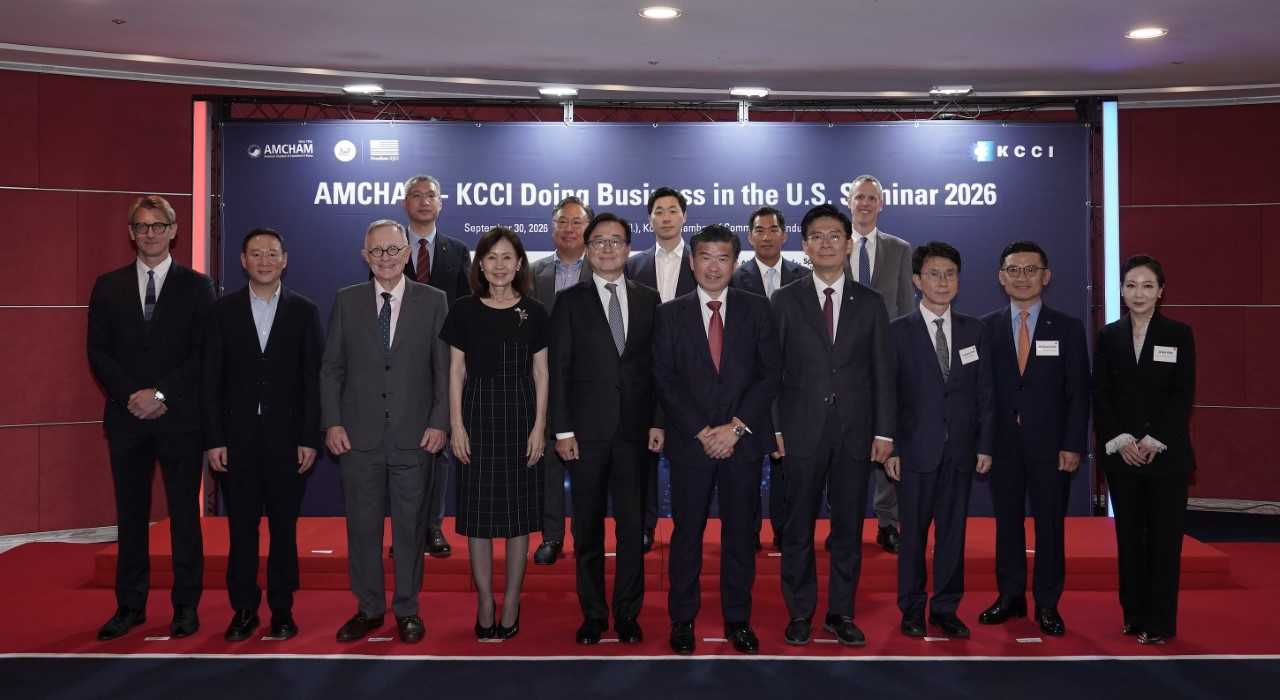
The American Chamber of Commerce in Korea co-hosted the 8th Doing Business in the US Seminar with the Korea Chamber of Commerce and Industry at the KCCI's international conference hall in Seoul on Wednesday.
Ambassador Steel highlighted that Korean investment in the US has surpassed $96 billion, saying Korean companies are active "in nearly every sector of the American economy" and that "Korean investment is creating opportunities for American workers, building factories and transforming communities."
"The Korea-US alliance has evolved from defense and security into an economic alliance," she said, adding that "the Korea-US economic partnership will grow even stronger as we celebrate the 250th anniversary of American independence and build the industries of the future together." She then delivered her closing appeal in Korean: "If the price is the same, please invest in America."
Korean lawmakers signaled their own support for expanding investment in the US market. People Power Party lawmaker Cho Jeong-hun, who leads his party's side on the Korea-US Parliamentary Friendship Group, said, "I'd like Americans to buy Korean, and I'd like Koreans to invest in America," adding that the alliance had moved "beyond buying and selling to a stage where we invest together and create jobs together for mutual benefit — the result of 70 years of blood, sweat, effort and perseverance."
Cho acknowledged the mixed feelings many Korean politicians share. "As a Korean politician, I'm proud to see our companies going abroad, but I'll be honest — there's also a part of me that wonders why they're building factories in America instead of Korea," he said. He added, however, that the US market holds "special economic and strategic value," and that the ruling and opposition parties had joined forces to pass special legislation actively supporting Korean companies entering the US market.
"It is not easy for the ruling and opposition parties to agree and pass a bill in a National Assembly that fights every day," he said. "The fact that this law passed quickly means there is no partisan divide when it comes to supporting our companies investing in the US. The Assembly will spare no effort in providing active support so that both Korea and the US see tangible results."
James Kim, chairman of AmCham Korea, said the Korea-US relationship has already moved well beyond traditional trade ties.
"Today, the relationship between our two countries goes far beyond simple trade. Investment, technology, innovation and supply chain resilience now define it," Kim said, urging Korean companies to pursue the US market more aggressively. "To be a truly global company, you need to be able to invest, sell and produce in America."
Park Jong-won, president of the Korea-US Strategic Investment Corporation, said Korea's investment in the US exceeded $19 billion in the first half of this year, up about 80 percent from the same period last year, while bilateral trade surpassed $181 billion through August, a 44 percent increase year on year. He said the figures showed the relationship was generating major opportunities for both countries.
"The US has world-class technology, an innovation ecosystem and a vast market, while Korean companies bring strong manufacturing competitiveness and rapid technological innovation," Park said. "By combining the strengths of both countries, we can go beyond a simple investment relationship and become partners that raise global industrial competitiveness together."
He said the partnership offered concrete gains on both sides. "The US can create high-quality jobs and strengthen supply chain stability through Korean investment, while Korean companies can expand their access to the US market and secure opportunities to enhance their global competitiveness," he said. "This is the mutually beneficial 'win-win' model of economic cooperation we are pursuing."
The Korea-US Strategic Investment Corporation is particularly working to identify investment projects not only in advanced industries such as semiconductors but also in the shipbuilding sector.
"The corporation is doing its utmost to ensure investment in the US proceeds without a hitch under our strategic investment framework," Park said. "In the area of shipbuilding cooperation and investment, we are also working closely with Korea's shipbuilding industry and related financial institutions to identify viable projects."
He said he was confident the partnership would generate a virtuous cycle in which strategic Korea-US investment leads to growth and stronger competitiveness for companies on both sides.
go@heraldcorp.com