Domestic tax increase of 56.2 trillion won would generate 10.8 trillion won in local allocation tax settlement under current law
North Gyeongsang Province estimated to lose 1.7 trillion won; South Jeolla 1.3 trillion won; South Gyeongsang 1.2 trillion won
Think tank says any discussion of saving next year's extra revenue must not come at the expense of this year's legally owed settlement
![Democratic Party of Korea leader Kim Min-seok (right) and floor leader Han Byung-do attend a ruling party-government consultation on the future response fund at the National Assembly members' office building on Wednesday. [Yonhap]](https://wimg.heraldcorp.com/news/cms/2026/10/01/rcv.YNA.20260929.PYH2026092902280001300_P1.jpg)
If the government transfers this year's projected surplus tax revenue in full to a future response fund and excludes it from the local allocation tax calculation base, the additional ordinary local allocation tax settlement that local governments would otherwise receive would shrink by about 10.5 trillion won ($7.75 billion), according to a new analysis. The Narasallim Research Institute said that even if discussions proceed on setting aside next year's extra revenue in such a fund, local governments' share from this year's surplus tax revenue must still be settled in accordance with current law.
According to the institute's report released Thursday — titled "Ordinary local allocation tax settlement to fall by 10.5 trillion won if surplus tax revenue is transferred to future response fund" — the local allocation tax settlement resources generated by this year's increase in domestic tax revenue are estimated at about 10.8 trillion won. Of that total, 10.49 trillion won would go to the ordinary local allocation tax and 324.4 billion won to the special local allocation tax.
The analysis is based on the government's revised estimate of this year's national tax revenue, which the Ministry of Economy and Finance released on Wednesday.
This year's national tax revenue is now projected at 478.6 trillion won, 63.2 trillion won more than the 415.4 trillion won incorporated in the first supplementary budget. General account domestic tax revenue is forecast to rise by 56.2 trillion won, from 368.1 trillion won to 424.3 trillion won.
The institute calculated the settlement resources by applying the 19.24 percent local allocation tax rate to that domestic tax increase. The ordinary and special local allocation taxes are distributed at ratios of 97 percent and 3 percent, respectively. The calculation assumes no change in legally excluded items such as the individual consumption tax on tobacco, and the institute said it simplified the calculation because certain tax items excluded from the local allocation tax base involve negligible amounts.
Under the current legal framework, local allocation taxes are settled based on the difference between the domestic tax revenue projected in the budget and the actual final accounts. The institute said the settlement arising from this year's surplus tax revenue must legally be paid out by 2028, and that in practice it is most commonly reflected in the following year — in this case, 2027.
However, if the law is amended as the government envisions — transferring all surplus tax revenue to the future response fund and excluding that amount from the local allocation tax calculation base — the settlement resources tied to the revenue increase would disappear entirely, the institute said. This would not mean cutting already-allocated tax grants; rather, the additional settlement that local governments would have received under current law would simply no longer materialize.
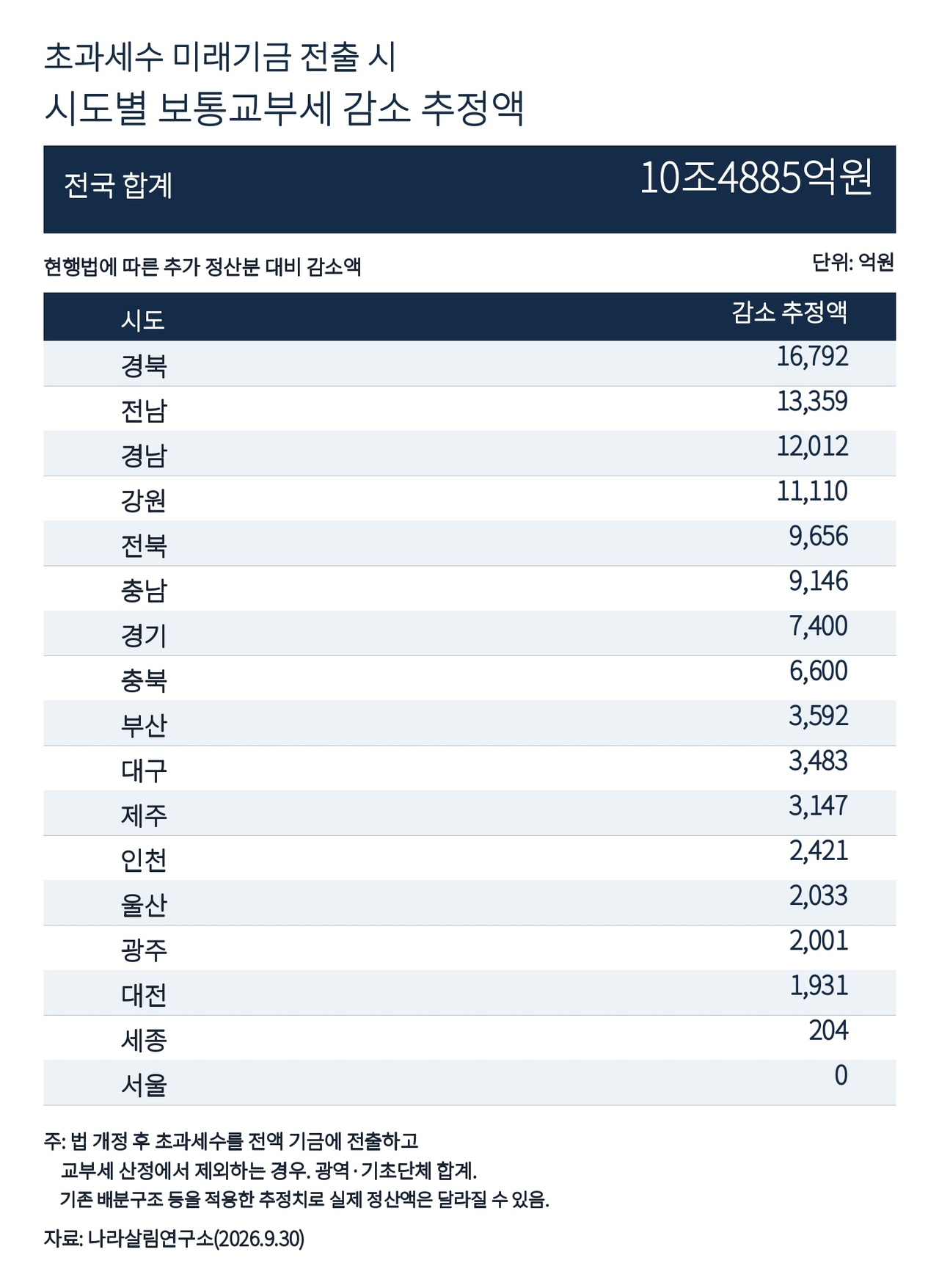
By region, North Gyeongsang Province faces the largest estimated reduction in ordinary local allocation tax, at 1.68 trillion won, followed by South Jeolla Province at 1.34 trillion won, South Gyeongsang Province at 1.2 trillion won, Gangwon Province at 1.11 trillion won, North Jeolla Province at 965.6 billion won and South Chungcheong Province at 914.6 billion won. Gyeonggi Province is estimated to lose 740 billion won, North Chungcheong Province 660 billion won, Busan 359.2 billion won and Daegu 348.3 billion won.
These figures combine the metropolitan government headquarters and the basic local governments under their jurisdiction. Seoul was not included in the analysis because it does not receive ordinary local allocation tax, being classified as a non-recipient entity. The institute cautioned that the regional figures are estimates based on this year's fiscal shortfall and existing distribution structures, and that actual settlement amounts could vary depending on fiscal demand and revenue conditions at the time of payment, as well as government distribution decisions.
The institute said a distinction must be drawn between "extra revenue" — tax intake that exceeds the long-term trend — and "surplus revenue," which simply exceeds the budgeted forecast. The judgment that some extra revenue should be set aside to buffer against economic fluctuations does not automatically lead to the conclusion that this year's surplus revenue must also be deposited into the fund, it said.
The institute particularly noted that the size of surplus revenue depends not only on actual tax collection but also on how accurately the government projected tax intake in the first place. Even if the same amount of tax is collected, the less the government forecasts in revenue, the larger the pot available for the fund — and the smaller the share left for local governments.
The institute also said the proposal to treat transfers of surplus revenue to the fund as an exception to the normal revenue-and-expenditure budget process should be examined for compatibility with the National Assembly's constitutional authority to deliberate and approve budgets. Because surplus tax revenue is general tax income that can be used for various purposes — including local fiscal support, debt repayment or fund contributions — any change to its distribution requires policy judgment and consensus, it said.
"Even as discussions on saving extra revenue proceed, the principle that surplus revenue will be settled in accordance with current law must serve as the minimum basis for compromise between the central and local governments," the institute said. It also recommended that the government disclose the settlement amounts for each local government and the reductions that would result from the proposed system change, and reach agreement with local governments, local assemblies and residents.
fact0514@heraldcorp.com