Interview with Kim Sol-ji, Nam Jae-guk, Ryu Se-il and Park Eun-kyung
'Dried Chili and Peach-Scented Lipstick' opens Friday
One actor, four roles — shedding costumes to shed characters
"My story, inside a patriarchal and queer narrative"
![The four lead actors of the play "Dried Chili and Peach-Scented Lipstick" — Park Eun-kyung, Kim Sol-ji, Ryu Se-il and Nam Jae-guk — from theater collective Gongnolli Club [Mapo Cultural Foundation]](https://wimg.heraldcorp.com/news/cms/2026/10/02/news-p.v1.20261002.6e47114e342c491081ebed2956b758cd_P1.jpg)
A young man and woman in a flirting scene. "I'm the type who plays hard to get," says Kim Sol-ji. Two actors who live to make people laugh — and they're at it again. Brazen and deadpan, an unpredictable volley of words begins.
"Let's go get mungteogi."
Ryu Se-il, playing the man making his move, tosses the line out. Without a fraction of a second's pause, the woman playing hard to get fires back: "I'm a vegetarian." Lines that exist nowhere in the script come flying out. Nam Jae-guk, watching from the wings, is fighting to keep a straight face. The ad-libs follow the unspoken rules of time, place and occasion, and they reflect wherever the company happens to be performing. In Daejeon, Sungsimdang gets a shout-out; in Geochang, the scenic spot Suseungdae is invoked. "Mungteogi" — a local beef dish — surfaced during the Daegu run of "Dried Chili and Peach-Scented Lipstick."
"There's no discussion beforehand at all. I just throw something out there, trusting that Sol-ji will catch whatever it is. When it clicks perfectly like that, I'm just so happy in that moment." (Ryu Se-il)
The next stop is Mapo, Seoul. Nam Jae-guk said he is "looking forward to seeing what ad-libs come out over the next month." Kim Sol-ji drops a hint: "I'm thinking Eulmildae might come up." It is a naengmyeon restaurant in Mapo that anyone in the know already knows.
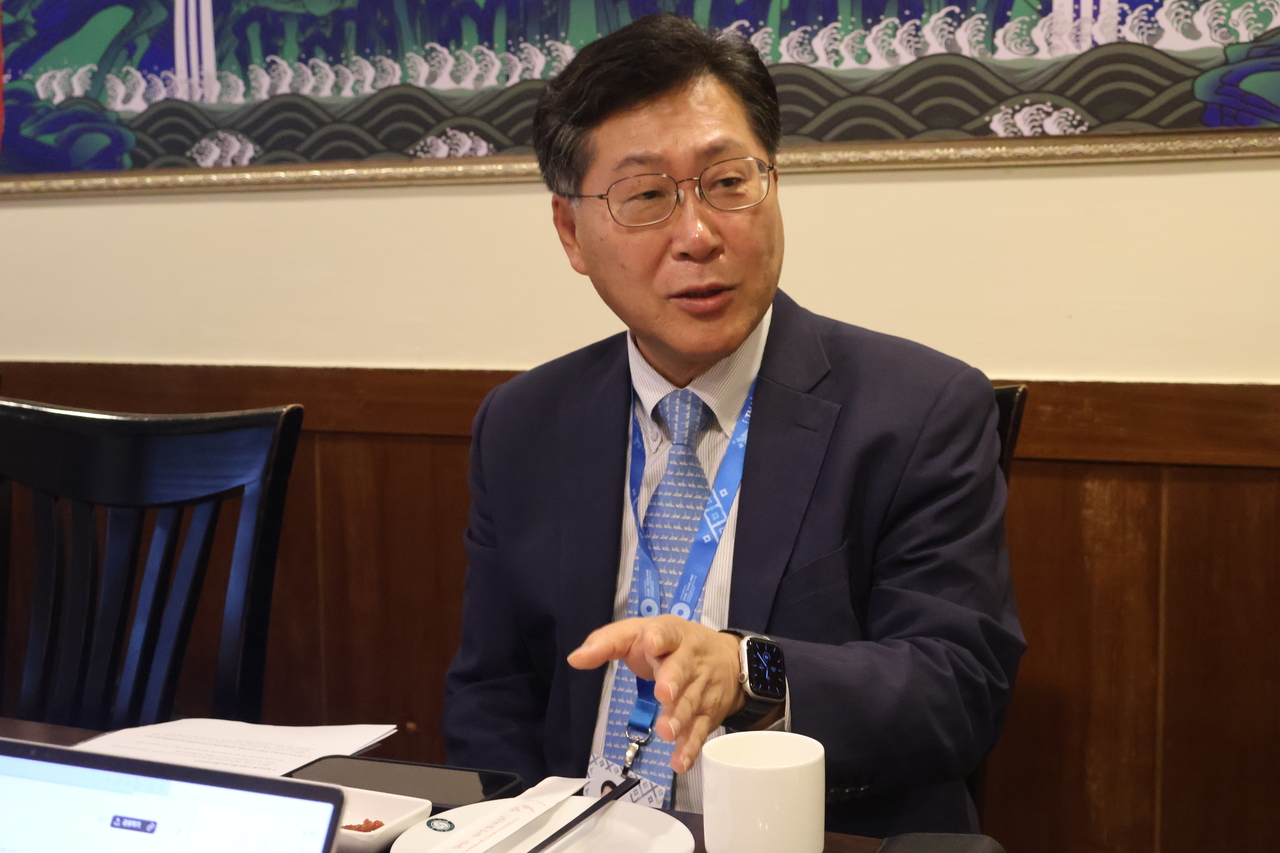
The four actors of theater collective Gongnolli Club — Kim Sol-ji (39), Nam Jae-guk (33), Ryu Se-il (35) and Park Eun-kyung (36) — are masters of the pass play, on stage and off. Whatever you throw at them, they catch it with their whole body, and when all four are in the same room, the noise level is off the charts. They make theater the way kids kick a ball around in the alley with no rules — which is exactly what the name Gongnolli Club, meaning "ball-play club," suggests.
The original cast members who have held the stage since the premiere of "Dried Chili and Peach-Scented Lipstick" in 2024 are now entering their final run. Meeting the four actors at Mapo Art Center ahead of opening night, Kim Sol-ji described the production as "a festival where the stories of four families are spread out everywhere, like chili peppers drying in the yard, hitting all five senses."
![A scene from the play "Dried Chili and Peach-Scented Lipstick" [Gongnolli Club]](https://wimg.heraldcorp.com/news/cms/2026/10/02/news-p.v1.20260927.59808d188f5042cb962225d08d642dd8_P1.jpeg)
A 100-minute role-play that breaks the mold
The setting is Sujeong Villa in Susaek-dong, Eunpyeong-gu, Seoul, in 2010, on the eve of redevelopment. The household's one source of pride is Gyubin, the eldest son who attends Seoul National University. His sister Eunbin, accepted to a dental school outside Seoul, wants nothing more than to escape the family home. Their mother Mihui is trapped in self-pity, worn down by her husband's absence and her mother-in-law's contempt. Presiding over everything is the family's absolute authority, grandmother Bokja. What shatters the household's fragile peace is a peach-scented lipstick that keeps disappearing. When Eunbin figures out her brother Gyubin's true identity, cracks begin to spread through the family.
The play took on an unfamiliar shape when Gongnolli Club got hold of it. The four actors have no fixed roles — they take turns playing all four characters. A daughter becomes a son, then a mother, then a grandmother. Gender and age are erased in an instant, along with the costume each actor frantically changes into backstage.
Ryu Se-il recalled that during the script-reading performance, actors matched to the appropriate age had each played their own role. "But if we went with a conventional drama series format, I felt Gongnolli Club's color wouldn't come through," he said. Kim Sol-ji added that the idea originated with director Kang Hun-gu, who wondered what it would look like to have a small group of actors rotate through the roles in a kind of role-play.
The casting had nothing to do with acting style or the actors' individual images — it was based on cold physical calculation. Park Eun-kyung explained that the team kept the backstage quick-change choreography from getting tangled, and set a rule that "all four actors play both Gyubin and Eunbin at least once."
![Gongnolli Club actors Park Eun-kyung, Ryu Se-il, Nam Jae-guk and Kim Sol-ji (from left) [Mapo Cultural Foundation]](https://wimg.heraldcorp.com/news/cms/2026/10/02/news-p.v1.20261002.cd1cde31b3424e8ab225310ddeec560e_P1.jpg)
The approach was not without its anxieties. Ryu Se-il said he initially worried about whether he, as a man, could fully inhabit a woman and a transgender character. "But the moment I put on the grandmother's clothes, I realized the audience knows I'm not really a grandmother — and they go along with it anyway. Once I understood that they enjoy the rules of the game, I relaxed." The combination of a gripping script and Gongnolli Club's irreverent energy keeps the 110-minute production bouncing from start to finish.
"When we played house as kids, nobody cared about gender — you'd just say 'I'm the dad this time, I'm the mom this time.' The sheer playfulness of pulling on a costume and running out onto the stage is just fun." (Kim Sol-ji)
Backstage, however, every second is a battle. Park Eun-kyung said that no matter how much they rehearse, something always goes wrong during a quick change. "There are nights when a shoe won't go on and I have to run out still putting it on," she said. "Every time I step onto the stage with my breath ragged and my nerves frayed, I'm trembling."
Hunched shoulders and a sunken jaw — synchronizing through the body
Gyubin grew up as the family's favorite, and now struggles between the burden of being the eldest son and his queer identity. Eunbin, perpetually overlooked and asked to give way, is fed up with a household that only has eyes for its son. The residents of Unit 203 at Sujeong Villa are a family, but each carries a different wound.
Nam Jae-guk, who laid the foundation for Gyubin, sees the character as someone "trapped in the mold of the good son — the only male in the family, the eldest."
"I thought Gyubin's desire to live as a transgender person, to reveal his identity, comes from a desperate longing to live fully as himself — just as he is. He wants a world and a life where he doesn't need to persuade anyone, doesn't need to be understood, doesn't need to be accepted — where simply being himself, exactly as he is, causes no problem at all." (Nam Jae-guk)
What makes the rotating structure particularly interesting is how it shifts perspective. When Nam Jae-guk, who plays Gyubin in the first half, becomes Eunbin in the second half, his view of Gyubin changes entirely. In a scene where Gyubin's actions get Eunbin fired from her part-time job, Nam said: "Until then, as Gyubin, I had felt grateful toward Eunbin. But when I became Eunbin and faced that moment, I was confused — thinking, 'Why is he so wrapped up in himself?'"
![A scene from the play "Dried Chili and Peach-Scented Lipstick" [Gongnolli Club]](https://wimg.heraldcorp.com/news/cms/2026/10/02/news-p.v1.20260927.92a43e3df5224247b9832951286483c0_P1.jpg)
Each actor shoulders a different piece of the family's deprivation: Ryu Se-il plays grandmother Bokja, a woman whose only goal is survival after living through Japanese colonial rule, liberation and war; Kim Sol-ji plays mother Mihui, a knot of resentment built up from caring for her mother-in-law and an obsessive attachment to her Seoul National University son; and Park Eun-kyung plays Eunbin, treated as a nuisance yet standing in solidarity with Gyubin.
Playing one actor across four roles demanded rigorous synchronization. As in other Gongnolli Club productions, the play opens with self-introductions, and in the first act the actor who first takes on each character establishes that character's baseline. Nam Jae-guk set the template for Gyubin, Park Eun-kyung for Eunbin, Kim Sol-ji for mother Mihui, and Ryu Se-il for grandmother Bokja. Once each actor had defined a character's distinctive traits, the others absorbed the gestures and speech patterns as if copying them.
Nam Jae-guk's Gyubin became defined by "shoulders hunched inward, the left hand gripping the right arm, and a habit of frequently touching his hair." Park Eun-kyung visualized Eunbin through "a defensive one-legged stance, crossed arms and a jutting lower lip." Kim Sol-ji gave Mihui "the customer-service smile of a door-to-door salesperson and a constant habit of rubbing dry hands together." Ryu Se-il took his cue from his own grandmother. "When she took out her dentures without using her hands, her jaw would sink in and her lower lip would droop," he said. "I pictured that and built Bokja from it." Kim Sol-ji admitted she still cannot quite replicate Ryu's version of Bokja. "I asked him to record his lines for me so many times so I could listen and practice," she said.
The four actors lock together on stage like four transforming robots moving in perfect unison, switching modes with the agility of something out-of-body. Even through the split-second character shifts, not a single gear grinds. Their seamless four-roles-one-actor performance grabs the audience by the collar and doesn't let go.
"When I'm playing a character, I think only of that character — but the moment I walk offstage and take off the costume, I shed that character completely. Because I have to go straight out as the next one, the physical synchronization has to already be in place, so that the moment I put the costume on, that character layers over me." (Kim Sol-ji)
![Gongnolli Club actors Park Eun-kyung, Ryu Se-il, Kim Sol-ji and Nam Jae-guk (from left) [Mapo Cultural Foundation]](https://wimg.heraldcorp.com/news/cms/2026/10/02/news-p.v1.20261002.cd9efd1b55f84b89a967ba320b874566_P1.jpg)
Raw instinct and relentless refinement — a pass play built on total trust
A single glance is more than enough — sometimes not even that. They are ready to receive each other just from the back of a head. Having worked side by side for at least five years, they know each other's strengths better than anyone. The extraordinary chemistry on stage rests on deep mutual trust. They tease and mock each other constantly, yet beneath it all lies a profound respect for one another as colleagues.
Nam Jae-guk marvels at Ryu Se-il's "animal-like instinct that throws itself in with total conviction," and at Park Eun-kyung's "obsessive attention to detail — the detail of someone truly possessed by theater." Ryu Se-il says he wants to emulate "Park Eun-kyung's upright attitude toward the work" and "Nam Jae-guk's tenacity in digging all the way to the bottom." On Kim Sol-ji, all four speak with one voice: "Acting isn't just her calling — she's a national treasure." Park Eun-kyung divides the four into two camps.
"Jae-guk and I feel like we don't have a lot of natural gifts, so we hold the fundamentals through the diligence and endurance of constant self-refinement. Se-il oppa and Sol-ji unni, on the other hand, are flexible — like people born for outdoor folk theater — and they solve things whenever something unexpected happens. The meticulous ones and the fixers are mixed together, and it feels harmonious."
The aesthetic foundation of Gongnolli Club, built around these four actors, is play. From the stalls, director Kang Hun-gu repeats one phrase like a mantra: "Don't act."
![Gongnolli Club actors Park Eun-kyung, Ryu Se-il, Nam Jae-guk and Kim Sol-ji (from left) [Mapo Cultural Foundation]](https://wimg.heraldcorp.com/news/cms/2026/10/02/news-p.v1.20261002.3e812bacaf9a4bec90f5df1cec8916a0_P1.jpg)
Nam Jae-guk said that at first he thought it really was just a matter of playing around, but came to understand that "you have to know who that character is with even greater obsession and conviction before you can play freely in any situation." Kim Sol-ji noted that elsewhere she finds herself straining to act, whereas here "there's a pleasure in making something rough and natural rather than polished."
Even for four actors who know how to play, the stage is always frightening. Because the production roams freely across the border between improvisation and choreography, Park Eun-kyung shook her head and said "the fear only gets worse with each passing day." Ryu Se-il agreed: "Meeting an audience is always terrifying." But they have learned to embrace the fear. "I think the moment you stop being afraid is actually more dangerous. Confidence grounded in evidence disappears when the evidence does — but groundless confidence has nowhere to go. Even if I crash and burn, I will not walk out there without confidence. That is my courtesy to the audience." (Ryu Se-il)
After a run of about 20 performances through Oct. 25, the play will part ways with its four actors. The production, which won the Young Theater Award at the Baeksang Arts Awards and a special jury prize at the Seoul Arts Awards at its premiere, will be recast with new actors. The original cast members, heading into their final performances of "Dried Chili and Peach-Scented Lipstick," described the play as "growing pains for everyone" (Nam Jae-guk) and "my story — a story in which anyone can find their own" (Park Eun-kyung).
"When Gyubin finally walks out the door at the end, that is when the real story begins. My hope is that when the audience walks out of the theater, they will feel a new beginning — as if they have broken through something inside themselves that they could not break on their own." (Ryu Se-il)
shee@heraldcorp.com