FAO food price index reaches 136.0 in September, rising for 3rd consecutive month
Wheat climbs 6.3% to highest since August 2023; corn at 3-year high
World grain output seen falling 2.1%; domestic farm prices down 1.0%
![This image is unrelated to the article. [Getty Images Bank]](https://wimg.heraldcorp.com/news/cms/2026/10/03/news-p.v1.20261003.94d5d9ddea1746be930b1c2e88a197d0_P1.jpg)
Global food prices soared to their highest level in nearly four years, rising for a third consecutive month, as logistics disruptions in the Black Sea region and supply concerns in major producing countries drove sharp gains in wheat, corn and other grains. Sugar also jumped more than 6 percent in a single month on a worsening global supply outlook.
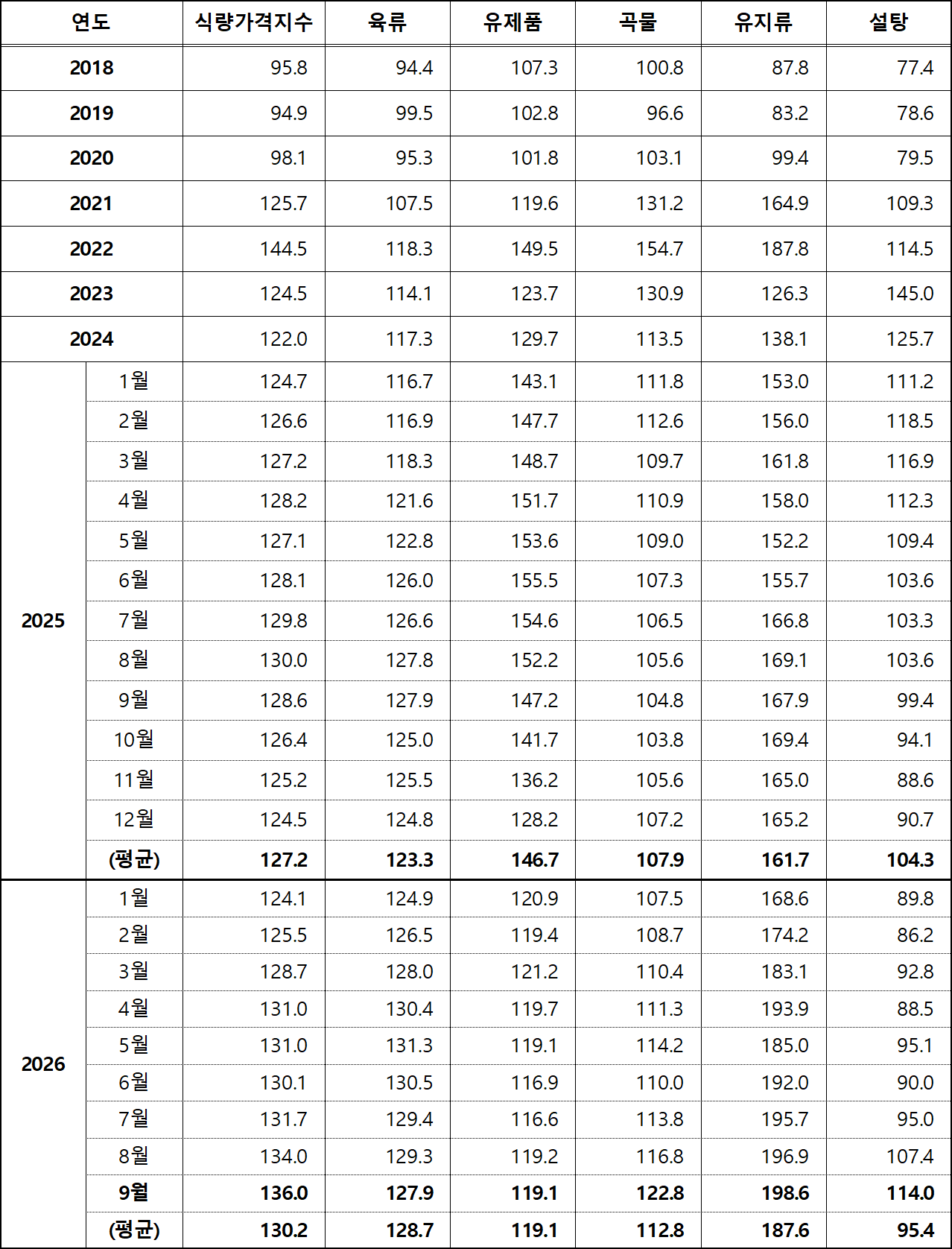
South Korea's Ministry of Agriculture, Food and Rural Affairs said Saturday that the FAO's global food price index reached 136.0 points in September, up 1.5 percent from 134.0 points the previous month. That is the highest reading since November 2022, when the index stood at 135.7 points — a gap of nearly four years. The index was also 5.8 percent above the 128.6 points recorded in the same month last year.
The index has risen for three straight months, climbing from 130.1 points in June to 131.7 in July, 134.0 in August and 136.0 in September. The FAO compiles the index monthly by tracking international prices for 24 commodities across five categories: grains, vegetable oils, meat, dairy and sugar.
Sugar posted the sharpest monthly gain among all categories. The September sugar price index rose 6.1 percent from the previous month to 114.0 points. A shrinking EU sugar beet cultivation area, adverse weather, lower sugar production forecasts in Thailand, below-average rainfall in India and concerns over El Niño-related crop damage all contributed to a deteriorating global supply outlook. Heavy rains in key Brazilian production regions also disrupted harvests, adding further upward pressure on prices.
The grain price index rose 5.1 percent from the previous month to 122.8 points. International wheat prices climbed 6.3 percent in a single month, reaching their highest level since August 2023, driven by logistics constraints in the Black Sea region that pushed importers to seek alternative suppliers, as well as dry weather in parts of North America ahead of winter wheat planting.
Corn prices also rose 5.6 percent from the previous month, hitting their highest level in more than three years, as a smaller-than-expected US harvest and reduced Brazilian export availability heightened supply concerns. Trade disruptions in the Black Sea region and uncertainty surrounding the Strait of Hormuz also weighed on sentiment, raising worries about fuel, fertilizer and freight costs.
Sorghum and barley prices rose 13.7 percent and 3.9 percent, respectively, in line with the broader rally in feed grain markets. The rice price index gained 1.4 percent as indica rice prices climbed on weather concerns and seasonal supply tightening.
The vegetable oil price index edged up 0.9 percent from the previous month to 198.6 points. International palm oil prices rose for a fourth consecutive month, supported by firm global import demand and production concerns stemming from dry weather in Southeast Asia. Sunflower oil prices, however, fell for a third straight month on expectations of adequate Black Sea region supplies.
The meat price index fell 1.1 percent from the previous month to 127.9 points, pulled down by declines in poultry and pork prices. Poultry prices dropped on ample Brazilian export supplies and weakening EU import demand, while pork prices fell as output increased in major exporting countries. Beef and lamb prices were broadly stable.
The dairy price index slipped 0.1 percent from the previous month to 119.1 points. A rise in milk powder prices largely offset a decline in cheese prices, while butter prices showed little change.
Global grain production is expected to decline. The FAO projected world grain output for 2026–2027 at 2.98 billion tons, down 2.1 percent from the previous year. Wheat production is forecast to fall 3.3 percent, rice 2.4 percent and coarse grains 1.3 percent.
Global grain consumption, meanwhile, is projected to rise 0.1 percent from the previous year to 2.97 billion tons. End-of-period stocks are expected to increase 0.1 percent to 950 million tons.
Despite rising international food prices, domestic consumer prices for agricultural and livestock products in South Korea fell 1.0 percent in September from a year earlier, even as overall consumer prices rose 2.9 percent over the same period. The Ministry of Agriculture, Food and Rural Affairs said it plans to closely monitor supply and demand conditions for farm and food products and respond proactively to keep food prices stable.
adastra@heraldcorp.com