Transfers between parents and children are presumed gifts
Note the purpose in transfer memos and keep receipts
Interest-free loans of up to 217 million won are allowed
A notarized date and monthly repayment records are key
Parents' medical bills should be paid with parents' money
Joint inheritance tax liability is a legitimate planning tool
South Koreans pay about 5.15 million won a year in insurance premiums on average, according to the Korea Insurance Development Institute's 2025 figures. This series helps you get more out of every won you pay.
Park, a 66-year-old resident of Songpa-gu, Seoul, owns a single apartment and a few hundred million won in savings — nothing more. Every month she sends her married son money for living expenses, and last year she transferred part of his jeonse deposit. When her ailing husband needed hospital care, her son offered to pay the bills on his own credit card, saying it was his way of being a dutiful child. Park assumed she had nothing to worry about. Inheritance and gift taxes, she thought, were problems only for the wealthy.
![[Getty Images Bank]](https://wimg.heraldcorp.com/news/cms/2026/10/05/news-p.v1.20261002.30da4297406a4186ab1e359335ff853c_P1.jpg)
But the landscape has changed. In today's Seoul, even owning a single standard-size apartment — 84 square meters — can be enough to leave your children with an inheritance tax bill. The danger lies in the kind of casual bank transfers and credit card payments Park made without a second thought. In a future inheritance tax audit, those transactions can be reclassified as advance gifts and trigger a tax liability. Park decided to consult a tax professional to understand the difference between inheritance and gift taxes, and what families need to watch out for when money changes hands.
Q. Which is cheaper — inheritance tax or gift tax?
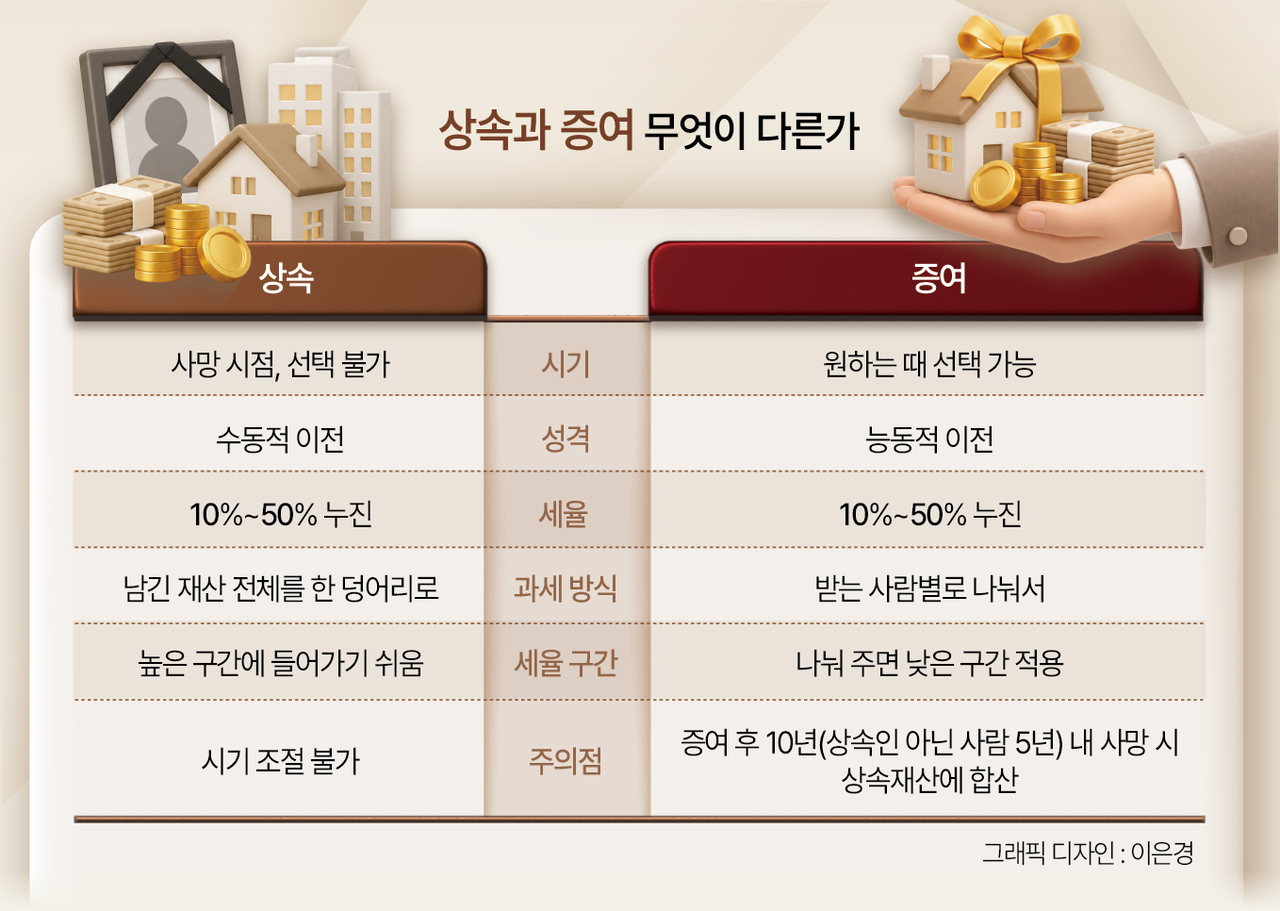
A. That is the question I hear most often. My answer is always the same. The decisive difference between the two is not the tax amount — it is who controls the timing.
Inheritance begins the day a parent dies. Even if next year's tax law changes make the burden heavier, there is no way to move that moment forward. You cannot ask an elderly parent to pass away sooner for tax reasons. Inheritance is a passive transfer: you have no say over when it happens.
Gift tax is different. If rates are set to rise next year, you can decide to act before the change takes effect. Gifting allows parents to transfer the assets they choose, to the people they choose, at the time they choose. It is an active transfer.
In a rising property market, that distinction matters even more. Because gift tax is calculated on the market value at the time of the transfer, the earlier you give, the lower the tax.
Consider an elderly couple who own an apartment in the Jamsil Jugong 5 complex in Songpa-gu, Seoul, and decide to gift it to their child. Had they done so 15 years ago, the gift tax would have been around 200 million won ($147,000) — manageable with a loan. Today, the tax alone would approach 2 billion won. That is beyond what most people can borrow, meaning the window for gifting has effectively closed.
Q. Inheritance and gift taxes use the same rate schedule — so why do the actual bills differ?
A. Both taxes apply a progressive rate of 10 to 50 percent. Taxable amounts up to 100 million won are taxed at 10 percent; anything above 3 billion won is taxed at the top rate of 50 percent.
The rate table is identical, but the calculation method is the opposite. Inheritance tax is assessed on the entire estate as a single lump sum — the larger the estate, the more likely it is to fall into a higher bracket. Gift tax, by contrast, is calculated separately for each recipient. Spreading assets among several children over multiple years means each transfer can be taxed at a lower rate.
However, all gifts received from the same person within a 10-year window are combined for tax purposes. A father and mother count as one person under this rule. The tax-free allowance — also on a 10-year cycle — is 50 million won for adult children (20 million won for minors) and 600 million won for a spouse. That is why long-term planning in 10-year intervals is essential.
There is an important caveat. If a parent dies within 10 years of making a gift, that asset is folded back into the taxable estate. For non-heirs — such as sons- or daughters-in-law and grandchildren — the lookback period is five years. The amount added back is valued at the original gift price, so any appreciation after the transfer is not subject to inheritance tax. Any gift tax already paid is also credited against the inheritance tax bill. The earlier you act while a parent is in good health, the more fully you can capture the tax savings.
Q. Does the National Tax Service really scrutinize routine bank transfers and monthly allowances between family members?
A. The most common source of unexpected tax bills in an audit is a casual bank transfer between family members.
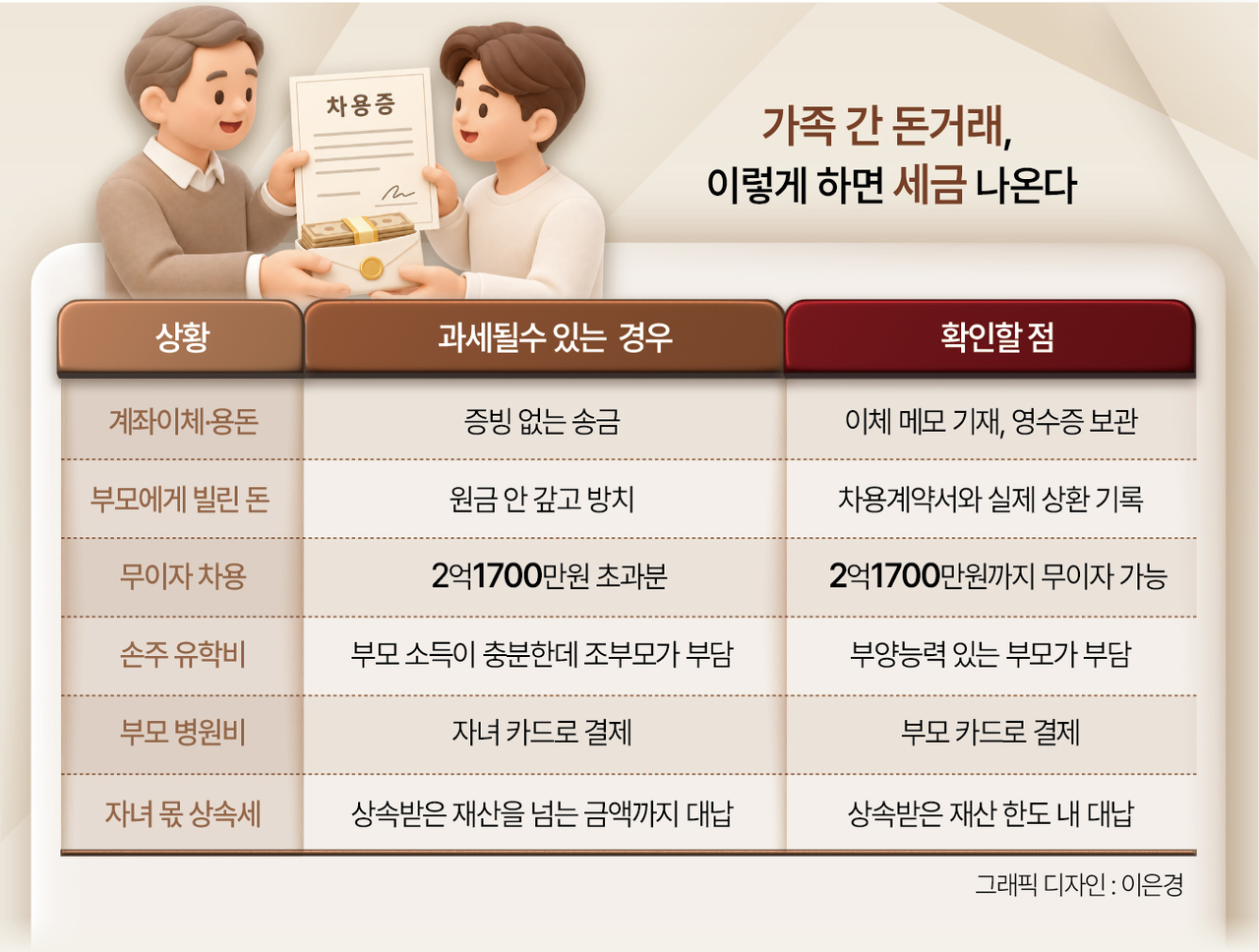
Tax authorities treat money moving between parents and children as a gift by default — not a loan. When an inheritance tax audit begins, the National Tax Service typically reviews 10 years of the deceased's bank records line by line. Any transfer to a child that cannot be explained with documentation is treated as an advance gift and taxed accordingly.
Large withdrawals shortly before death also warrant caution. Under Article 15 of the Inheritance Tax and Gift Tax Act, if more than 200 million won is withdrawn or disposed of within one year before death — or more than 500 million won within two years — and the use of those funds cannot be accounted for by asset category, the amount is presumed to have been received by the heirs and added to the taxable estate.
To avoid this, make full use of the memo field when making transfers. If the payment covers something that is ordinarily tax-exempt — such as living expenses or wedding costs — or if it is a reimbursement to be settled later, write a clear description such as "wedding furniture" or "family trip reimbursement," and keep the actual receipts.
For living expenses to qualify as tax-exempt, the money must be spent immediately as needed. If funds received under the label of living expenses are deposited into a savings account, invested in shares, or used to buy a home, they are treated as a gift.
Q. How can a child borrow money from a parent without triggering a gift tax?
A. Tax authorities do not automatically accept loans between parents and children. The taxpayer must prove — in both form and substance — that the money was genuinely borrowed. There are three things to get right.
First, you must be able to prove when the loan agreement was made. To show that the document was not hastily drawn up after an audit notice arrived, obtain a notarized date or send the agreement by registered mail to create an official timestamp.
Second, you must actually repay the loan. Under tax law, loans of up to 217 million won can be made interest-free without triggering gift tax. This is because the difference between the statutory interest rate of 4.6 percent per year and the interest actually paid must not exceed 10 million won annually to avoid taxation. Four point six percent of 217 million won comes to about 9.98 million won, which falls just under that threshold. However, if no principal is repaid at all — even with no interest — the National Tax Service may treat the arrangement as a disguised gift and assess tax. Make small monthly repayments within the child's income capacity and keep the transfer records.
Third, the child must have a realistic ability to repay. A student or unemployed child with no income cannot credibly sign a loan agreement for hundreds of millions of won — tax authorities will not accept it. Repayment plans must be calibrated to the child's actual earnings.
Q. Do grandparents owe gift tax when they pay a grandchild's overseas tuition or give wedding money?
A. Tax law exempts living expenses and education costs that fall within what society generally considers reasonable — but only when the person paying has a legal duty to support the recipient.
The primary duty to support a grandchild rests with the grandchild's parents. If the parents are employed and earning enough, and a wealthy grandfather pays overseas university tuition and living costs directly, that is not a tax-exempt education expense — it is a gift.
In that case, the gift tax is also heavier. Skipping a generation and giving directly to a grandchild adds a 30 percent surcharge on top of the calculated gift tax. If the grandchild is a minor and the amount exceeds 2 billion won, the surcharge rises to 40 percent.
Wedding gifts follow the same logic. An amount that falls within socially accepted norms is not taxed, but large sums require care. Wedding cash gifts are also treated in principle as congratulatory money given to the parents hosting the wedding — not to the couple. That makes it difficult for a child to claim wedding gift money as the source of funds when buying a home.
For those who want to help with wedding costs, the marriage and childbirth gift tax deduction is the safer route. Gifts received from parents or grandparents within two years before or after the date of marriage registration qualify for an additional deduction of up to 100 million won.
Q. Is there a problem with a child paying a parent's hospital bills on their own credit card?
A. This is one of the most common ways a well-meaning child ends up paying more in inheritance tax.
Inheritance tax is levied on the net estate — assets minus liabilities — as of the date of death. What happens when a child pays a large medical bill on their own card before a parent dies? The parent's assets remain intact because the child's money covered the expense. Inheritance then begins with a larger estate, and the tax bill rises accordingly.
If the parent's own card is used instead, the parent's financial assets are genuinely reduced before death, and the taxable estate shrinks by the same amount. For example, paying 50 million won in medical bills from the parent's funds would reduce the inheritance tax by 15 million won in a 30 percent tax bracket.
Always pay a parent's medical bills with the parent's own money. If a child has no choice but to pay first, keep documentation showing it was a loan to the parent. Medical bills that remain unpaid at the time of death can be treated as the parent's debt and deducted from the taxable estate.
Q. If a surviving mother pays the inheritance tax on behalf of her child, does that trigger a gift tax?
A. This is one of the most practical and entirely legal tax-saving tools available. The short answer: if the mother pays within the limits of her own inherited share, no gift tax applies to the child.
The reason lies in the joint inheritance tax liability provision in the tax code. All heirs are jointly and severally liable for the full inheritance tax. From the National Tax Service's perspective, it can collect from any of the heirs — so if one person pays the entire bill, it is not considered paying someone else's tax. Used strategically, this means a parent can effectively pass additional money to a child, free of gift tax, by covering the child's share of the inheritance tax.
Consider a family with a taxable estate of 10 billion won and an inheritance tax bill of 3 billion won. Under the standard allocation — a 9-to-1 split — the mother would owe 2.7 billion won and the child 300 million won. Under the joint liability provision, the mother can pay the full 3 billion won. The effect is equivalent to transferring 300 million won to the child without any gift tax.
Ordinarily, paying another person's tax bill counts as a gift. But because inheritance tax is governed by a statutory joint liability obligation, the child does not owe gift tax on the amount the mother covered. The one condition: the amount paid on the child's behalf must not exceed the value of what the mother herself inherited.
Ultimately, with both inheritance and gift planning, timing and method matter far more than the immediate tax bill. A deliberate, well-timed asset transfer is the most powerful form of tax saving available.

won@heraldcorp.com