Round 2 applications open Wednesday through Oct. 16; odd-even birth-year rule applies first two days
Applicants choose their own enrollment type: general income, SME employee or small-business owner
Up to 500,000 won a month for three years, with a 6–12% government contribution and tax exemption
Next year: preferred-tier contribution to rise to 15%, or 25% for non-metropolitan SME workers
Round 2 applications for the Youth Future Savings program open Wednesday. Starting with this enrollment cycle, applicants must choose their own enrollment type — general income earner, small or medium-sized enterprise employee, or small-business owner. This marks a change from round 1, in which applicants did not select a type themselves; instead, they were automatically sorted into the standard or preferred tier after a screening review.
According to the Financial Services Commission and the Korea Inclusive Finance Agency, round 2 applications will be accepted Wednesday through Oct. 16, excluding Saturdays, Sundays and public holidays. On Wednesday, only applicants whose birth year ends in an odd number may apply; those with an even-numbered birth year may apply Thursday. From Monday through Oct. 16, applications are open regardless of birth year. The application window runs from 9 a.m. to 6:30 p.m. each day.
Standard vs. preferred tier: income and household criteria determine eligibility
Youth Future Savings is a three-year savings account that allows monthly deposits of up to 500,000 won. The government adds a contribution equal to 6 or 12 percent of the deposited amount and exempts interest income from tax. When the interest rate, government contribution and tax-exemption benefit are combined, the effective yield is equivalent to a simple-interest savings account paying roughly 13.2 to 14.4 percent annually for standard-tier holders and 18.2 to 19.4 percent for preferred-tier holders.
The program is open to people between the ages of 19 and 34 who meet income and other eligibility requirements. For this round, those born between Nov. 17, 1991, and Nov. 27, 2007, may apply. Up to six years of mandatory military service may be excluded from the age calculation. Eligibility requires an annual salary of no more than 75 million won or annual business revenue of no more than 300 million won for small-business owners, along with a household income at or below 200 percent of the median. For dual-income two-person households, the household income threshold is relaxed to 250 percent for the standard tier and 200 percent for the preferred tier.
The standard tier pays a government contribution equal to 6 percent of deposits and is available to general income earners with an annual salary of 60 million won or less, as well as small-business owners with annual revenue of 300 million won or less. SME employees and new hires who meet certain conditions, along with small-business owners with annual revenue of 100 million won or less, qualify for the preferred tier, which carries a 12 percent contribution rate. Those with an annual salary above 60 million won but no more than 75 million won may still enroll but receive only the tax exemption, with no government contribution.
Screening follows applicant's chosen tier; disputes may be appealed
Because applicants now select their own enrollment type starting in round 2, the application process differs by tier. Applications can generally be submitted through participating banks' apps without additional documents, but those applying as small-business owners must obtain a small-business owner verification certificate before applying. Applicants who operate two or more businesses must obtain a certificate for every business they run. A preliminary screening result is provided before the final review, and applicants may file an appeal if the outcome differs from the tier they selected.
Those who enroll in the preferred tier as SME employees must continue to meet the employment requirement after joining. To receive preferred-tier benefits for the full enrollment period, they must have worked at a small or medium-sized enterprise for at least 29 of the 36 months up to one month before maturity. Job changes are permitted up to twice during the enrollment period.
Existing Youth Leap Account holders will again have the option to switch to Youth Future Savings in round 2. Those wishing to switch must first complete a round 2 application and receive confirmation of eligibility, then open a Youth Future Savings account and close their existing Youth Leap Account through a special early termination within the account-opening period.
Income and preferred-tier eligibility screening runs from Oct. 19 through Nov. 13, with final results announced Nov. 12–13. Applicants who receive approval may open an account from Nov. 16 through Nov. 27. Participating institutions include NongHyup, Shinhan, Woori, Hana, IBK, Kookmin, Suhyup, iM, Busan, Gwangju, North Jeolla Province, South Gyeongsang Province, Kakao Bank and Korea Post. Toss Bank is expected to join from round 3.
Preferred-tier benefits to expand, with retroactive application for existing holders
Benefits could expand next year if the government's budget proposal clears the National Assembly. Under the plan, the preferred-tier contribution rate would rise from the current 12 percent to 15 percent, with 25 percent applied to SME workers outside the greater Seoul metropolitan area. The government is also pursuing retroactive payment of the higher contribution rate for existing preferred-tier holders, as well as retroactive payment of the standard-tier contribution for those currently receiving only the tax exemption.
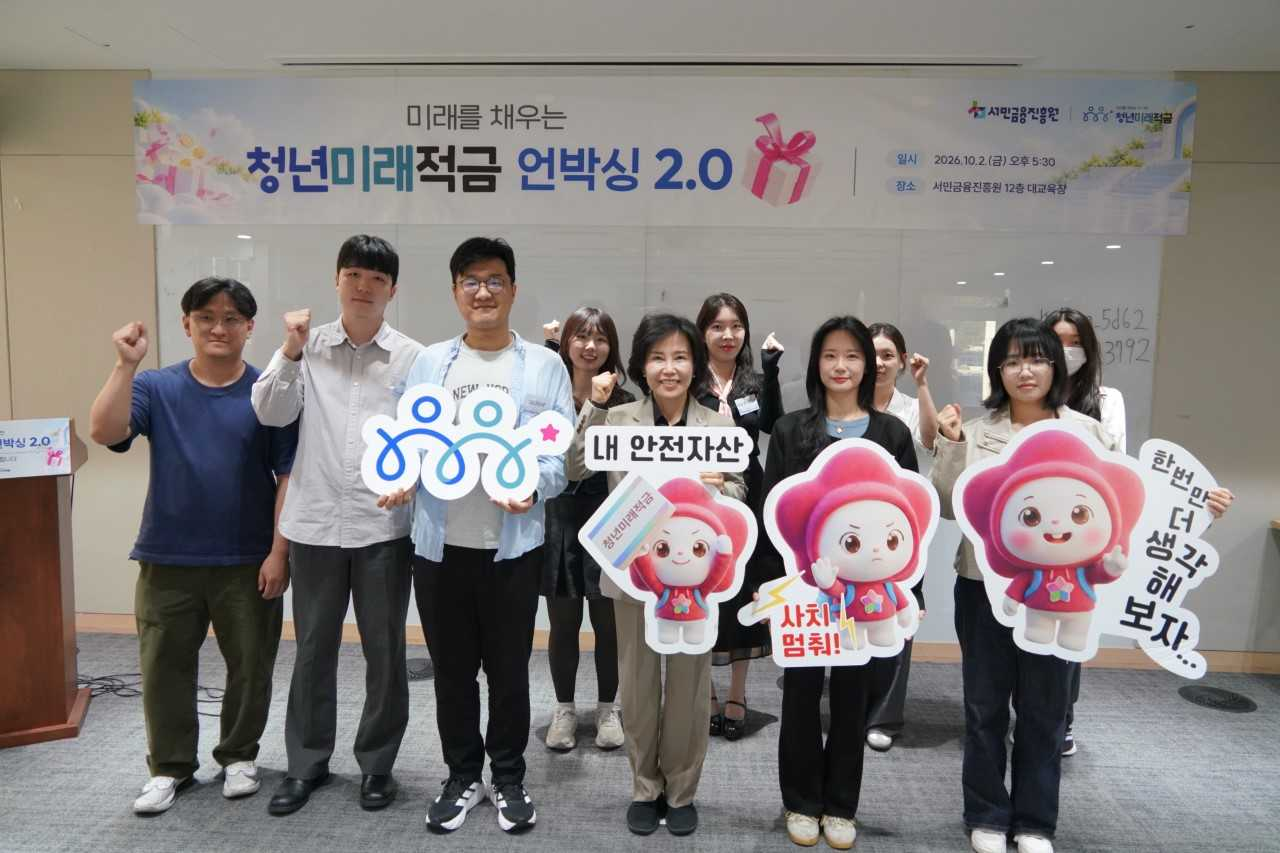
Ahead of the round 2 enrollment period, the Korea Inclusive Finance Agency held a "Youth Future Savings Unboxing 2.0" briefing Friday, inviting 11 online content creators. The event introduced changes for round 2, including the self-selection of enrollment type, cross-verification for preferred-tier eligibility and the preliminary screening result notification.
"Even policies that are truly necessary for young people are hard to use if they feel complicated, so it is important to communicate them in a way that is easy and approachable in the language young people use," agency President Kim Eun-kyung said. "We will continue to engage through a variety of channels so that young people can fully understand and make use of the financial policies available to them."
snsd@heraldcorp.com