Chief Justice Jo Hee-dae makes rare public remarks at national audit
Cheong Wa Dae holds firm on its position, prolonging the vacancy
Last year each justice handled about 4,084 cases
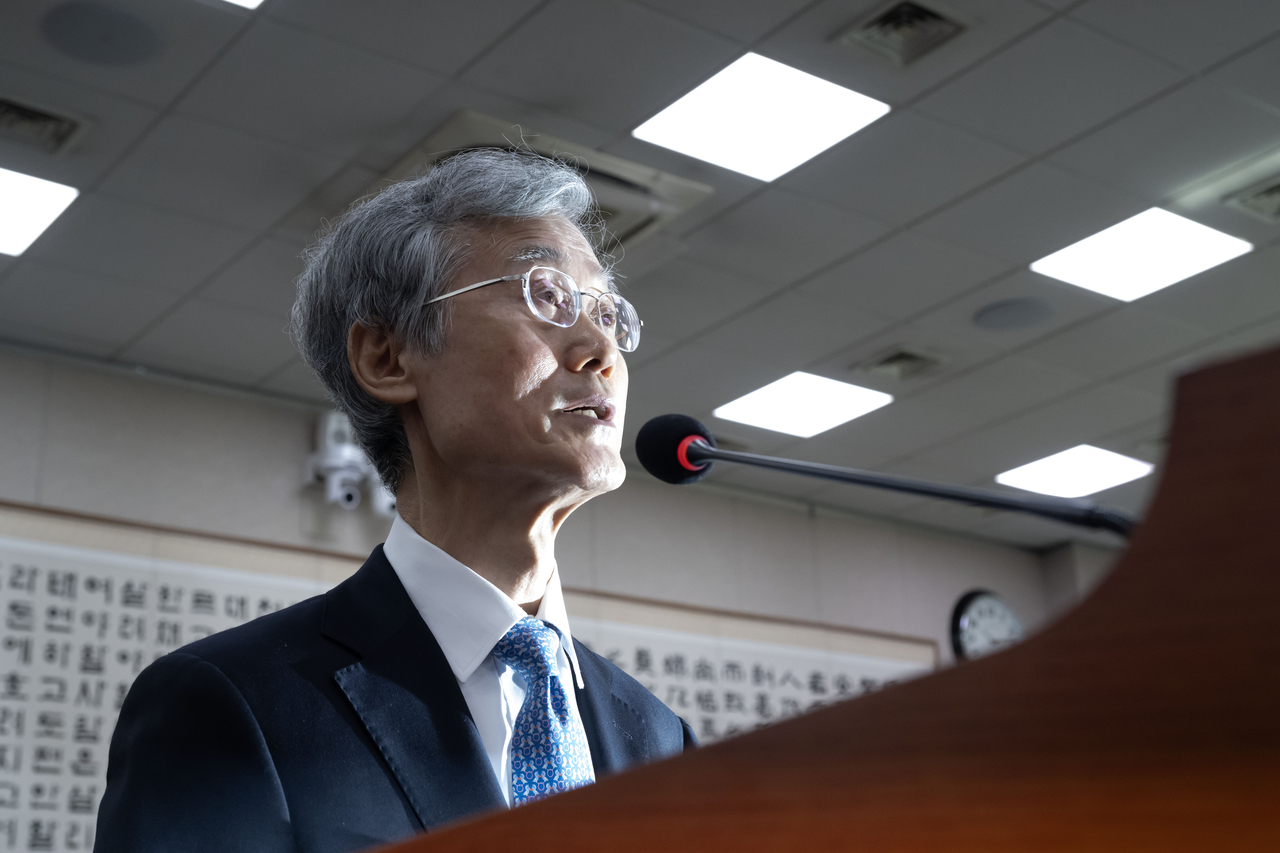
There is no end in sight to the prolonged vacancy on the Supreme Court. Chief Justice Jo Hee-dae and Cheong Wa Dae have each refused to budge from their positions on the question of re-nominating a justice, and observers say the two sides are further from a resolution than ever. Jo made unusually candid remarks at a national audit session, making clear he considers his constitutional duty fulfilled once he submits a nomination, while Cheong Wa Dae reiterated that its own stance remains unchanged.
According to legal circles, Jo publicly laid out his position on the chief justice's nomination authority Tuesday before the National Assembly's Legislation and Judiciary Committee during the Supreme Court's national audit. He initially indicated he would decline to testify on the nomination issue, citing the separation of powers, but as questioning intensified he spoke his mind at length.
Citing Article 104 of the Constitution, Jo said, "Just as the chief justice cannot interfere at all in the National Assembly's confirmation process or the president's appointment process, neither the National Assembly nor the president can interfere at all in the chief justice's nomination." He added that "the chief justice's constitutional authority and duty are fully discharged upon submission of the nomination."
Jo also rebuffed criticism that he had broken with the longstanding practice of consulting with Cheong Wa Dae before nominating a candidate. He said past consultations had been conducted solely to facilitate a swift and smooth appointment, and that "there is no constitutional problem whatsoever with skipping the consultation." The remarks reaffirmed his existing position that he cannot comply with Cheong Wa Dae's demand for a re-nomination and that the original nomination process was without fault.
Cheong Wa Dae is not backing down either. After Jo submitted a written nomination for Son Bong-gi, a senior judge at the Daegu District Court, on Aug. 18, Cheong Wa Dae responded on Aug. 28 by calling the move "a unilateral written nomination without substantive consultation" and demanding a re-nomination. Even after Jo said he could not comply, Cheong Wa Dae repeatedly urged a prompt re-nomination, criticizing what it called a mistaken belief that the chief justice's nomination authority supersedes the president's appointment authority. Following Jo's remarks at the national audit on Tuesday, Cheong Wa Dae made clear its position had not changed. Presidential spokesperson Kang Yu-jung said, "Cheong Wa Dae has no separate statement; it has already made its position known regarding the nomination and appointment of Supreme Court justices."
With both sides invoking their respective constitutional powers — the chief justice's right to nominate and the president's right to appoint — analysts say a breakthrough will be difficult to achieve. Jo's declaration that his constitutional authority and duty were fully discharged upon nomination has made a compromise through re-nomination even less likely, observers said.
![President Lee Jae Myung shakes hands with Chief Justice Jo Hee-dae at the 107th March 1 Independence Movement Day ceremony held at COEX in Gangnam-gu, Seoul, on March 1. [Yonhap]](https://wimg.heraldcorp.com/news/cms/2026/10/07/rcv.YNA.20260301.PYH2026030102740001300_P1.jpg)
The longer the vacancy persists, the heavier the caseload burden on the Supreme Court becomes. According to the 2026 Judicial Yearbook recently published by the Supreme Court's Court Administration Office, the court handled a total of 49,009 principal cases in 2025. Excluding the chief justice, who participates only in en banc rulings, and the court administrator, who does not hear cases, the remaining 12 justices each handled roughly 4,084 cases that year.
The Supreme Court handles most appeals through three small panels, each composed of four justices. As of Sept. 19, following the inauguration of Justice Kim Seong-su, the first and second panels each had four justices, but the third panel had only three — Justices Oh Seok-jun, Eom Sang-pil and Lee Suk-yeon. Under the Court Organization Act, a panel of three or more justices may hear cases, but the vacancy inevitably shifts a greater share of the caseload onto the remaining justices.
Analysts say the vacancy will also disrupt en banc proceedings, in which the chief justice presides and all justices participate. The Supreme Court is currently hearing the case against first lady Kim Keon Hee on charges including stock price manipulation involving Deutsch Motors in an en banc session. Cases against former Prime Minister Han Duck-soo and former Minister of Interior and Safety Lee Sang-min on insurrection charges have also been referred to the en banc court. In en banc deliberations, justices sometimes refrain from putting matters to a vote when a ruling would not be unanimous or overwhelmingly one-sided, deeming it inappropriate to reach a conclusion with a seat vacant.
Jo acknowledged responsibility for the prolonged vacancy. At the national audit, he said he was "deeply sorry to the public for the concern caused by the extended vacancy on the Supreme Court." He added that he would "make every effort to ensure the court is fully constituted," but offered no concrete plan for resolving the situation. Lawmakers on the Legislation and Judiciary Committee pressed him on how he intended to fill the vacancy going forward, but he provided no substantive answer.
yg@heraldcorp.com