Labor commission orders Hyundai Motor to bargain with subcontractor union
Decision issued Aug. 31, but written ruling not yet sent
30-day deadline passed Sept. 30 with no extension provision
Commission cites case file of over 12,000 pages
![The Ioniq 5 production line at Hyundai Motor's Ulsan factory [Hyundai Motor]](https://wimg.heraldcorp.com/news/cms/2026/10/12/news-p.v1.20260527.4b02c322b71341549f64e78d963831ad_P1.jpg)
The National Labor Relations Commission has ruled that Hyundai Motor must bargain with a subcontractor union — yet more than a month later, it has offered no explanation for that decision. The delay is deepening uncertainty in labor relations as disputes over whether prime contractors must negotiate with subcontractor unions continue to mount following the enactment of the revised Trade Union Act, commonly known as the "Yellow Envelope Law."
According to sources in the automotive and labor sectors, as of Wednesday the commission had not yet sent Hyundai Motor the written ruling in its case challenging the announcement of a bargaining demand — a deadline that had been set for Sept. 30. The commission confirmed it was still drafting the document.
Industrial safety recognized, car sales reps excluded — but no reasoning given
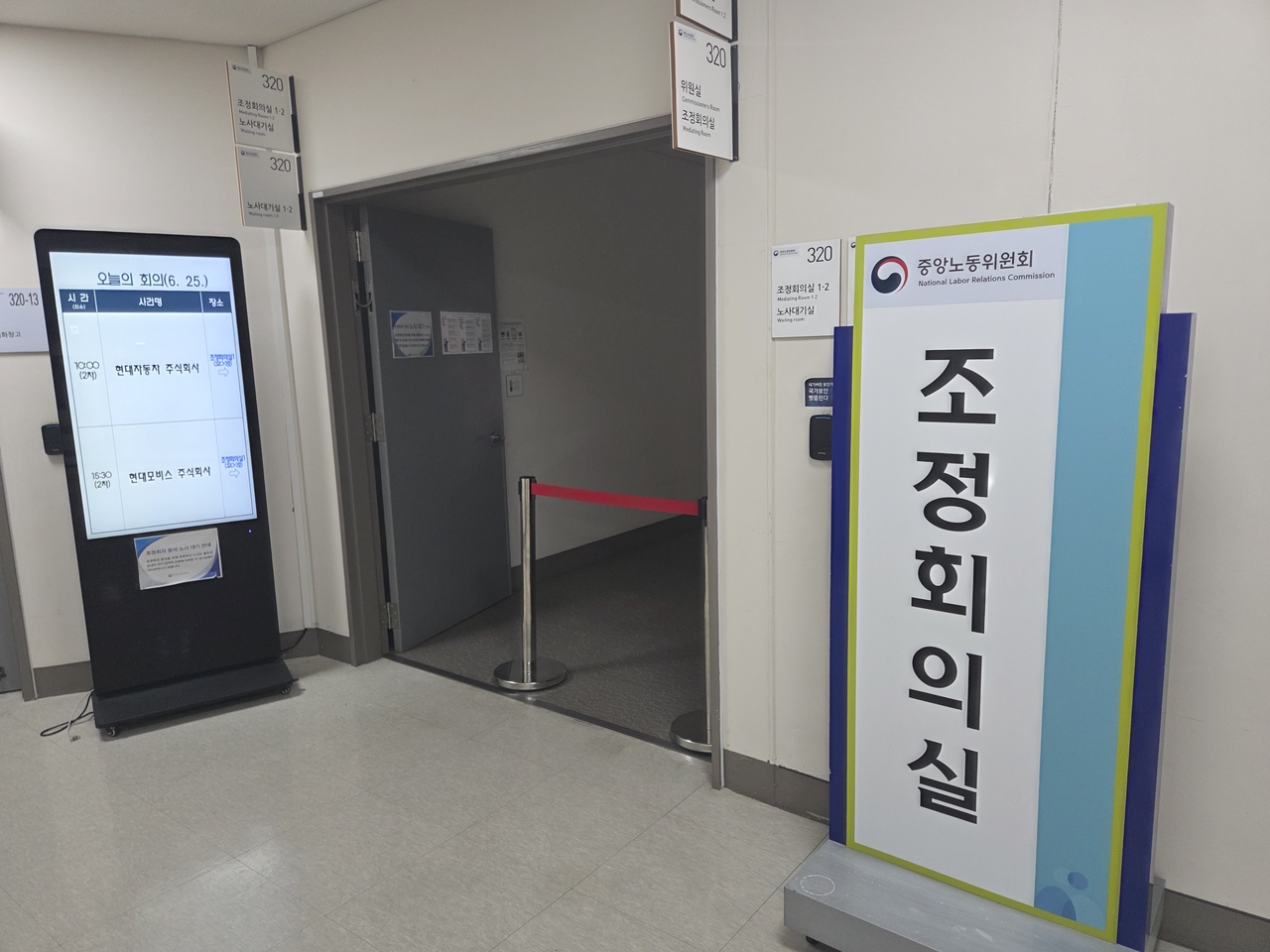
The commission held a hearing on Aug. 31 and that same day upheld the initial ruling by the Ulsan Regional Labor Relations Commission. The case was divided into three parts: production; cafeteria and security; and sales. The production segment covered assembly, production management, maintenance, vehicle dispatch, design and test-vehicle driving.
For subcontracted workers in factory and research production, cafeteria, facilities and cleaning, and security and guard roles, the commission recognized Hyundai Motor as an employer — but only for bargaining topics related to industrial safety. It did not recognize the company as an employer for car sales representatives, known as car masters, at dealerships.
Because the outcome differed by bargaining topic, the factual basis for each determination can only be confirmed once the written ruling arrives. Labor commission rules require the written decision to be sent to the parties within 30 days of the ruling date, setting a deadline of Sept. 30 with no provision for an extension.
The commission said the delay stemmed from the complexity of the case — noting that Hyundai Motor's workforce spans numerous job categories with varied legal issues, involves about 40 subcontractors, and has generated a case file exceeding 12,000 pages. It said it was working to complete and dispatch the written ruling as quickly as possible.
![Hyundai Motor's headquarters in Yangjae [Hyundai Motor]](https://wimg.heraldcorp.com/news/cms/2026/10/12/news-p.v1.20251204.3815b38e4a0e4e3398d90e88718afee3_P1.jpg)
The problem may not be confined to Hyundai Motor. According to data submitted by the commission, 108 appeals related to the revised Trade Union Act were filed between May and August this year, of which 83 have been resolved. The commission declined to say whether any other cases also faced delays in sending written rulings.
With the written ruling still outstanding, both labor and management are waiting for the next step without knowing the reasoning behind the decision. Any party wishing to challenge the commission's ruling must file an administrative lawsuit within 15 days of receiving the written decision. Because the document has not arrived, that statutory window has not even begun. It is also difficult for either side to assess the scope of bargaining by topic.
An industry official said workloads at labor commissions have surged since the revised law took effect, as demands for employer-status determinations pile up. "For the parties who want a clear legal ruling, the uncertainty just keeps going," the official said.
Stay orders split by case, unions press for strikes — prime contractors caught in a bind
The commission takes the position that filing an appeal does not suspend the effect of the initial ruling. If a prime contractor's employer status was recognized at the initial stage and the written ruling was delivered, the company is obligated to engage in collective bargaining. "Where the initial ruling recognizes the prime contractor's employer status and the written decision has been served, the prime contractor has a duty to bargain collectively in accordance with that ruling," the commission said.
This is adding to uncertainty for individual companies even after labor commission rulings are issued. Firms that have challenged appeal rulings through administrative lawsuits have also sought stays of execution, but courts have ruled inconsistently across cases. According to the commission, as of Sept. 21, 15 administrative lawsuits had been filed contesting appeal rulings under the revised law. Of nine stay applications filed alongside those suits, three were granted and three were denied.
Posco received a stay from the Seoul Administrative Court on Sept. 18 for a ruling on the separation of bargaining units, halting negotiations it had been conducting with the National Plant Construction Workers' Union. Jungheung Engineering & Construction, by contrast, had its stay application denied and has proceeded to the process of confirming a bargaining representative union.
![Hanwha Ocean's Geoje facility in South Gyeongsang Province [The Herald Business DB]](https://wimg.heraldcorp.com/news/cms/2026/10/12/news-p.v1.20251223.aa00b0eb2d5a4f288cd2cafa575b3787_P1.jpg)
Pressure from subcontractor unions that have secured bargaining rights is also intensifying. Two subcontractor unions at Hanwha Ocean — the Geoje-Tongyeong-Goseong Shipbuilding Subcontractors' Branch and the Welliv Branch — applied to the South Gyeongsang Regional Labor Relations Commission in June for mediation of a labor dispute, saying the prime contractor had refused to respond to their bargaining demands. After the regional commission suspended mediation, both branches secured the right to strike, and from Sept. 30 members of the shipbuilding subcontractors' branch began a high-altitude sit-in protest at the Geoje facility. After a court denied Hanwha Ocean's stay application, the company officially confirmed the two branches as bargaining-demand unions and began collective bargaining with them on Thursday.
An industry official said companies face a dilemma: agreeing to bargain with a subcontractor union could be interpreted in future court proceedings as a voluntary acknowledgment of employer status, making it difficult to engage willingly if they are considering a legal challenge. "At the same time, a union that has secured bargaining rights may also secure the right to strike and use that to pressure the prime contractor," the official said. "Uncertainty has grown considerably."
eyre@heraldcorp.com
fact0514@heraldcorp.com